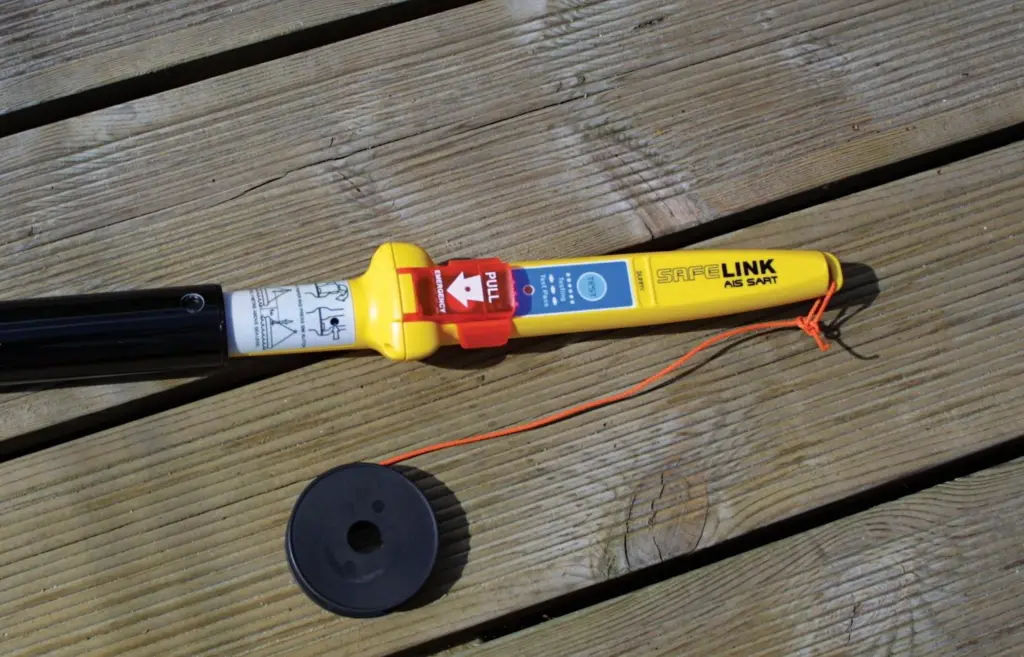
The announcement coincided with the June launch at Seawork 2010 of two new products from Kannad, the Safelink AIS SART and the Safelink EPIRB with an integral fast find GPS.
Mark Hart of Ocean Safety said, ‘We are very pleased to be working alongside Kannad as their distributor. It is great to be able to work with a company which has a development division which truly understands our customers’ requirements for marine safety equipment and continues to keep their products updated with the latest technology, which is totally in line with our philosophy at Ocean Safety.’
The Kannad SafeLink AIS SART is a manually deployed survivor location device, which stows neatly into a quick release, compact soft carry case and meets IMO/SOLAS requirements. Once activated it transmits structured alert messages within the VHF frequency, providing a GPS position and the serialised identification number as an emergency AIS signal to ships, land stations and any other vessels equipped with AIS receivers.
The SafeLink AIS SART can be wall mounted to the vessel or packed into a liferaft or grab bag, is lightweight, floats and has an integral lanyard. As a locating system the SafeLink AIS SART is a more economical alternative to the traditional radar only SART. Once activated, the unit will transmit continuously for 96 hours and it has a six year battery life.
The new Kannad SafeLink EPIRB, with an integral 20 channel fast locating GPS, is designed to be more compact and easier to stow, with a vastly improved six year battery life along with its unique feature, the user replaceable battery.
Once the EPIRB has been manually or automatically activated and is transmitting, a high brightness LED will continue to give a visual identification to its exact location and the transmission will continue for a minimum of 48 hours. Once activated the Category 2 unit is designed to float higher in the water, with a clear view to the satellites. The Category 1 version features a float free hydrostatic release. Both the Cat 1 (automatic) and Cat 2 (manual) models can be activated manually or by immersion in water.