The world’s experts in these operations, including parachuting diving teams, engineers and military doctors, were concentrated off the Spanish coast near Murcia in the Mediterranean to improve their response capability.
Not just one, but four diesel powered submarines were simulating the unthinkable. They disappeared from their last known reported positions and have gone missing.
Fortunately for the submarines’ crews, this carefully planned event was choreographed as part of the ambitious NATO-led Bold Monarch exercise, the largest multi-national exercise in this field, which coordinated and demonstrated the operational, diving, medical and engineering expertise involved in saving lives in one of the most challenging environments on the planet.
Bold Monarch’s opening scene featured a bustling Spanish harbour, a warship with a floodable dock, massive support vessels bristling with cantilevered ‘A’ frames supporting mini-submersible rescue vehicles cradled within.
The plethora of high tech gadgetry was complimented by international teams of Naval officers, doctors in combat fatigues, and submariners trained to parachute from aircraft to create a floating hospital village. What made Bold Monarch unique is the truly remarkable level of cooperation and the mutual understanding of the military capability amongst the submarine operating nations taking part.
The multi-national Navy representatives were warmly welcomed by the Spanish host nation and NATO exercise controllers. At the pre-sail conference the unprecedented level of cooperation became clear as meticulous planning and rehearsal of procedures continued throughout the day to overcome the challenges of operating in many languages. The safe conduct of the exercise was of paramount importance to all participants and a crystal clear understanding of the schedule of events as the rescue scenarios unfolded was crucial to the success of the exercise.
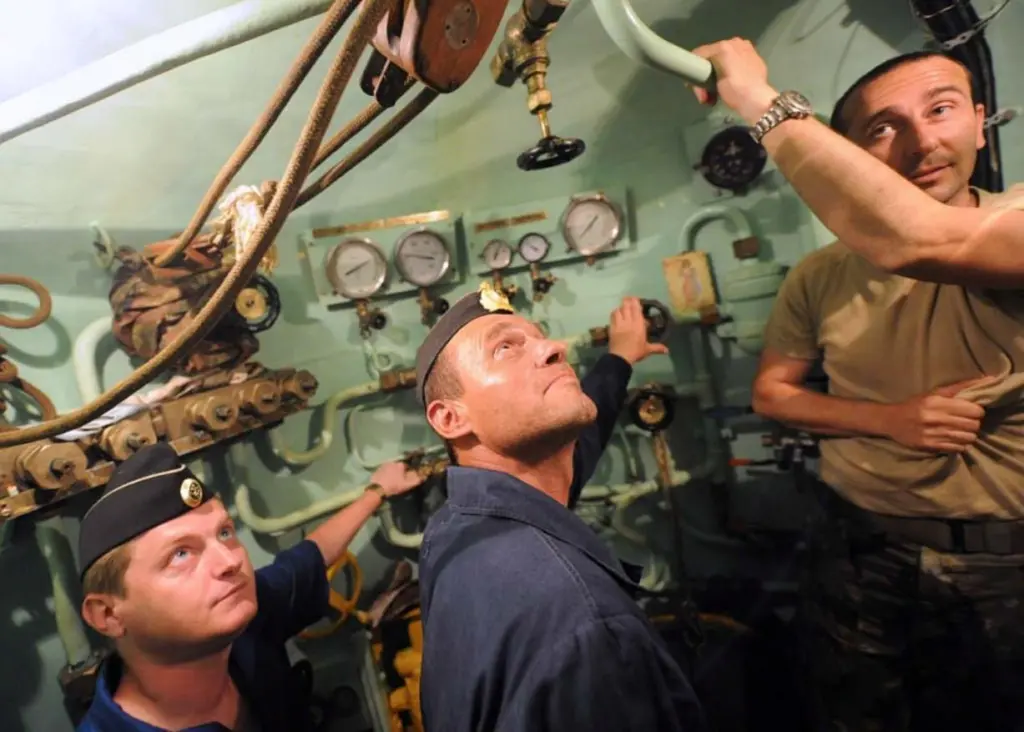
Media interest generated by Russian participation was clear, as the exercise marked the historic first mating of a Russian Navy submarine, the Alrosa, with NATO’s Submarine Rescue System (NSRS), evacuating real sailors from the submarine to the surface. The exercise also demonstrated the rescue system from the Russian Federation Navy Black Sea Fleet, the Italian Navy, and the United States Rescue Diving and Recompression System (SRDRS) with each of the submarines taking part.
The exercise also called upon deep specialist medical teams trained in hyperbaric medicine. Rescuing injured crews from the seabed presented a unique set of challenges, especially if the atmosphere has become toxic and pressures are rising. Personnel may have been severely injured by physical impact, so bringing these casualties to the surface presents a complex and specific medical challenge.
In Bold Monarch, the doctors worked closely with the Parachute Assistance Groups, who can descend from military aircraft to the surface with liferafts, first aid and communications equipment to establish contact with the distressed submarine, extending the survival time until the main recovery assets arrive on the scene.
Divers can also support the operations, particularly in shallower areas, inspecting the hull, conducting underwater engineering tasks, delivering urgent supplies and supporting the integrated rescue effort. Self contained atmospheric diving suits allow these divers to work at considerable depth.
The Spanish command ship, ESPS Galicia was operating off the coast of Murcia in the Mediterranean.
Follow developments on exercise Bold Monarch 2011are on the NATO website at: www.manw.nato.int