PNA has published information concerning the capacity and characteristics of the ports it owns, with a view to supporting a European level wind energy sector that would make use of its port facilities for support and assembly.
“We have run a long distance race for several months. A large amount of consultation, technical definition and proposal has been rigorously carried out, said PNA president Laurent Beauvais. “We have reached the end of the process. We are now ready, in line with the manufacturers’ schedule.”
Jean-Michel Sevin, CEO of PNA added, “In the marine energy and offshore wind farm market, the port of Caen-Ouistreham and, more particularly, that of Cherbourg, is very well positioned, in relation to the performance and characteristics of our ports, and in terms of deadlines. We are in a position to respond immediately to expressions of interest.”
PNA ports will be able to offer industrial, technical and logistical support to the planned development of major wind farms in the Channel, both on the English and the French side. This is particularly, but not only, in relation to the assembly of wind turbines.
PNA’s initiative follows on from the French government’s call in July for tenders to be handed in for the development of offshore wind farms on an unprecedented scale in French waters. Four out of the five proposed fields where offshore wind turbines are due to be built, on the French side, are located in the Channel. Similarly, British sites have been identified for wind energy development in the Channel, and they include the offshore block known as Rampion, near Brighton and Navitus Bay Wind Park, near the Isle of Wight. The Blanchard Strait, which is just off the coast of Normandy, offers another opportunity, with at least 1 GW of energy accessible a few nautical miles from the port of Cherbourg.
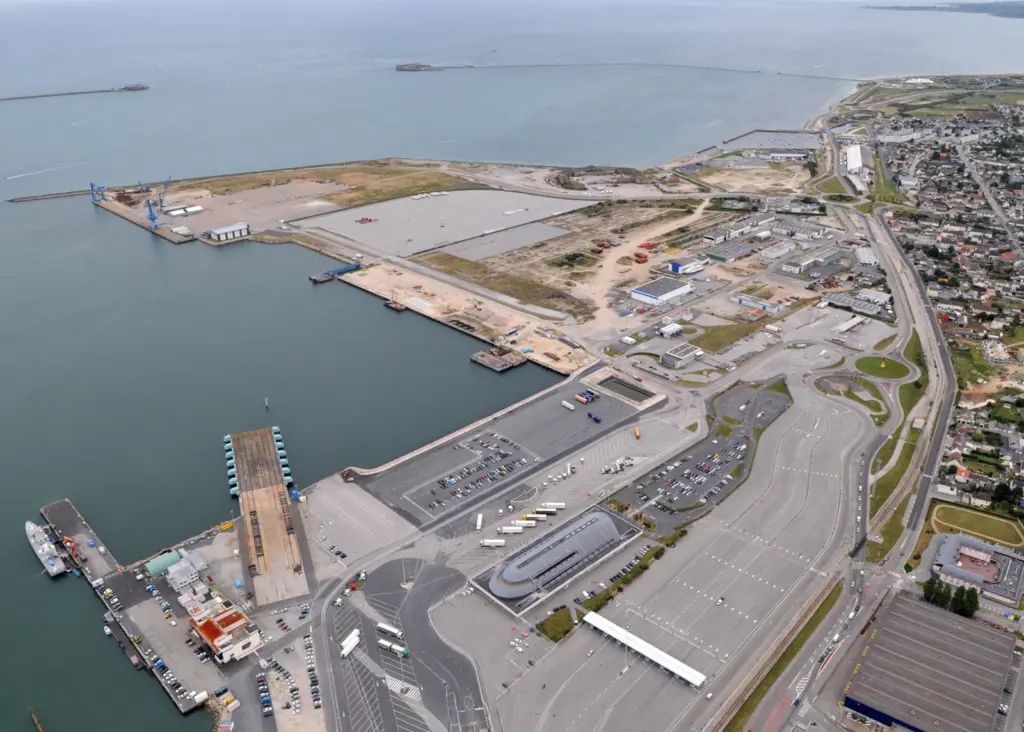
The configuration of the port of Cherbourg allows for the reception of all the marine based renewable energy sector’s activities, be they related to manufacturing (such as the construction of booms, blades, masts or foundations) or logistics (more particularly in connection with the turbine assembly process, before the units are transferred to site).
The port of Cherbourg’s proposal appears well suited to the needs of manufacturers. The port is characterised by significant existing land capacity, which includes a continuous plot of 36 hectares in the port area, which is currently free from all activity and is particularly suitable for heavy loads, thanks to the shallow bedrock.
Additionally, a further 64 hectares, 32 of which are adjacent to the currently available plot, could be taken from the main harbour. Finally, as a conventional business park, 13 hectares in the immediate proximity of the port will be made available from 2015.
The offloading platforms at the port of Cherbourg are served, on the shore side, by the 380m Quai des Flamands. This wharf will be extended to 600m from 2014, and, on the land side, will be connected directly to a dual carriageway as well as the rail network.
The port of Cherbourg quays are accessible 24 hours a day without draught constraints, with a 13.5m depth allowing for the accommodation of provision and service ships without waiting.
PNA can also offer an environment free of the constraints usually generated by the processes and regulations relating to risk prevention planning and to environmentally sensitive zoning, as all these areas have already been covered.
The port of Caen-Ouistreham is complementary to Cherbourg, and can position itself for the housing of personnel working on the construction and maintenance of offshore wind farms.