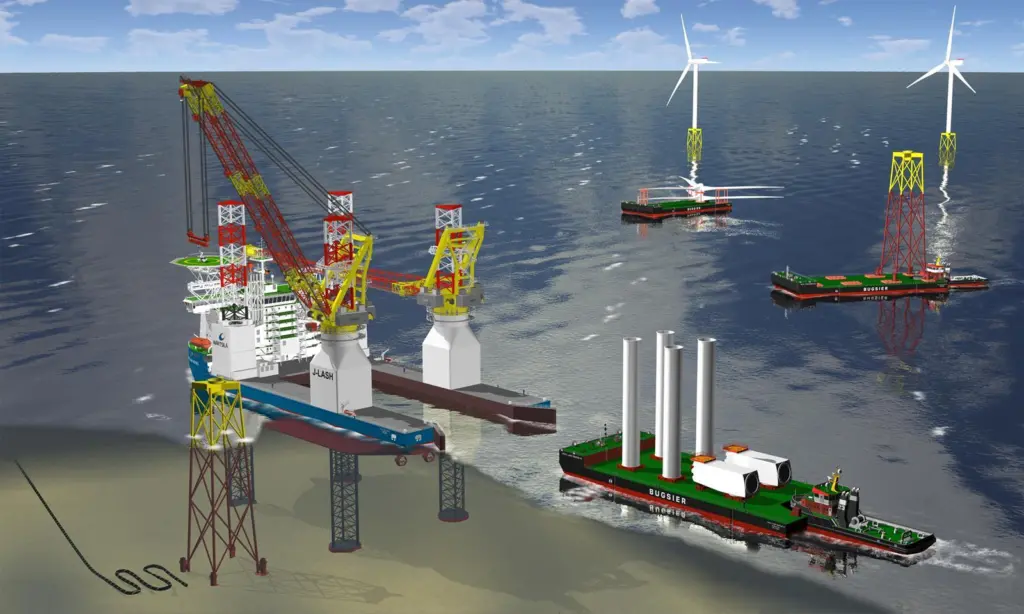
German tug owner Bugsier Reederei and Finnish marine solutions provider Wärtsilä have jointly developed the design that challenges the usual arrangement where the vessel has a dual role of installation vessel and cargo carrier. The concept, named a ‘jack-up docking installation vessel’, is based on the LASH barge design of vessel dating back over 30 years.
Turbine installation typically involves jack-ups (towed and self-propelled) sailing to load-out ports to pick up components before returning to the site. While the ship-shaped hulls of the latest generation are capable of higher transit speeds than their predecessors, they operate as sophisticated cargo carriers for part of the time. In an operation that is weather dependent this may involve either being in port or in transit during valuable weather-windows better suited to installation.
Transferring components to an installation vessel at sea is dependent on heave-compensated cranes and reasonable weather but the Bugsier Wärtsilä design eliminates motion related risks by incorporating the supply barge within the vessel itself, becoming one integrated unit. The concept comprises three components, the jack-up docking installation vessel, articulated tug units and standard North Sea sized feeder barges. What would usually be the installation vessel’s cargo deck is instead a floodable dock with a gate at the after end (the accommodation is located forward). Once on site and under full ballast the legs are lowered to the seabed and the cargo dock flooded. The dock gate is opened allowing a loaded barge to enter, the gate is then closed. Jacking-up continues to working height with the water in the dock being released, allowing the barge to settle on keel blocks on the reinforced dock bottom. Construction is thereafter carried out as standard with all elements of the windfarm able to be installed including foundations.
Two key advantages are highlighted with their design. The installation vessel remains on site throughout the construction phase (it can be bunkered from a suitable feeder barge): second is the ability to remain at one location for each installation, avoiding complications from jacking-up in separate locations when construction involves more than one operation, thus avoiding any cable safety zones that may be present. The concept adopts articulated tug/barge units where risks from manoeuvring are minimised through the inclusion of DP capable, integrated steerable thrusters on the barges, controlled from the tug.
It is all about the numbers of course and the designers state that one dock ship, three barges and two tugs can do the work of three traditional installation vessels with potential savings of one-third of the investment costs. More savings are possible with eliminating the requirement for a suitable base load-out port: instead feeder barges will be capable of reaching the production sites of component manufacturers that are not always located near suitable deepwater ports. Provisional statistics of the dock vessel include a LOA of 147.5m, breadth 60m and speed 11kn.