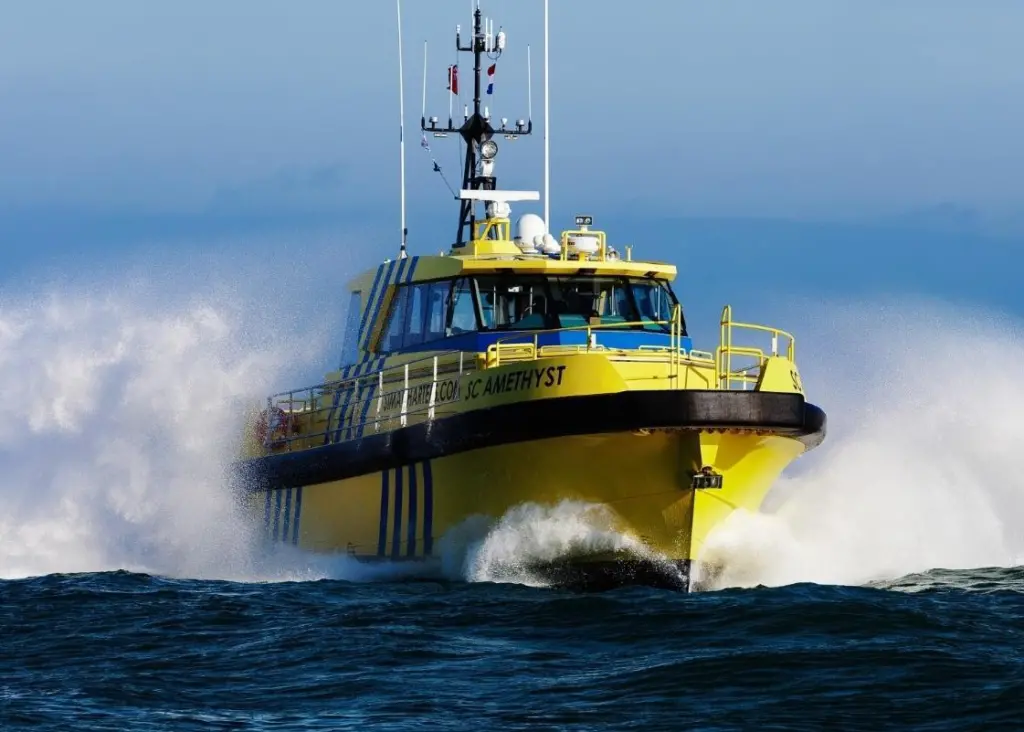
Developed primarily as an offshore service vessel for transporting goods and personnel to offshore structures the hull incorporates features that show a revolution in hull design that has allowed the concept to be patented.
The concept was originally developed by Jaap de Bruijn who was obsessed to improve the performance and comfort of a boat he built himself. By constant modification of the composite hull he worked towards his goal of improved performance but when he shared the results with Vripack’s naval architects they said it could not work. Peter Bouma at Vripack recalls, “At first we didn’t believe him at all. No formulas, algorithms or white papers supported anything he claimed.”
However Captain Jaap was convinced. “I just knew that when I was in a gale force with my ship, taking out seasoned pilots, everyone was amazed by the soft ride of my boat regardless that we were doing 25 knots in 2.5 metre significant wave heights.” So after hundreds of hours of research, sea trials and empirical comfort studies Vripack managed to capture the essence of the Slide Hull and improve it even further with some 15% efficiency increase at fast displacement speeds. The result is the Amethyst, the first vessel equipped with the Slide Hull.
The Slide Hull is a moderate vee planing hull with a deadrise of 17° but outside this basic hull concept the vee hull has been considerably modified. When seen afloat the hull looks conventional with a relatively fine entry and a lower chine line that keeps fairly low at the bow. It is the way that this lower chine line has been modified as it runs aft that gives the Slide Hull its unique characteristics. A secondary chine above helps to deflect spray and water away from the hull.
Just below the waterline towards the bow the lower chine adopts a reverse angle. Normally a chine would be horizontal to generate lift and to deflect the water away from the hull. On the Slide Hull the chine is angled downwards which would generate harshness in the ride but by keeping the chine narrow at the forward end the harshness is removed. It is only from amidships to aft that this reverse chine adopts a significant width and at the transom the reverse chine is almost large enough to be an embryo side hull. The size of this reverse chine can be judged by the fact that the effective deadrise at the transom measured from the apex of the keel to the outer edge of the chine is 13° compared with the 17° angle of the main section of the hull.
“This hull arrangement generates considerable lift which accounts for the efficiency of the Slide Hull, without having a negative effect on the seakeeping.” says Bouma. “The comfort of this hull is described by users as like the boat is riding on cushions. The damping in waves is beyond unique and thus prevents sea sickness. Another factor is having the centre of gravity roughly at the midship point which helps to reduce pitching motions.”
“In addition the fuel consumption of our Slide Hull outperforms any other vessel that I have ever seen.” continues Peter Bouma, “The SC Amethyst uses just 180 litres per hour at a cruising speed of 21 knots which is really low for a 45-ton-ship. The lines are placed such, that when the vessel picks up speed the water flows in a way that resembles how you go down a slide, hence the name. Thanks to the Slide Hull we outperform all other competitors in this field”, says Bouma.
The Amethyst has a length of 20.25 metres and a beam of 6.3 metres and operates with a draft of 1.6 metres. She is powered by a pair of 1176 kW Volvo Penta diesels of type D13 and these are coupled to IPS pod drives with forward facing propellers. This combination gives a top speed of 28 knots and an economical cruising speed of 22 knots.
A 20 kW Kholer generator supplies the electrical power and the fuel capacity is 8000 litres and the water 800 litres, a combination that gives a useful 800 mile range at cruising speeds. The wheelhouse has seating for 12 passengers and down below there is one double cabin and two single cabins for the 4 man crew plus a large saloon and toilet and galley facilities.
On deck there is cargo space for a 10 foot container and strengthening for future fitting of a crane and an A-frame. A moonpool accessible from the aft deck allows for the deployment of subsea equipment and aft there is a hydraulic rescue lift. A Seakeeper gyro stabiliser helps to reduce vessel motions. The bow is squared off and fendered for wind farm operations.
Inside the wheelhouse there is a full range of navigation and communication electronics. The main radar is a JRC unit and there is an Olex chart plotter, back up radar and plotter have been supplied by Raymarine. Much of the communications equipment is supplied by Simrad and there is a full range of safety electronics including an AIS unit, echo sounder, GPS, magnetic and fluxgate compasses as well as EPIRBs and SARTs. Comfort is maintained with a Kabola diesel heating unit plus air-conditioning.
The Amethyst is operated by Sima Charters and Vripack reports that two more vessels with Slide Hulls are under construction, emphasising the faith in the design concept. Vripack reports that this new hull is specifically designed for fast displacement hull speeds particularly for vessels with a large variation in loads.
By Dag Pike