Since first being used to send and receive passenger telegrams at the start of the 20th century, two way radio has provided a vital long distance link between ship and shore.
More than 100 years later, despite the arrival of satellite communications, mobile telephony and GPS, that relationship continues.
Traditionally, the benefits of two way radio were that it could transmit voice reliably over long distances. With the arrival of digital technology, it now offers much more than voice transmission. This has seen its use spread from straightforward ship to shore communication to broader applications in ports, shipping control and onboard communications for crew.
For example, when Brentwood Communications was contracted to supply handheld radios for the construction of two new berths at the port of Felixstowe, the company ended up providing ordinary, land assigned two way radios alongside a specialist maritime model.
While the ICOM IC-M87E handsets supplied were programmed and licensed to use offshore marine VHF frequencies, the client also wanted radios which could be used in and around the port to coordinate operations between engineers, construction contractors, transport operators and so on.
As distance wasn’t an issue, but clarity of communications in a busy, confined area was, Brentwood supplied Motorola handsets programmed to shorter wave UHF frequencies. UHF is much better suited to delivering crisp, clean audio over shorter distances through the many obstacles and buildings you find on a busy port.
Non-marine models are also finding popularity in the maritime industry for offshore use. Another client was the operator of a German-built superyacht built by Jon Bannenburg. In this instance, the radios were to be used at sea, but for on-board communication between the crew rather than with the shore.
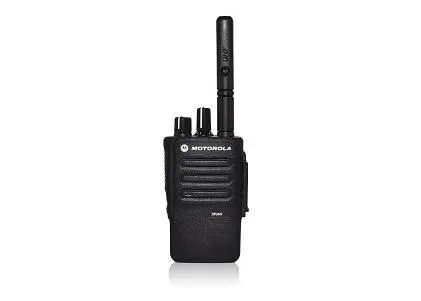
On this occasion Brentwood recommended the digital Motorola DP3441. Built for use in tough industrial environments, the DP3441 is a robust, fully waterproof handset fully capable of withstanding the rigours of sea life. Not only that, it is extremely compact, and therefore ideal for the hands-on work of busy stewards and engineers.
But, according to James Miller, what really stands out about digital models such as the DP3441 is the range of additional features which analogue marine VHF radios just cannot support. For example, many digital handheld radios now support text messaging, Bluetooth for connecting to hands free accessories, GPS tracking and even WiFi connectivity.
In addition, they come with a wide range of safety monitoring and alert features which provide added peace of mind for difficult work at sea or at high volume cargo ports. For example, a one touch emergency button for raising an alarm is now standard, while features like Lone Worker and Man Down automated alerts should an operative get into difficulty.
Reliable, secure voice transmission over distance will always be central to the use of radio communications in the maritime industry. That vital connection between sea and shore is why the industry has its own dedicated VHF frequencies which are carefully licensed and controlled. But with digital models evolving to include more and more data and security features all the time, two way radio has a broader role to play than ever keeping personnel connected whether they work on shore, on a vessel, or both.
Brentwood Communications has more than 40 years’ experience supplying two way radio solutions to businesses and organisations from every sector of the economy.
By Jake Frith