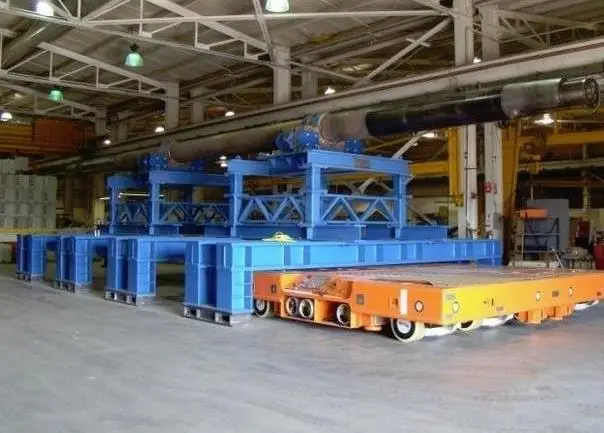
“Transporters provide capacity and manoeuvrability unlike any other vehicle with automatic guidance,” said Tom Phillips, business unit manager at Wheelift. Wheelift is a manufacturer of heavy-capacity SPMTs and AGVs, and nearly any Wheelift transporter can be used in an AGV system.
“Wheelift AGVs are changing what’s possible in heavy, demanding product assembly,” said Phillips. “Our AGV systems are the first to offer a practical solution for transporting loads over 30 tons—with individual heavy-capacity transporters, as well as the ability to sync multiple transporters to act as one.”
These advantages make them an ideal alternative, or supplement to, traditional cranes.
There are three core technologies required to make these heavy capacity transporters and AGV systems possible. Independent fluid equalizing suspension disperses loads among the wheels to maintain balance. Independent on-centre rotation axle assemblies allow for precise omni-directional travel. And computerised steering and load control integrates with assembly and facility systems to automate processes and load moves.
Because of these features, Wheelift claims that its AGV systems have capabilities and flexibility beyond traditional cranes. Wheelift transporters move loads from 30 to 500 tons and more, and handle both inside and outside operations. They can travel on most existing factory floors and surface conditions and provide flexibility for changes and growth.
Phillips continues, “The ability to use a site ‘as-is’ is very appealing to an end-user in that there will be little to no process downtime for facility infrastructure upgrades.”
Because of the extremely heavy loads being handled, and the duty cycles required, Wheelift transporters use either an LPG engine/generator or battery package to provide continuous, uninterrupted power.
All of the features and capabilities of Wheelift’s manually operated transporters are available in an AGV for automatic operations when required. Manufacturers can now combine the power of Wheelift transporters with the efficiencies of automation to minimize their material handling efforts leading to improved deliveries and reduced costs.
By Jake Frith