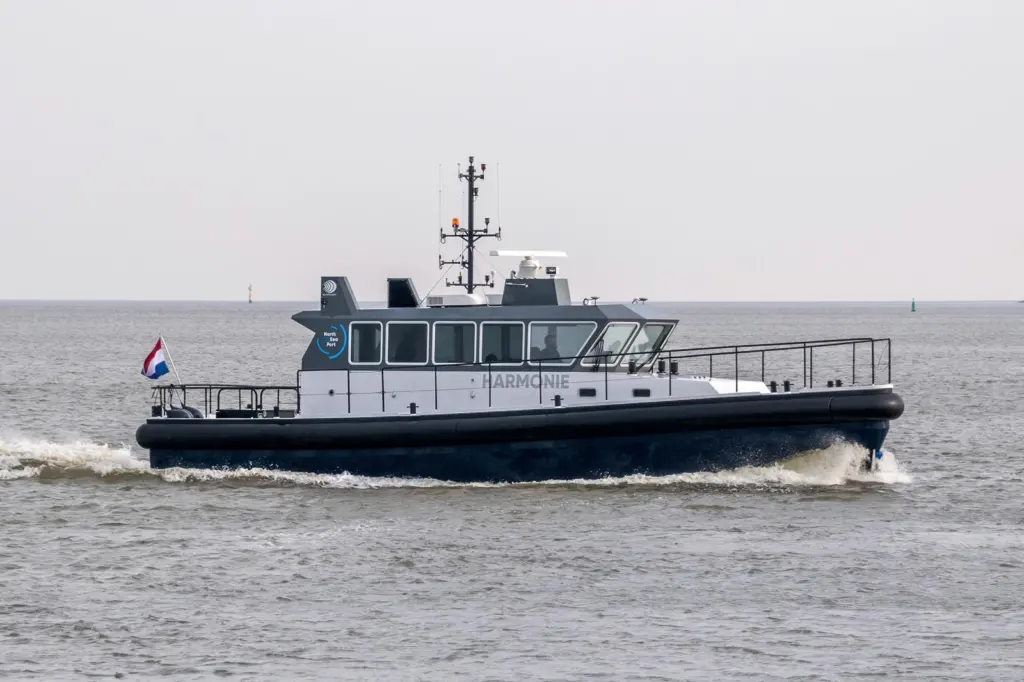
One of these is the hydrographic survey vessel which picked up DPC’s ‘Port Support Vessel of the Year’ award at the end of 2018.
The 15m long Harmonie is the first in the Profiler Class which includes 16.6m, 19.9m, and 25.5m versions, shaped around a continuous deep-V hull and twin-screw drives. The neat dimensions particularly suit its duties: the owner, North Sea Ports, is using Harmonie to keep an eye on the region’s fairways and harbours which have a tendency to silt up.
The yard chooses its designs carefully: whereas the current build, a high-speed pilot boat, will be aluminium, Harmonie has a steel hull, the extra weight evening out the motion explained founder and MD, Albert Keizer.
Interestingly, when asked why it isn’t a catamaran, Keizer is characteristically blunt. “A twin hull is a disaster for surveys,” he said. “Everyone assumes it’s stable, but you have two separate bodies in the water to account for. Not only is the influence of swirls, air bubbles and vibration far greater, there is also some flexing between the hulls, so calibration becomes very difficult.”
That’s not all: the motion sensors which correct the data have no trouble when the boat is moving smoothly “but on a twin hull, the movements are too stiff – too sudden”, he explained. “I’d say a lot of survey companies are still using catamarans, but they haven’t tried a monohull – it’s much better.”
The yard itself is evolving: located in the outer harbour of Lauwersoog in Holland’s north, it covers 15,000m2. Five buildings have already been completed: there’s a maintenance and repair and specialist steel, aluminium and fitting-out workshops plus the recently finished 35m long, 18m wide and 10m high main construction hall.
However, he explained: “I am working on a building that will be 40m long, 30m wide and 20m high but this requires a permit: as that takes two years, we started with the smaller construction hall first.” It’s supported by the shiplift: this is the largest in the Netherlands, Belgium and Northern Germany and it’s capable of lifting up to 240 tonnes.
As a result, it can get very busy, the yard seeing as many as 25 vessels at one time with a constant stream of wind farm support vessels servicing the nearby turbines to add to the variety of workboats.
Further, Keizer has very good relationships with other companies which also utilise the lifter and some of the space for diverse projects including materials, goods and container rentals as well as managing marine spares.
However, the shipyard’s profile is changing: “Last year, most of the vessels were maintenance and repair contracts,” said Keizer. “This year it will be about 50-50.”
It’s partly due to the Next Generation’s broad, in-house capability. “We do everything,” he said, “including pilot boats, wind support, taxis, crew tenders and specialist survey vessels”, and it’s engineering department also has the expertise to adapt the concepts to suit requirements.
The technical underpinning gives it the ability to take on support work for other parties: NGS provided both engineering and project management for the construction of the Javelin 25.25, Braveheart Marine’s Patriot and worked with Moscow University in the development of a ship for permafrost research.
Keizer is not backward about looking forward, either. The yard is investigating new, clean technologies with a view to incorporating them into practical designs. For example, there’s the potential for utilising hydrogen, for both propulsion and auxiliary systems, he explained.
This embraces gaseous and a novel powder-form storage, fuel cells as well as straightforward burning in internal combustion engines, he said: “Some of the wind turbines could start to produce hydrogen, if there’s enough scale, the price will drop…. and this will make it interesting for all kinds of vessels.”
Finally, the yard is growing fast: “We started with just two of us, but it’s doubled every year,” said Keizer. Now there are 25 permanent staff and another 15 or so contractors.
By Stevie Knight