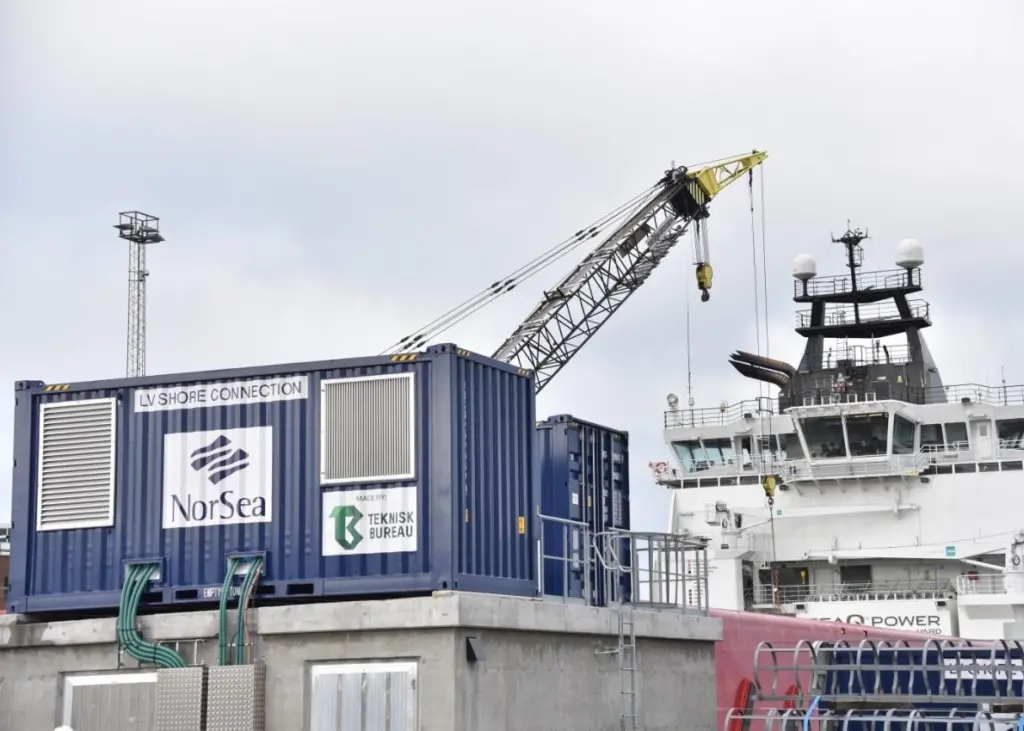
The aim of this technology upgrade is to reduce emissions and boost energy efficiency at four NorSea Group bases along Norway’s coast.
The environmental and economic aspects of ‘cold-ironing’ – when a vessel in dock stops its onboard generators and plugs in to the shoreside grid to support its hotel loads – are well established for cruise liners, ferries and naval ships. There is now a trend to expand this approach to smaller craft, such as offshore support vessels (OSVs). The potential benefits become clear when you consider that a typical, modern OSV can spend up to two and a half days at a time in dock, burning 2,000 litres of fuel a day.
Leading the trend is NorSea Group, the offshore support services provider. Its first shore-to-ship power systems has been deployed at Kristiansund, a particularly busy port for OSVs, and similar systems are being commissioned at Hammerfest, Dusavik (Stavanger) and Tananger (Sola). The new facilities will enable OSVs to cut their diesel generators while docked and plug-in to the port electricity supply to power onboard activities such as loading, unloading, heating and lighting.
“NorSea anticipates that shore-to-ship power will produce a total annual saving of up to 15,000 tons of CO2 – equivalent to the emissions of more than 7,000 cars, says Norsea’s Project Driector, Ralf Larsen. “Just as important are the savings in nitrogen oxides (NOX) sulphur oxides (SOX) and particulate emissions, together with the reduction in noise and vibration experienced by the crew and the local population.”
CO2 TARGETS
Norsea’s customers in the offshore oil and gas industry are one of the main drivers for Norway’s green port revolution. For example, Equinor, the Norwegian energy giant, has said it is targeting a 50 percent reduction in CO2 emissions on the Norwegian Continental Shelf by 2030, having already cut them by around 26 percent since 2011. It wants to adopt a green approach across every aspect of its operations and sees shore-to-ship power as a key measure in this.
The importance of this project was recognised by Enova, the Norwegian government enterprise responsible for the promotion of environmentally friendly production and consumption, who contributed around 90 percent of the $8.5 million cost.
Norway’s Teknisk Bureau is the system integrator for the shore-to-ship power project across the four bases. The systems are designed to support the power needs of an OSV, which typically consume 350 to 450 kilowatts.
The shore-to-ship power system must support two vital functions:
– Convert the alternating current (AC) feed supplied by Norway’s grid from 50 Hertz (Hz) to the 60 Hz required by the vessel’s onboard network.
– Maintain a safe, stable and reliable supply no matter how much the load imposed by the vessel varies
To meet these requirements, Teknisk Bureau has placed ABB’s air-cooled ACS 880 drive at the heart of its systems. Built on ABB’s common converter architecture, the ACS 880 covers a voltage range from 380 to 690V and a power range from 300 to 5000kW in a compact design for easy cabinet assembly and maintenance.
A critical feature of the ACS 880 is the novel Optimal Grid Control (OGC) function developed to support microgrid operations. The drive provides a stable, high-quality, three-phase supply even allowing for the long connection distance between the cable and the vessel. It also handles load variations, current peaks and short circuit conditions to meet protection requirements. This project is the first time that OGC has been deployed in a customer application.
CONTAINERIZED
The compact design of the ACS 880 enabled Teknisk Bureau to install all the components required for the power systems in a standard 20-foot shipping container, for ease of handling – and redeployment if required in the future. There is still sufficient room to operate, change components and carry out service operations. The air-cooled design also handles the high heat output – around 30kW generated by the frequency converter and transformer.
Andre Aarthun, Teknisk Bureau Project Manager, said:” We knew what equipment we needed to deliver 440V and 690V from shoreside to the vessel. We also knew we needed a frequency converter to establish the correct frequency and maintain a stable voltage, while also being as energy-efficient as possible. An ABB switchboard had already been specified and when we heard about the ACS 880 we recognized it as the ideal solution.
“While we understood that this was first time that this drive was being applied in a shore-to-ship power application we had confidence that it had been subjected to a rigorous test program to withstand everything the harsh Norwegian climate can throw at it.”
As a pioneering technology leader, ABB has provided the drives for 16 containers – 4 for Kristiansund, 6 for Dusavik, 4 for Tananger and 2 for Hammerfest.
This project in Norway is an excellent example of the benefits offered by shore-to-ship power in terms of cuttings emissions and saving energy. According to ABB, globally, it offers the total abatement potential of 18 MtCO2 today and that could increase to 70 MtCO2 in 2050.