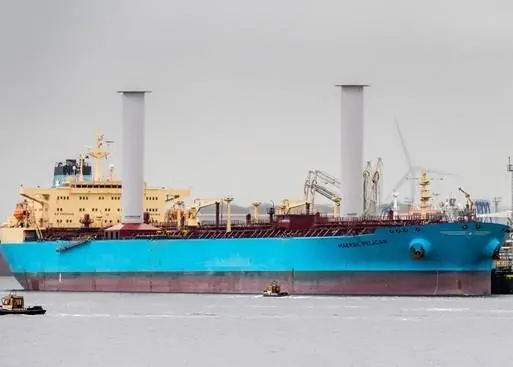
Two Norsepower Rotor Sails were installed onboard the Maersk Tankers product tanker, Maersk Pelican, for a one-year trial. The Rotor Sails are large, cylindrical mechanical sails that spin to create a pressure differential, the Magnus Effect. This propels the vessel forward. The sails deliver auxiliary wind propulsion to the vessel, resulting in the optimisation of energy efficiency and a reduction in fuel consumption.
“During the one-year trial period on Maersk Pelican, crew and operators have reported positively on the usability, safety and performance of the Rotor Sails in all conditions,” said Tommy Thomassen, chief technical officer at Maersk Tankers.
Fuel savings = lower emissions
As part of the test on the sails, installed onboard Maersk Pelican in August 2018, the aggregated total fuel saved from 1 September 2018 to 1 September 2019 was 8.2% savings. This is equivalent to approximately 1,400t of CO2. The savings were confirmed by comparing detailed performance information to a baseline established with full scale measurements and computational analysis done for the vessel prior to the Rotor Sail installation.
In a simulation model, Norsepower shows that with the currently installed Rotor Sails operating in global average wind conditions of all shipping routes, there is a savings potential up to 12% on fuel and emissions, including CO2. Based on the same simulation model, Norsepower estimates that applying Rotor Sail technology to the entire global tanker fleet would reduce annual CO2 emissions by more than 30 million metric tonnes.
By Rebecca Jeffrey