The main objective of the testing programme – undertaken at the PLOCAN test site in the Canary Islands by a consortium of partners, including Vryhof Anchors, Fiellberg, Energia Mediterranea and Wavepiston, with support from the EU Fast Track to Innovation (FTI) scheme – is the integration of different technologies to ‘fill a gap in the wave energy and water desalination market and exploit the combined resource potential in Europe.’
WAVEPISTON WEC
As part of the project, a full-scale prototype of the Wavepiston wave energy converter (WEC) system will be kitted out with technologies from all four partners and tested for 8-12 months in real-life operational conditions at the PLOCAN site. In doing so, the consortium plans to reduce costs by updating component design through several sequential design cycles. It also hopes that the real-world demonstration of a combined solution for zero-emissions electricity and water production will help to build market confidence and make the system more attractive to a wider range of customers.
As Michael Henriksen, CEO at Wavepiston, explains, activities will be based on a staged integration and deployment process – with testing carried out at both the component and system level before final system integration and deployment ‘to reduce the risks of malfunctioning and ensure optimal integration.’
“The collection of data for life cycle assessment and qualification [will] offer customers a demonstration of ‘fitness for service,’ which is critical to speeding up the permitting process of new installations and reducing risk profile and insurance costs,” he says.
“The testing programme will also strengthen market and regulatory intelligence,” he adds.
ISOLATED COMMUNITIES
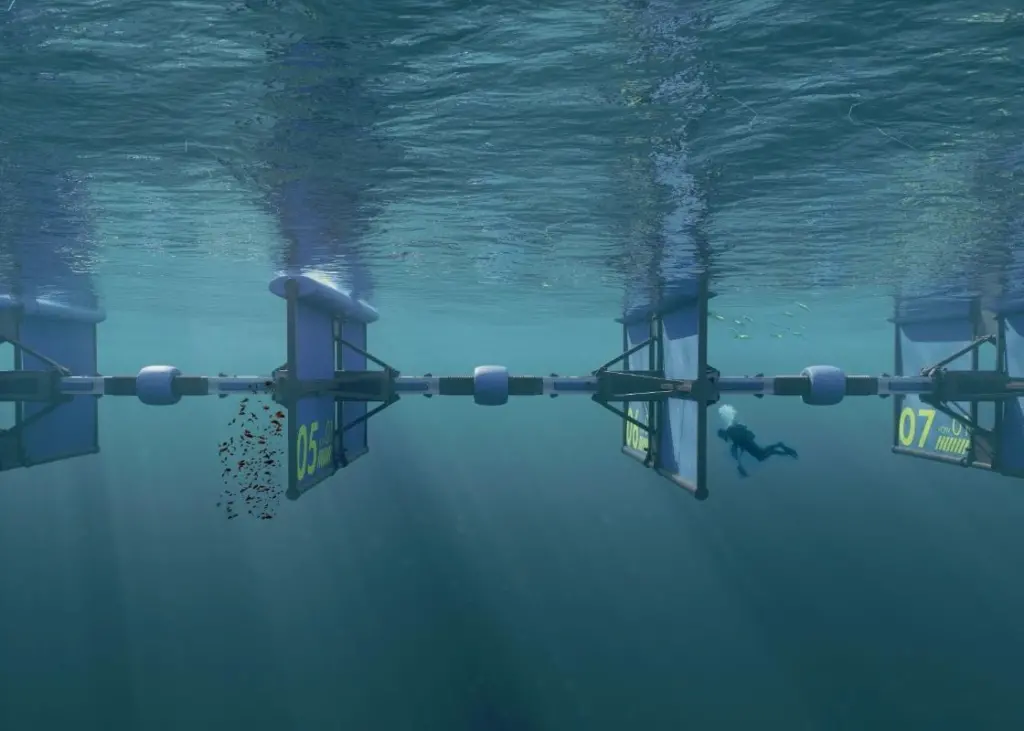
In the sea, the W2EW solution consists of a Wavepiston wave energy converter (WEC) combined with a Vryhof mooring system. It works by converting wave movement into pressurized sea water – which is then fed to a land-based turbine generator for conversion to electricity, as well as a station for the desalination of sea water via reverse osmosis. Due to the intermittency of the wave energy, a flow control system – based on valves controlled by an electrical signal – is used to manage the electricity and/or water production in real-time, to maximize the system performance.
“This management is performed based on information on the consumption and production from other sources, as well as storage capacity,” says Henriksen.
Each full-scale wave energy system has an electricity generating capacity of 150 kW and is capable of producing up to 28,000 m3 of desalinated water per year.
According to Davide Piccioni Co-Founder and Managing Director at Energia Mediterranea, key benefits of the W2EW system include the fact that it achieves electricity production and desalination with renewable energy – and is ‘non-intrusive in relation to carbon footprint, uses non-toxic material’ and minimises what he describes as ‘visual pollution.’
“The system is can also regulate power production versus desalination in relation to consumption, increasing the efficiency of the total system. For example, when there is less need for power, but there are still energetic waves, the system can shift to producing more desalinated water and use this for storage in reservoirs, where it is easier and cheaper to store water,” he says.
The consortium plans to install the W2EW system at the PLOCAN test site during the second half of 2021. After testing and demonstration is completed, Henriksen reveals the next step is to install a larger pre-commercial system, with ‘several’ potential locations under consideration.
“The ‘first step’ markets are islands, hotel resorts, and isolated coastal communities. They are highly dependent on expensive diesel generated power and many of these places lack fresh water,” he says.
“The second step is the utility scale market, which could consist of power generation, desalination or a combination. The system could also be an alternative and/or operate in synergy with offshore wind and solar PV,” he adds.