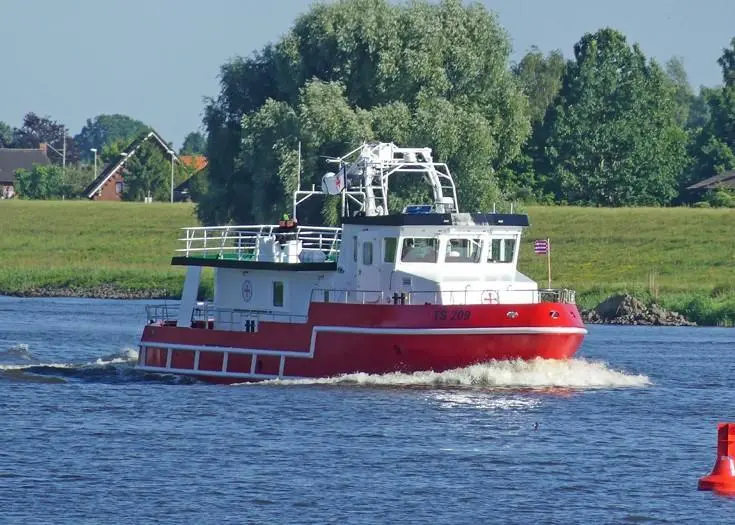
The training ship, tagged TS 209, is 22m long, 6.16m wide and draws 1.5m. For three crew and eight trainees, it is based at the DGzRS Baltic rescue training centre in Neustadt. But it will be available to any of the service’s 55 stations along Germany’s nearly 2,400 kms of North Sea and Baltic coasts. A spokesman told Maritime Journal simply: “There is no similar boat. It will be unique”.
TS 209 has never been intended for rescue. It is a conventional displacement-hulled newbuild for teaching safety and seamanship skills to DGzRS volunteers. The service said those skills included going alongside, towing, manoeuvering, technical navigation such as radar training and collision and encounter – as well as the recovery of injured people from ship interiors.
Although it is the DGzRS’ first pure training ship, TS 209 will complement two 9.5-10.1m Class boats already being used for training. The service has said it will in future also make more use of the biggest cruiser in its fleet, the 46m Hermann Marwede, for training.
The choice of an inland builder for TS 209 is also a first for the DGzRS. The Hermann Barthel Schiffswerft, lies some 250kms up the Elbe and is a builder of specialist boats for, among others, the German Waterways and Shipping Administration (WSV).
TS 209 set its own record on completion, sailing down the Elbe, along the North Sea coast and then up the Weser to the DGzRS yard in Bremen for final touches – a trip of over 300kms. No newbuild has, it seems, ever done that before in the 165 year history of the DGzRS.
The service usually builds its big cruisers at Weser-based Fassmer Werft and its smaller boats at Tamsen Maritim near Rostock. Explaining the decision to go inland for the training ship the DGzRS said Barthel “has a lot of experience in building boats like this”.
The training ship’s equipment, listed for Maritime Journal by DGzRS spokesman Ralf Baur includes two Cummins QSB6.7 main engines, each of 224kw operating over ZF 286 A gearings with PTO for rudder and fan. Its stern tubes and shafts of 70/80mm, along with 800mm propellers and rudder are from Thies in Rostock, he said.
Additional on-board equipment mentioned by the DGzRs includes a Side Power bow thruster Type SEP250/300TC 24 V of 300kgf, two independent trainee consoles each with its own Raymarine Quantum radar, two AXIOM Pro 16″ and IS 70 display for DST 800 sonar and log, an AIS 350 receiver, Navionics charts and two Sailor 6210 FM units for for navigation training.
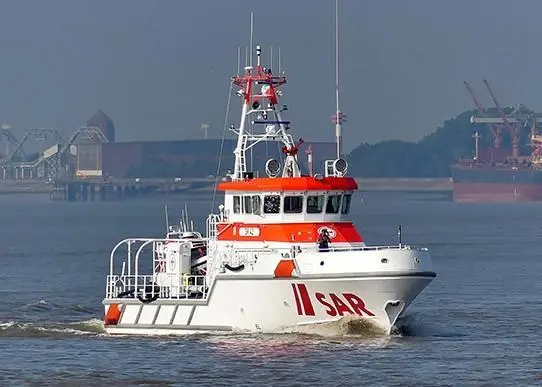
Unlike the one-off TS 209, much of the equipment on the latest rescue cruiser SK42 is the same as on its predecessors in the DGzRS 28m Class, with refinements added as the series has developed, Baur told Maritime Journal.
SK 42, the last of six in its class since 2015, was also entering service in September after completing final tests in the German Baltic. It is only the second of the Fassmer-built series with a name revealed early to encourage funding and is being called Nis Randers after a popular German sea rescue hero. The name of sister ship SK40-Hamburg was also revealed before naming in 2020.
The 27.9 x 6.2m SK 42, drawing 1.95m, is driven by two MTU 16V 2000 M72 main engines each of 1,440kw developing 24 knots. The engines were built for extreme weather operation and are designed to run during heavy listing or 360° righting. They operate over ZF 5000 reverse gearings onto fixed propellers.
SK 42’s auxiliary power plant consists of a Deutz BF 6M 1013 M which also supplies the power for SK42’s hydraulic 75kW Jastram bow thruster and its fire extinguishing pump.