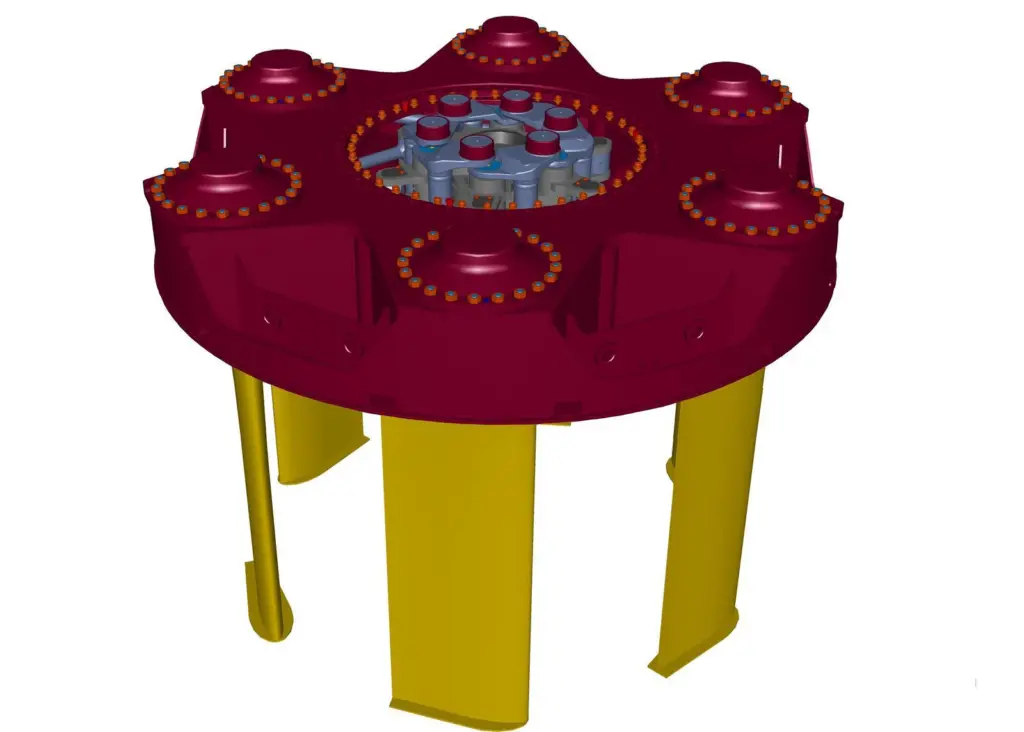
Owned by CMAL, they are being built by Ferguson Shipbuilders in Glasgow. Each of the hybrid vessels will be equipped with two Voith Schneider Propellers (VSP) with an input power of 375 kW per propeller. With its hybrid concept, the shipyard aims to reduce the ferry’s CO2 emissions by up to 20%.
The vessels will be the first of their kind to combine a diesel-electric propulsion system with lithium ion battery technology. The ferries will operate on various routes in the Scottish waters, which are characterized by strong currents and heavy winds. Both double-ended ferries are powered by two Voith Schneider Propellers each, which support the environmentally friendly ferry concept with their high degree of efficiency and low draft. In addition, they will provide the vessels with excellent performance characteristics and safe maneuvering even under the most difficult operating conditions.
To take load off the diesel engine temporarily, the two lithium ion battery banks of each ferry are charged overnight from the grid. The hybrid propulsion system reduces the ferry’s fuel consumption and thus its CO2 emissions, with an ambitious aim of reducing emissions by up to 20%. Apart from the economic benefits, the hybrid propulsion system leads to a significant reduction in mechanical stress and noise, in particular when entering and leaving ports.
Ferries are generally designed and built for the specific operating scenario in question, with the port infrastructure kept in mind. The new hybrid ferries are to be used on various routes in the Scottish waters to transport approximately 150 passengers and 23 cars per ferry, with a service speed of approximately 9 knots.
Many Scottish ferry landing areas consist of concrete ramps. The ferries dock without being moored tightly. Accurate control and positioning as well as high manoeuvrability are essential for docking in rough seas. To ensure that the two type 16R5 EC/90-1 VSPs are well protected during docking manoeuvres, the propellers are arranged diagonally in recesses and not in central positions at the front and aft, as is otherwise the case.