The European Wind Energy Association foresees an average annual growth of 28% in offshore turbine installations in EU waters to 2020. On the assumption one vessel installs 100 (4MW) turbines annually, along with maintenance and repair, DNV has calculated a requirement for 20 to 25 vessels for European projects alone. In examining the subject, DNV highlights the fact that turbine installation vessels are something of a new breed, incorporating requirements of a cargo ship and a jack-up unit.
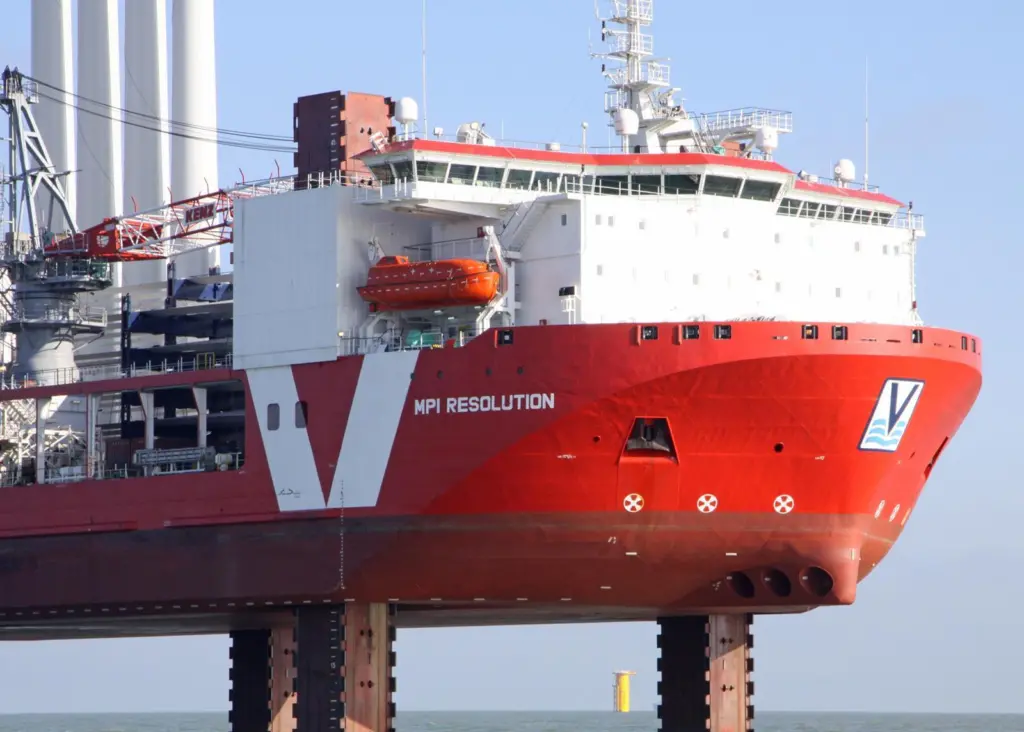
Demand for installation vessels is driven largely by UK Round 3 and German and Dutch waters projects. With the UK’s offshore wind programme, Rounds 1 and 2 were generally described as ‘20/20’ projects (up to 20 miles offshore and 20m water depths). This allowed for a gradual ascent of the learning curve, including for the installation vessel sector. The workhorses of the early days were non-propelled, multi-purpose jack-up units converted for installation duties. One of a few notable exceptions was MPI Offshore’s MPI Resolution, the world’s first dedicated turbine installation vessel, launched in 2003 and based on a conventional ship-shaped hull
The workhorse’s limitations soon became apparent however for projects above the 20/20 criteria. Requirement for tug assistance for transit to and from loading ports along with the desire to accommodate greater loads soon led to further development of MPI’s model. Installation vessel designs emerged based on large ship-shaped hulls with substantial offshore cranes, also designs adopting more traditional ‘barge’ shaped hulls, both self-propelled and with jack-up capabilities.
GustoMSC and UAE based Lamprell are prominent names in design and build of these next generation vessels and it is the resultant mix of cargo vessel and offshore jack-up for class consideration that DNV are drawing attention to. Design assumptions include repeated operations in restricted waters (jack-up operations on average every second day), limited design conditions, relevant design loads for all operational conditions and the ability to leave the field during bad weather.
Class rules compliance centres on a cargo vessel with self elevating capability entering ports regularly to load equipment and observing usual DNV rules for Classification of Ships (for ship related items). Statutory rules meanwhile involve SOLAS certificates and Mobile Offshore Drilling Unit compliance along with accommodation and safety requirements for large non-maritime crews.
DNV has published class notations for offshore windfarm construction vessel since 2009. Experience with the latest and largest such vessels have highlighted the importance of structural interactions between the hull, crane and jack-up technology. DNV’s role includes facilitating adequate communication between yard and flag state, ensuring operational and market demands are met, including extended fatigue requirements.
By Peter Barker