Government shipowner Rijksrederij manages a fleet of specialist vessels, and Tridens I is employed by European maritime research institutes such as IMARES in order to determine levels of North Sea fish stocks along with other duties.
However, the 73m research and fisheries vessel needed not just a life extension, but a capability upgrade to accommodate changes to surveying equipment – which have come a long way in a quarter of a century. On the ‘pure’ deck equipment side, the vessel had its A-frame refurbished with changes to give the clutching system a smoother operation, and a Palfinger PKM750-16 knuckleboom unit replaced the older deck crane explained Mr Frits van Dongen of Damen.
But it was really the bottom that needed most of the attention, and it was this that turned it into a very large job for Maaskant Shipyards, part of Damen Shipyards Group, as it required a high-tech engineering package to be developed in conjunction between Rijksrederij, Damen Research, Damen Maaskant Shipyards Stellendam and GNE BV Hardinxveld-Giessendam.
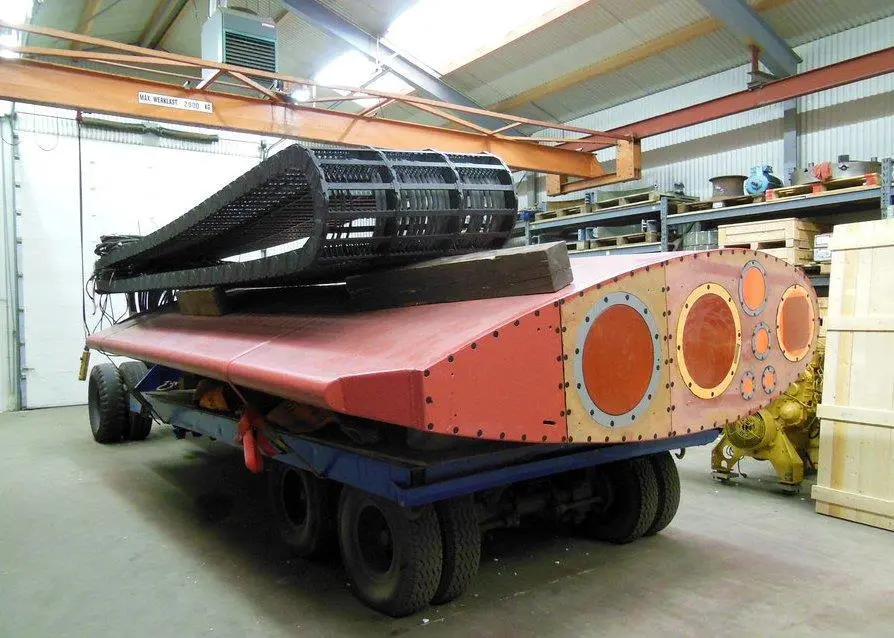
The new survey equipment required a drop keel – basically a large fin – to be lowered into the water in order to reduce interference, getting below the bubble layer around the hull. This ‘fin’ has to house several different units, each needing a transducer running on its own, differentiated frequency in order to pick up various kinds of marine life. So although a streamlined body was researched and found, taken together with all the necessary equipment, it still made quite a weight: the deployment winch had to be sized to handle 18 tonnes.
The new moonpool was one of the biggest issues “as it meant cutting a very big hole in the side of the vessel” said Mr van Dongen. This required strengthening the 13m beam hull to accept a large 4m by 3m slice and positioning of the ‘trunk’ – the drop keel deployment frame. Further, there was a knock on effect: since the large moonpool, trunk and drop keel needed to be amidships in order to mitigate against vessel motion this displaced a number of cabins, which then had to find a new home on the main deck along with an extended wheelhouse.
Still, when it comes to noise the propeller is the main issue said Mr van Dongen, so the engines were fitted with a completely new system to control the load characteristics and therefore the vibration transmitted into the hull.
It has taken five months of intense work, but Tridens I is now good to go for another ten years.
By Stevie Knight