Voith recon in the UK
Voith Turbo, the German marine propulsion specialist, has just completed its first major refurbishment project in a brand new UK facility.
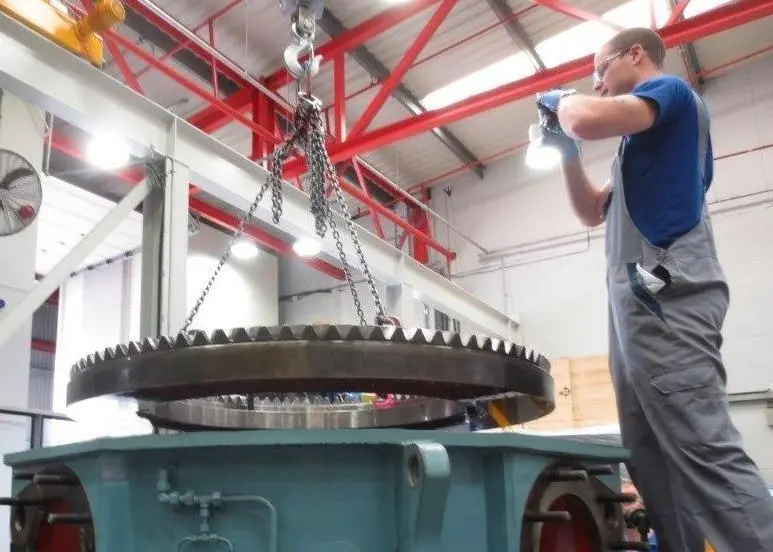
The complete overhaul of a 26-tonne Voith Schneider Propeller (VSP) has been carried out for Red Funnel, the Isle of Wight ferry company based in Southampton, at Voith’s Croydon workshop.
The refurbishment follows Voith’s investment in specially designed jigs, fixtures, machinery and lifting equipment capable of handling Voith Schneider propellers, gearboxes and other ancillaries.
Sean Chambers, technical manager at Red Funnel, said: “We have had issues in the past with previous companies but Voith have done a fantastic job with the first propeller.
“We chose Voith because we wanted to work with the original equipment manufacturer who would do a quality job using original parts.”
He added: “We have seven propellers in our fleet and we are now looking to refurbish one every year. We have now transported the second propeller to Voith and the refurbishment should be completed in November.”
Mark Harvey, Voith’s UK marine manager, said: “In the past refurbishment contractors have taken in propellers, refurbished them, and then simply sent them back to the customer without recording what has been changed and for what reason.
“By contrast we have adopted a collaborative approach involving the customer at all critical stages of the refurbishment process.
“We strip down the propellers completely and then prepare a detailed report on the propeller’s condition. The customer is then invited to inspect the propeller and be involved in the decision process for remedial work.
“The customer then has the option of repairing the unit, or replacing it with a new one depending on the expected life of the propeller.”
He went on: “We want to develop long-term relationships with our customers so we help them get a better understanding of how their propeller is performing and how we can develop maintenance procedures to achieve the optimum performance of their equipment.”
During the refurbishment work Voith carried out extensive rigorous testing, including non-destructive testing of critical parts, before the unit was transported back to Red Funnel.
During the installation phase Voith service technicians supervise the installation of the VSP and carry out full HATs (Harbour Acceptance Trial) and SATs (Sea Acceptance Trial) to ensure everything is operating as specified before the propeller is handed back to the owner.
“We ensure the propellers also meet the rigorous engineering and safety standards of both navigation bodies as well as insurance inspectors,” added Mark.
The Voith Schneider Propeller (VSP) is the most well-known Voith Turbo marine product and was first developed in the 1920s.
Popular on Tugs and ferries that are required to turn in their own length, the VSP thrust can be generated in any direction and in any magnitude so it can operate even in narrow ports where strong winds and currents are critical factors in the safe operation of the vessel.
The VSP uses vertical blades that are rotated and constantly angled to provide the most efficient angle of attack.
On the Voith Schneider Propeller, a rotor casing which ends flush with the ship’s bottom is fitted with a number of axially parallel blades and rotates about a vertical axis.
To generate thrust, each of the propeller blades performs an oscillating motion about its own axis. This is superimposed on the uniform rotary motion. The larger swept area of the VSP’s rectangular blade, compared to the circular blade of a screw propeller of the same diameter, produces a higher efficiency compared to other steerable thrusters. The Red Funnel Raptor class car ferries, all of which were built by Ferguson shipbuilders of Glasgow in the 1990s have two VSP units each. When a VSP is not being used for propulsion its blades can be completely feathered to the water flowing through it, so making a pair of them a useful propulsion system for a double ended ferry.
By Jake Frith