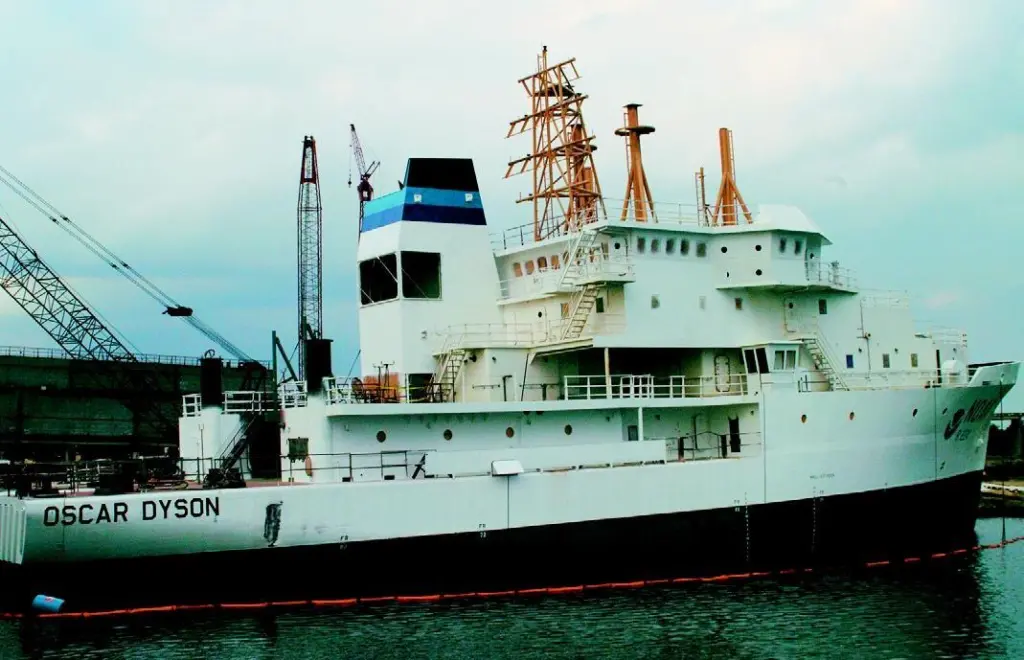
Due to become operational in the autumn of this year, it will survey Alaskan waters and the Bering Sea in its mission to protect, restore and manage the use of living marine, coastal and ocean resources through ecosystem based management.
The Oscar Dyson will use a variety of techniques, including hydro-acoustic surveying, to collect the essential data required to establish accurate quotas.
A powered ship of this size would normally generate enough background noise to hinder surveying operations, so Oscar Dyson has been equipped with the most advanced noise suppression technologies in the world. Achieving a low acoustic signature was a critical design parameter for the vessel and Thordon COMPAC bearing material from Canada’s Thordon Bearings Inc was written into the specification.
The propulsion system of any ship is an area where noise infiltrates the water. According to the specifications, the stern tube bearing needed to be ‘of environmentally safe and acoustically inefficient materials’.
Thordon COMPAC propeller shaft bearing systems feature pollution-free water lubrication, no use of oil, an expected 10 year or longer bearing wear life and a low coefficient of friction with hydrodynamic performance at lower shaft speeds which results in quiet operation.
The Oscar Dyson is also equipped with Dynamic Positioning for precise station keeping. The DP coordinates the thrusters and main shaft, with many starts, stops and low shaft speeds necessary to maintain the vessel at a precise geographical coordinate. Shaft squeal (also known as ‘stick slip’) is often generated when a ship operates in this manner, with the shaft literally trying to stick to the bearing. The noise radiates from the vessel into the water.
Thordon COMPAC’s inherent self-lubricating properties and hydrodynamic design keeps breakaway friction low, which helps eliminate stick slip effects.
Thordon engineers also modified their standard offering to allow for sustained hydrodynamic operation at very low shaft RPM.
NOAA has recently announced plans to exercise its option to build a second NOAA FSV at VT Halter Marine for delivery in 2006.
MJ Information No: 195105