![MaritimeJournal[Seawork]](https://www.maritimejournal.com/wp-content/uploads/2026/09/MaritimeJournalSeawork.svg)






Port power: which option to choose?
Ports are coming under more and more pressure to keep their carbon obligations, both by using battery-powered machinery such as cranes in port, and accommodating electrically propelled vessels at berth.

Where to get this extra electricity from when the national grid is at best stretched is becoming an increasingly urgent problem.
To address some of the issues MSE International, the cluster organisation that supports the marine sector, has published the white paper Energy Storage for Port Electrification (ESSOP).
The paper looks at several battery options and how to integrate solar – but concludes that there are far from any easy answers.
As the paper says, to ensure electrical resources are always available to meet intermittent and uncertain loads, investment will be needed in multi-vector energy supply chains as well as energy storage in the ports themselves so that the grid is not stressed.
“The ability to use energy storage as a means of minimizing the port’s cost of procured energy is a key advantage of in-port batteries,” the paper says.
“ESSOP has explored two ways in which ports can minimize their energy costs by using energy storage.
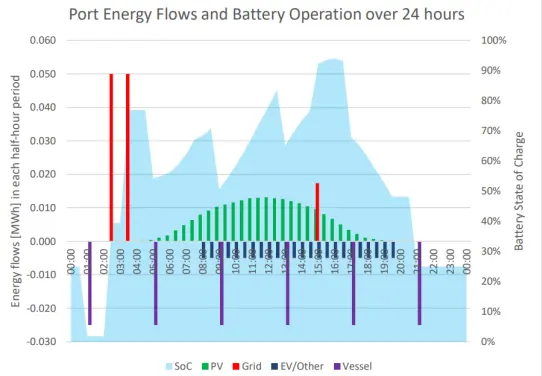
1. Optimising when they buy electricity to exploit low price periods
An intelligent battery controller can be deployed to avoid buying electricity during peak periods. ESSOP has developed, MSE International says, a model that simulates the requirement of a battery depending on the vessel: ferries and workboats, for example, will need to berth several times a day, whereas a cruise liner will have a high load requirement but much less frequently.
2. Optimising how to use PV solar generation to offset grid electricity
“A relatively small amount of PV solar generating capacity can bring significant reductions in the expenditure on grid electricity,” the paper says, showing how in the summer, it can mean drawing on the grid far less.
“Ports that have a high-power grid connection (or could upgrade their connection at reasonable cost) do have the option of supplying shore power directly from the grid,” says the paper. “In many cases, however, battery storage will be beneficial: allowing the port to optimize its procurement of electricity under a time-of-day tariff, to reduce its peak load on the grid connection and to optimise use of on-site renewable generation, notably PV solar.”
The paper briefly looks at lithium-ion, lithium/lead-acid hybrid and vanadium redox flow batteries, each of which has advantages and disadvantages. And will be suitable for different use cases and duty cycles.
“Although batteries of all type are presently quite costly, and introduce round-trip losses, the use of battery storage can be attractive for some use[1]cases,” it says. “This is especially true for more frequent loads (eg ferries and workboats that berth several times each day) where the flow battery option is shown to offer cost advantages over direct grid connection and other battery technologies.
“Conversely, high infrequent loads (eg shore power provision to cruise ships) are much more challenging, with levelized costs dominated by high capital cost of battery storage.”
The white paper can be downloaded here.

Related Articles
 SEAWORK NEWS
 INDUSTRY NEWS
 OTHER NEWS