![MaritimeJournal[Seawork]](https://www.maritimejournal.com/wp-content/uploads/2026/09/MaritimeJournalSeawork.svg)



Italy halves funding for two offshore-wind hubs
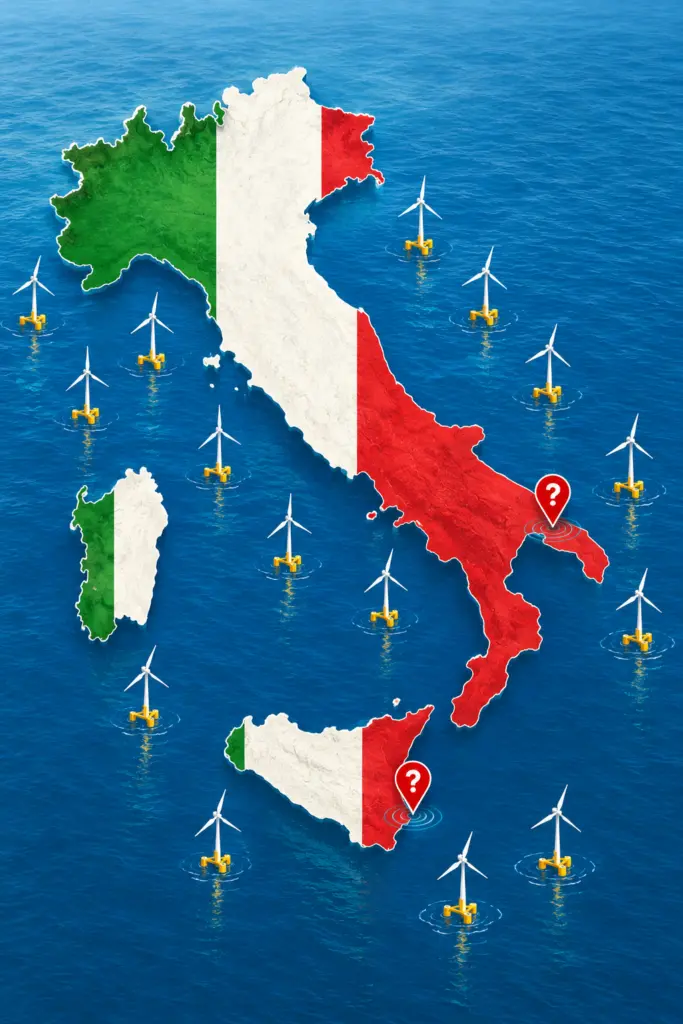
Italy has cut planned funding for offshore-wind infrastructure at two ports that had been earmarked to become floating offshore wind hubs.
The allocation for the ports of Taranto and Augusta has been slashed €78.3m to €38.3m, prompting criticism but also questions about the country’s offshore wind plans, according to Italy’s national news agency ANSA.
The Ministry of Environment and Energy Security (MASE) told the two port authorities on 22 September that the available funding had been reduced following what it described as ‘linear cuts’ to the ministry’s spending budgets. The revised allocation gives Augusta €24.3m, down from €49.8m, while Taranto will receive €13.94m rather than the €28.5m originally planned.
The reduction was reported in Italy as part of wider cuts to ministry spending intended, among other things, to help finance measures such as a reduction in fuel excise duties.
U-turn
The decision is a substantial E-turn from the investment programme announced just over a year earlier, when the Italian government formally designated Taranto and Augusta as the country’s priority sites for the development of offshore-wind industrial hubs.
An interministerial decree signed on 4 July 2025 identified the two ports as suitable for offshore-wind shipbuilding activities, ‘chosen on the basis of criteria of technical-economic feasibility, availability of space, construction times and logistical connection’, the Ministry of Infrastructure and Transport (MIT) said.
“With this initiative, the Ministry of Infrastructure and Transport, in collaboration with the Ministry of the Environment and the Ministry of the Economy, launches a strategic path for the energy transition, the sustainable development of port shipbuilding and the consolidation of Italy’s role in the Mediterranean as an industrial hub for offshore wind,” said the MIT.
The Deputy Prime Minister and Minister of Infrastructure and Transport, Matteo Salvini, who has followed the dossier carefully, expressed great satisfaction.”
Backlash
The cut has prompted criticism from industry and regional politicians, particularly in Taranto, where offshore wind has been presented as part of a broader strategy for industrial diversification.
Confindustria Taranto president Salvatore Toma said the organisation could only express ‘strong concern and alarm’ over the decision.
Toma said offshore wind could become an important element of Taranto’s industrial redevelopment, supporting investment, assembly and maintenance activities as well as training and employment.
There has also been criticism from the Puglia regional council. Regional councillor Cosimo Borraccino described the reduction as ‘a hard blow’ to southern Italy and said the decision would structurally weaken investments that were important to Taranto and Augusta.
Italy’s floating-wind strategy
Italy is particularly focused on floating offshore wind because much of the country’s coastline quickly reaches water depths that make conventional fixed-bottom foundations difficult or unsuitable. The Port of Taranto’s 2026-28 planning document identifies an Italian offshore-wind pipeline of approximately 88GW, based on the 4C Offshore database, of which almost 86GW is planned as floating offshore wind.
Just 30MW of offshore wind capacity was installed in Italy when the document was prepared, consisting of the operational wind farm near Taranto.
The Taranto port document also says Italy’s proposed offshore-wind capacity is considerably larger than that identified in other Mediterranean markets, but that Italy remains much less developed than the leading northern European offshore-wind markets.
The ports were selected partly because of the physical requirements of floating wind. Because floating turbines can be assembled in port and towed offshore, large quayside areas, deep water, heavy-lift capability, fabrication facilities and suitable marine access are all needed.
According to Italy’s offshore-energy lobby AERO, just four out of 26 offshore-wind projects, with a combined capacity of around 18GW, have been given environmental approval.
Reuters said billions of euros of potential investment and more than 25,000 jobs were at risk, according to AERO.
Analysts at TGS/4C reported this week that only 2.1GW of offshore wind had reached FID globally in 2026 so far, despite more than 12GW expected to enter operation this year.
Related Articles
 OTHER NEWS
 DREDGING & FLOOD DEFENCE
 OTHER NEWS