![MaritimeJournal[Seawork]](https://www.maritimejournal.com/wp-content/uploads/2026/09/MaritimeJournalSeawork.svg)

USV launches subsea glider in milestone for unmanned operations
ZeroUSV has successfully launched a subsea glider from an uncrewed surface vessel (USV), marking a milestone for autonomous vessels in subsea operations.
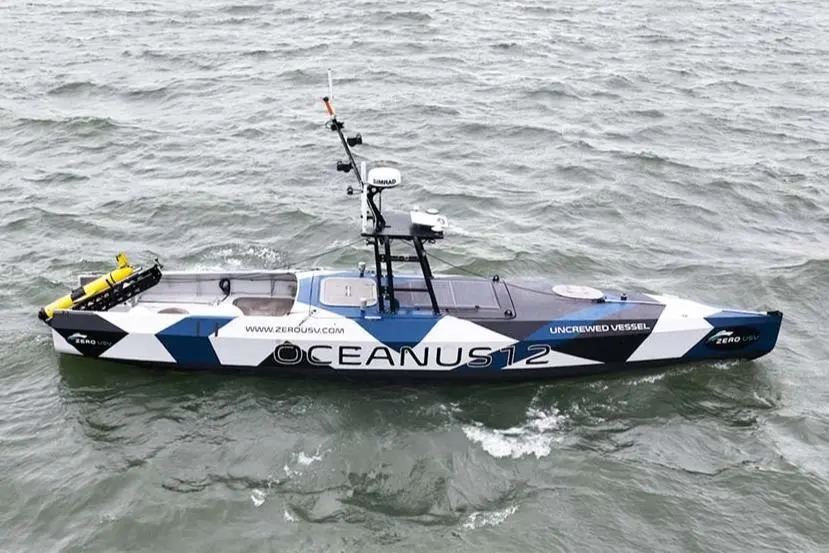
The demonstration, conducted under the Royal Navy’s Atlantic Bastion programme, saw a Teledyne Slocum Glider deployed from a ZeroUSV Oceanus12 platform.
The trial highlighted how an uncrewed surface vessel can act as a launch and support platform for long-endurance underwater systems, reducing reliance on larger crewed ships. Two Oceanus12 units were deployed as part of the wider activity, integrating subsea vehicles, sensors and autonomous technologies.
“This is an incredible milestone,” said Matthew Ratsey, managing director and Co-Founder of ZeroUSV.
“For the first time, the world has seen the launching and operating of an ocean glider from an uncrewed vessel, which opens up new possibilities for persistent subsea monitoring and long-endurance operations at sea.”
USVs for defence
The project is expected to expand with multiple industry partners contributing to capability development. The trial also reflects growing collaboration across the autonomous maritime sector.
ZeroUSV’s Oceanus platform’s modular design enables deployment of a wide range of subsea technologies, including sonar and survey equipment.
Looking ahead, ZeroUSV plans further demonstrations of its autonomous vessels throughout 2026, including the introduction of the larger Oceanus17 platform, designed to deliver increased payload capacity and endurance for extended subsea operations.
The Atlantic Bastion programme forms part of a broader UK Ministry of Defence initiative to assess how autonomous vessels can support maritime security tasks, including subsea monitoring and protection of critical undersea infrastructure.
Teledyne Marine and MSubs recently established a strategic partnership focused on integrating autonomous surface platforms, underwater vehicles and advanced sensing systems for future naval applications.
Last month, ZeroUSV, Oshen and MarineAI have launched a first-of-its-kind programme to create a distributed sensing network that supports underwater monitoring and secure communications for submersible fleet operations.
Related Articles
 OTHER NEWS
 ACCESSORIES & EQUIPMENT
 SPECIAL REPORTS