![MaritimeJournal[Seawork]](https://www.maritimejournal.com/wp-content/uploads/2026/09/MaritimeJournalSeawork.svg)





Unusual – but practical – choice for dredger refit
When does composite win hands-down over steel? When it’s on the walkway reports Stevie Knight.
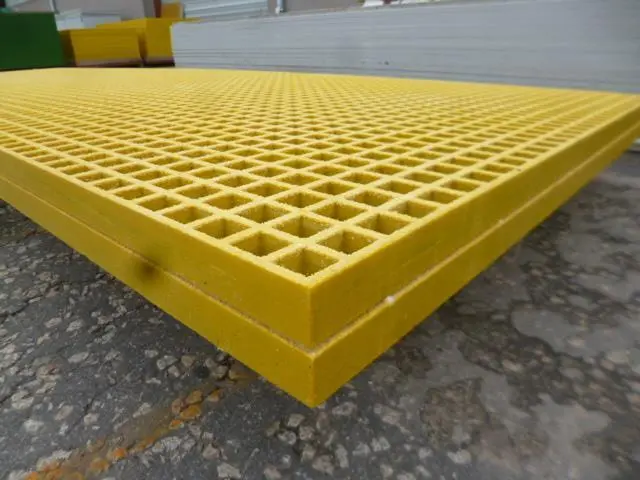
That’s what the crews of two pairs of sister Tarmac vessels agree: these have taken the novel step of avoiding the usual like-for-like refit, installing composite gridwork instead.
According to Captain Paul Turner of City of Cardiff, steel came with definite problems: “The metal surfaces always get warped in use: the distortion means all day long you hear ‘bang-bang-bang’ on every footstep as people go marching backward and forward in big boots.”
As Capt Turner explained the traditional material gave him a headache for an entirely different reason: “There’s a safety issue: the galvanised steel walkways, these always corrode.” Cardiff’s chief engineer, Damion Spencer, agreed: “The dredger’s action loads the atmosphere with a high concentration of salt and moisture, that’s a killer for metal.” The problem for all three sisters is that schedules can be tight without much room for interruption.
“However”, added Capt Turner, “if you don’t see to something like this promptly, you are risking an accident – you can damage your knees from tripping, that’s painful enough… but I’ve also actually seen someone fall in from a corroded jetty. One thing you have to understand, Tarmac is all about safety. We need to keep that central.”
Given all this, both Turner and Spencer were willing to give a ‘fit and forget’ solution a try, getting in touch with Gripclad on the suggestion of one of the ship managers. Barry Eagle, CEO, explained that while the City of Cardiff was a first for the company, it had seen plenty of other applications with a variety of similar (and not so similar) requirements, running from engine rooms to port and harbour walkways and many other kinds of access – even stair surfaces for Network Rail’s busiest stations.
This introduces another significant element: slip. “It’s a fibreglass base in an Isophthalic resin, with an aluminium oxide grit on top, bonded into the surface,” said Eagle. It results in a resilient structure with superb underfoot traction “pendulum tested for a high co-efficient of friction and a PTV reading above 65”, he explained. For the uninitiated, that translates to “a pretty good grip, even if you have an oily surface repeatedly drenched by seawater”.
Interestingly, a different contract highlights another important characteristic: “It’s very light in comparison to steel. Grillage over a reservoir needed to be pulled up from time to time to allow maintenance of the pumps underneath… the water company were used to it being awkward, needing two men on the job just to move it out of the way,” said Eagle. “Fitted with Gripclad, the same section could be raised by a single person using one hand.”
Needless to say, vessel installation benefits: the composite’s lightweight makes it easy to handle. However, there’s no compromise on strength: a 38mm grating will take a point loading of half a tonne “so you don’t need crosswise strengthening beams, it is stiff enough to span the gap between one side of a gangway and the other”, explained Eagle.
More there’s no hot work like welding or even sawing, installation being both fast and simple. “Yes, we supply ‘standard’ panel sizes, but what happens is the customer gives us a drawing with all the awkward shapes, T-sections, rhomboids, triangles, whatever, and we cut it, for no extra charge,” said Eagle. “We number and label all the pieces so there’s no confusion; all that’s needed is to slot them in, clamping the sections into position with M-clips.”
There’s one other element that’s worth mentioning: the composite is non-magnetic, non-conductive “and won’t spark like metal if you drop your tools onto it”, said Eagle.
The success of the installation meant that City of London, City of Westminster and City of Chichester followed in Cardiff’s footprints, having their own composite walkways refitted in the same smart, light grey. Although Gripclad does provide other colours including an emerald green and a safety yellow that’s useful for high-vis, public areas such as ferries, Eagle admitted the grey “is by far the most popular”.
“Aesthetically, the new composite grid is much better,” Spencer concluded: “I know when people come onboard the vessel they are not there to fault find, but you have to admit, rusty old walkways don’t look too great.”
Will other vessels follow suit? Eagle believes so, although he said, “I think people have been conditioned to think in terms of steel grids which have no slip resistance. But, why apply an antislip coating to a steel grid which doesn’t last and isn’t very practical? By contrast, GRP grating will survive decades without any attention.”

Related Articles
 ACCESSORIES & EQUIPMENT
 OTHER NEWS
 ACCESSORIES & EQUIPMENT