![MaritimeJournal[Seawork]](https://www.maritimejournal.com/wp-content/uploads/2026/09/MaritimeJournalSeawork.svg)


HVO fuel trial for windfarm CTV
An offshore wind crew transfer vessel has achieved an immediate 28% reduction in CO2 emissions during transit and first days of operation.
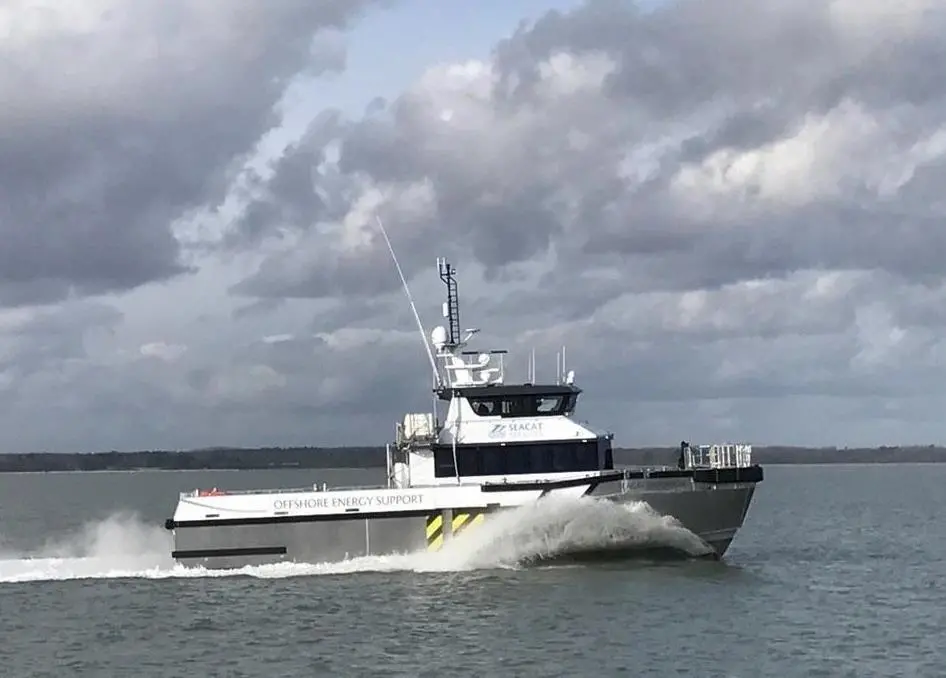
Seacat Enterprise has completed its journey to and first operational assignments at Triton Knoll Offshore Wind Farm using Hydrogenated Vegetable Oil (HVO).
Following a scheduled refit at the Alicat yard in Great Yarmouth, which saw Seacat Enterprise undergo a number of modifications, she was loaded with 8000 litres of HVO30 for her return trip to Grimsby and first days of operation. Her journey and first assignments were completed successfully, with all engines performing to expectation.
HVO is developed utilising waste oils derived from agricultural products, and as such has a markedly lower life cycle greenhouse gas (GHG) emissions profile than traditional marine gasoil (MGO) derived from fossil feedstocks. The reduced emissions profile of HVO, combined with its ability to blend almost seamlessly with MGO, thereby reduces total operational emissions in accordance with the volume of the blend. In loading Seacat Enterprise with HVO30 – wherein 30% of total fuel volume was HVO – Seacat has reduced CO2 emissions from the vessel’s transport and first operating days by 28%.
Commenting on the development, Ian Baylis, Managing Director, Seacat Services, said: “Up to 96% of emissions from the offshore wind support sector are generated while our vessels are under charter, during which time the fuel choice is specified by the customer. As offshore project owners and investors look to reduce emissions from their supply chains, we are proactive in supporting our charterers as they address this added pressure – and projects like this one prove what can be achieved with our vessels today.”
The design modifications made to Seacat Enterprise during her refit were specified by Seacat’s long-time vessel design partner, Chartwell Marine, and overseen by marine sustainability consultancy, Cedar Marine.
This test case for HVO is part of a range of efficiency measures Seacat is implementing across its operations and new build programme. In Q4 2020, Seacat placed double orders for the BARTech 30 and Chartwell 24 with FOSS – a pair of vessel designs that use hull form and foil optimisation to significantly reduce carbon emissions while maintaining operational performance.
By Jake Frith

Related Articles
 OFFSHORE RENEWABLES
 OFFSHORE RENEWABLES
 ENVIRONMENT