
WSV cranes cannot be an afterthought
Self sufficiency is becoming more and more important for wind farm support vessels – especially as wind farm sites are getting ever more distant, with soon to be allocated UK Round 3 sites on the far horizon or beyond.
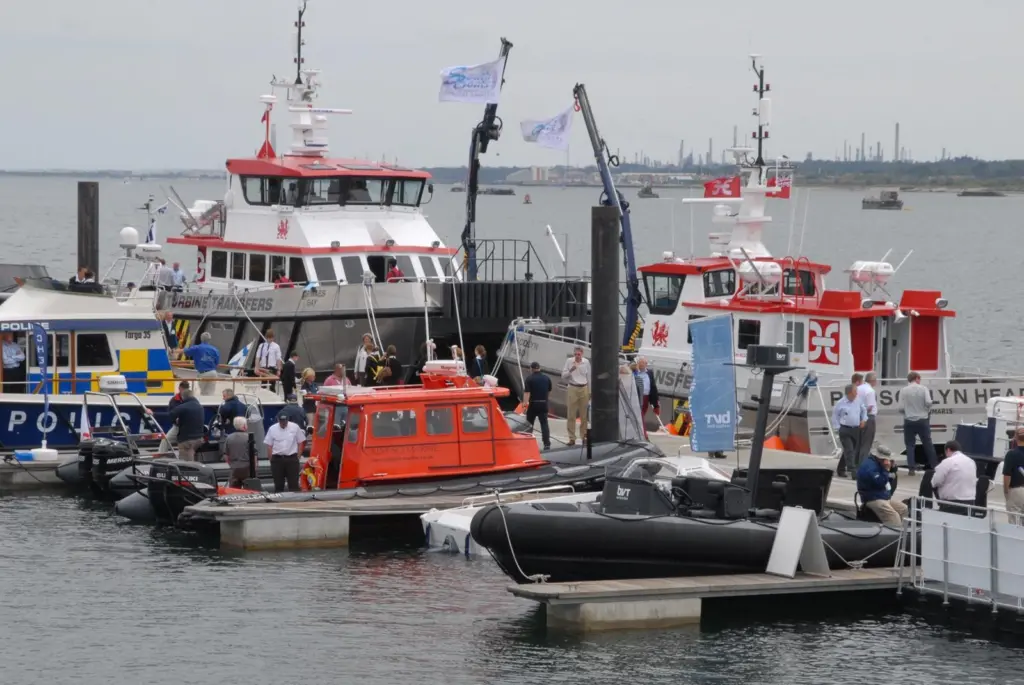
It follows that wind farm support vessels (WSVs) are becoming ever more specialised, and South Boats, one of the most established builders, has developed an interesting take on the subject of deck cranes.
Cemaes Bay is South Boat’s second South Catamaran 69/20m WSV, the largest model so far. But the deck equipment layout has changed for both this vessel and Roscolyn Head, since both now sport the deck cranes on the foredeck rather than aft. The vessels are operated bu the new Renewables Division of Holyhead Towing and the skipper of the boat told MJ, ‘The reason is a simple one, the majority of the work done for wind farm support takes place off the bow, unlike the more usual multipurpose cats which tend to work from the stern.’
The crane on Cemaes Bay is set off centre toward the port side on a steel plinth, which gives it an extra few feet of height so that swinging equipment over the side requires less lift. The plinth is bolted down to make the whole unit entirely removable.
It will be used mainly for getting equipment on and off the boat while shoreside and moving often large wind farm components around the deck for working on after the wind turbine’s crane has lowered them.
The crane on Caemas Bay is a Palfinger PK10000M knucklboom model, with three extensions. The maximum hydraulic outreach is 12.4m, with an extra 4m of manual reach added. This gives an 8m lift with a load of 1,120kg, and 330kg at full 16.4m extension.
The model on the slightly smaller 15m Roscolyn Head is a Palfinger 4501M, with a maximum hydraulic outreach of 11.1m and a lift of 440kg at 8m extension.
Derek Hughes of South Boats told MJ that the Palfinger cranes and the vessels they are on were matched at the design stage. ‘The bottom line is that the craft needs to be multifunctional, but you can’t retrofit this kind of equipment, he said. ‘Amongst other things, it affects stability so it needs to be calculated in with the whole design from the start.’