



TidalStreams turbine validated in deep water tests
Two British engineers have developed a breakthrough design that could within five years begin to generate substantial amounts of cheap electricity from deepwater tidal flows. TidalStream Ltd reported last month that their unique turbine platform design, code named Triton, has successfully undergone validation testing at the deep-water test basin at Ifremer in Brittany, France.
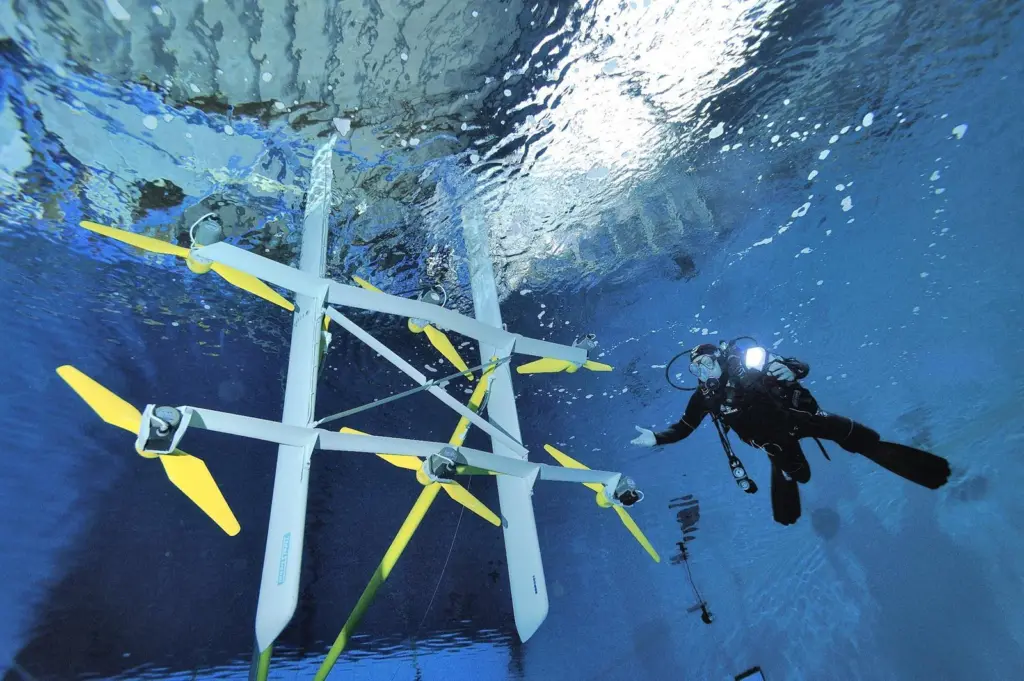
The company demonstrated, at model scale, that its design is practical for tidal stream capture, claiming major advantages over other renewable energy systems. The UK has half the tidal stream resource of the whole of Europe, the equivalent of several nuclear power stations in energy terms, with no CO2 emissions, fewer concerns over safety and at potentially lower cost.
A tidal stream turbine is just like a wind turbine underwater, adapted to deal with the density and flow rates of water, and would be located in the highly energetic channels close to shore around the north of Scotland, Ireland, and England. This design differs from other attempts to capture power from the sea in that it can generate a large amount of power, 10MW, from a single installation. A tidal farm of just 50 Triton turbines could supply the needs of over a quarter of a million homes.
Triton’s design is also different in that it can be operated in two distinct modes; as a catamaran which can be floated out to site and deployed and maintained without the use of cranes or divers, and as a vertical submerged spar supporting up to six turbines across the flow.
The model tested in France was 3m in size. The full scale version would be installed in selected places around the UK and, once in position, would span a water depth of over 60m. This is higher than Nelson’s column but with only a small amount of the structure showing above water. When floating, it becomes a 1,200 ton catamaran.
Unlike wind energy, tidal stream is a silent, predictable and almost invisible form of renewable energy, found mostly at sites close to shore, and one in which the UK is uniquely rich.
The TidalStream 10 MW turbine enables cost effective deployment and operation for horizontal axis tidal generators. Different individual turbine generators can be used, the platform providing the installation and maintenance base that will reduce costs and provide safe operating conditions. The individual generators will mostly use technology and components developed from the wind industry that already exist, and that have benefited from ongoing development over the last 30 years.
The TidalStream 10 MW turbine is claimed to improve the cost effectiveness of tidal energy systems by creating a multi-MW unit with a single seabed shear foundation and up to 10MW output from a single installation. It enables float-out, installation without barges, cranes, jack-ups or divers, providing a stable platform for safe and simple topside access to machinery and systems in hostile and turbulent sea conditions. It maximises energy capture by using the full depth of the tidal stream (currents near the surface generally run significantly faster than those near the seabed) and reduces loads by allowing the turbines to align with the flow.
The TidalStream Partnership was founded in 2005 by John Armstrong, formerly technical director of Taylor Woodrow’s subsidiary Wind Energy Group, and Michael Todman, formerly chief engineer at Rolls-Royce Industrial & Marine Power. TidalStream Limited is working with Ramboll UK to develop the full scale design.
Related Articles
 MARINE CONSTRUCTION
 ENVIRONMENT
 ENVIRONMENT