![MaritimeJournal[Seawork]](https://www.maritimejournal.com/wp-content/uploads/2026/09/MaritimeJournalSeawork.svg)





Geotextiles Secure Canal Bed at Minden
The Mittellandkanal is one of the most important navigable waterways in Germany, providing an east-west route for inland waterborne transportation. Ships draughts continue to increase and are currently anything up to 2.50 metres. This has created a problem for the Mittellandkanal at Minden West.
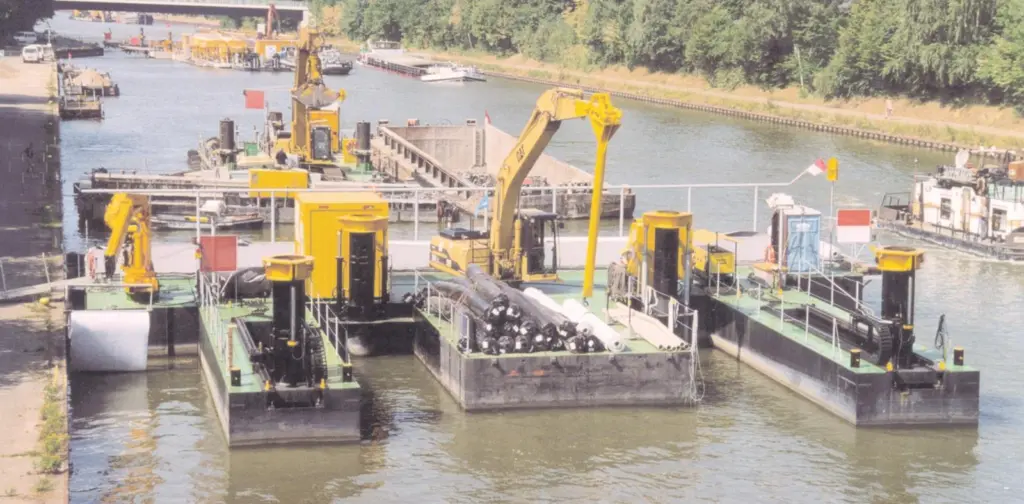
‘The clearance between the ships’ propellers and the canal bed has become much smaller with the passage of time, ‘ said civil engineer Andreas Kagel.
The bed consisted of a clay seal overlain by a 700mm thick protective layer of a gravel, overburden and clay mixture. This mixture was in danger of being stirred up by propellers resulting in the clay layer eventually losing its sealing properties by gradual removal of the small clay particles, thus the watertightness of the bed was no longer guaranteed.
The works undertaken by contractor Josef Mobius, with Andreas Kagel being their site manager, were designed to remove about 400 of the 700mm and replace this with a partially-grouted stone rubble lining to act as a bed protection layer. This lining consists of 400 mm of armourstone, Class II (100-300 mm), placed on geotextile filtermats manufactured by HUESKER.
Prevention of future fines loss was achieved by the use of a HaTe nonwoven, type E800/2, tested by the German Federal Institute for Waterway Engineering (BAW). The geotextile used has a demanding role to play.
‘On the one hand, the nonwoven must be resistant and not tear and on the other it must have filtering properties appropriate to the soils, ‘ said Kagel.
Also, to prevent the underlying fine-grained particles from escaping through the nonwoven, the geotextile must have good separation properties. By preventing this migration from taking place, HUESKER’s HaTe nonwoven ensured that the stability of the canal bed was not compromised.
Approximately 230,000m 2ofgeotextile were installed and covered with 400mm of stone protection.
A 4km length of the Mittellandkanal within the town of Minden was protected in water up to 4m deep. ‘The urban setting means the width of the canal varies greatly and there were numerous bridges’, said site manager Kagel. There was also a requirement to maintain waterway traffic during the contract period.
MJ Information No: 19518

Related Articles
 OTHER NEWS
 OTHER NEWS
 FEATURES & VIDEOS