


20 Years of Marine Propulsion
20 years does not seem a long time in marine propulsion. Most of the ships that were new, or recently launched, in 1987 are still afloat today. Like the vast majority of present day ships, they have a single main engine driving a shaft and propeller, either direct or through a reduction gearbox. Outwardly the engines and other major components seem very much the same.
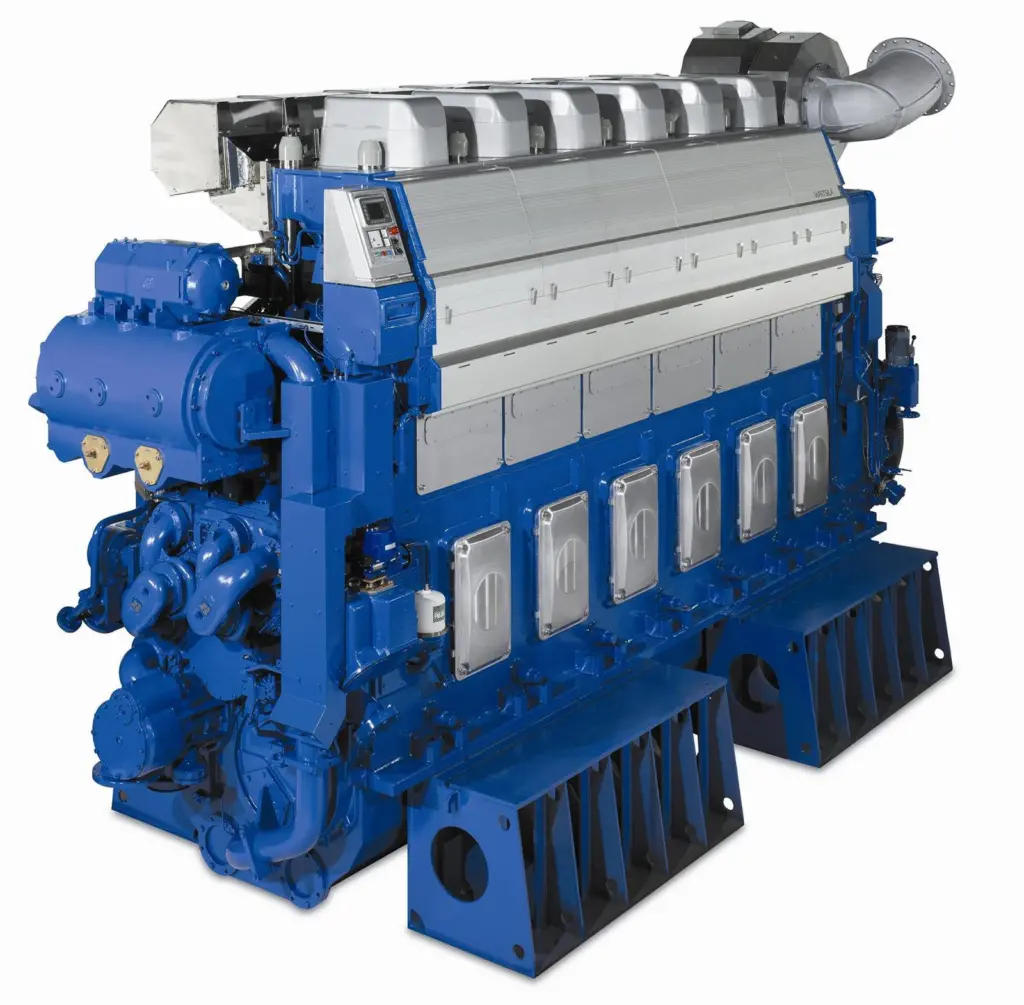
But lurking within current engine blocks a great deal has changed. Two words can sum up the last 20 years – emissions and consolidation.
Let’s take the latter first. There are fewer manufacturers and designers of marine engines now than there were 20 years ago. The biggest merger came about when Wärtsilä acquired what was then known as New Sulzer Diesel, a move that affected mainly the world of large low speed engines, but the Sulzer four stroke designs were absorbed into the Finnish group’s range. Caterpillar took over not only the MaK range of medium to large engines from Krupp, but also acquired Perkins, and its marine arm Sabre. Together with the acquisition by MAN of the former GEC Alstom brands of Ruston, Paxman and Mirrlees Blackstone, this heralded the end of the British marine engine.
Now that the Ruston RK280 engine, Rustons having proved popular in fast ferry and tug applications in particular, is built in Germany as the MAN 28/33D, we have reached the end of an era. Unless, that is, we can count the JCB built, Ricardo-developed small diesel that Mermaid offers in marine form as the J444.
Environmental concerns have prompted the biggest changes to the marine engines business in the last 20 years. In 1987 the industry was just waking up to the fact that marine engines, like those in vehicles and plant, pumped noxious substances into the atmosphere and something would have to be done about it. In 1987, I was involved in the leisure marine sector, where things bit first. The first sign of change was the concentration of four stroke outboards, in response to the fact that the two strokes would not be able to meet emissions limits anticipated in sensitive areas such as California and the Bodensee.
Smaller tonnage has been fortunate in that it has been able to follow the considerable developments in vehicle and industrial engines. Large ships run on heavy, residual oils, which are not suited to many of the techniques that small diesel engines running on distillate fuels have employed to become both cleaner and more efficient. Moreover, fitting bulky equipment to clean exhaust gases is not feasible on a ship as it is for an oil burning power station for example. So in-engine measures have been employed, and continue to be developed, to limit formation of nitrogen oxides, while sulphur emissions are being controlled through the use of low-sulphur fuel.
Attention is turning to other emissions from ship and boat engines including particulate matter and carbon. To cut carbon emissions, vessels have to use less fuel. So attention is focusing now on fuel saving measures such as waste heat recovery, low resistance hull design, high efficiency propellers as well as vessel operating patterns.
Diesel electric propulsion continues to gain favour, particularly in the specialist vessel sector, and alternative fuels are now being seriously considered. The hybrid propelled tug is becoming a reality. The Norwegians are using LNG for an increasing number of cross-fjord and coastal ferries, and investigations are proceeding apace into biodiesel for ships. Even hydrogen fuel cells, the stuff of fantasy in 1987, are under serious consideration.
Propellers and gearboxes are little changed, beyond growing in size and becoming more efficient. As smaller tonnage ships have progressed, so have the elements of their propulsion systems. ZF, for example, has recently delivered its largest marine gears yet, for an Incat fast ferry.
Fast ferries have also been mainly responsible for the entry of the waterjet into the mainstream propulsion market. As the 1980s gave way to the 1990s, the vehicle carrying catamaran began to revolutionise that market, Subsequently vessel lengths, and, even more significantly, payloads have increased.
Other than the engines, podded propulsion units have been the biggest development of the last 20 years, with, it has to be said, mixed results. In some applications, such as icebreakers and ice classed small tankers, ABB’s Azipod has been a great success. In the large cruise ship market many systems have been delivered but there have been problems. The Azipod’s competitors though have fared far worse and seem to have mostly retreated from the market.
The soundness of the basic pod principle has been proven by its adoption by smaller vessels. Volvo Penta’s IPS uses similar principles and has proved a great success in the leisure market. It would seem to lend itself well to commercial applications demanding high manoeuvrability, such as pilot boats.
The next 20 years will be even more challenging, and interesting, as environmental concerns step up a few more gears and fuel begins to run out. Who knows what we may be writing in 2027?
Bill Thomson is editor of MJ’s sister publication, The Motor Ship.
Related Articles
 POWER & PROPULSION
 VESSELS
 POWER & PROPULSION