



New hearts for Dart workboats
Three workboats operated by Dart Harbour and Navigation Authority in the UK have been repowered with Perkins Sabre engines. They are Lynx, a pilot boat that doubles as the harbour launch, Hercules, the authority’ s largest vessel and floating crane that, in addition to its moorings duties, is also available for hire to assist moving heavy loads in the harbour, and Triton, an 8.3m tug that is also available for towing.
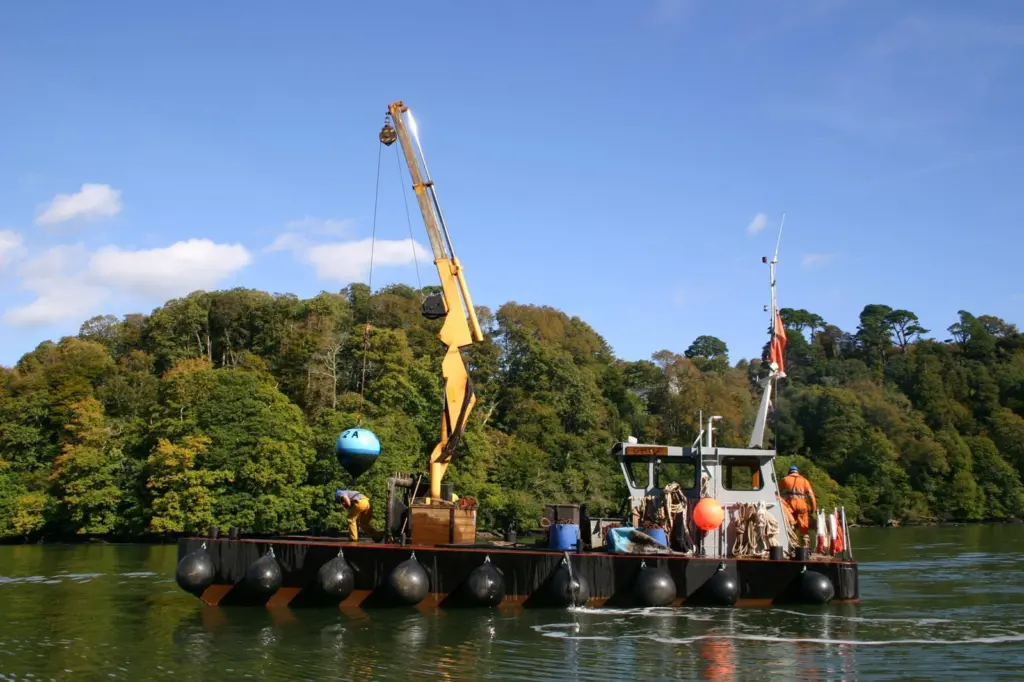
The engines, which were installed by Brixham based Oxley Marine Engineering, are the Perkins Sabre M130C and the Perkins Sabre M215C. The steel hulled
Hercules
is now powered by a pair of the keel cooled 130hp M130C engines; aluminium hulled
Triton
by a single M130; and glassfibre hulled
Lynx
by a single M215C that was de-rated from its standard 215hp to 160hp at the Wimborne Marine Power Centre, home of Perkins Sabre. The existing gearboxes, a Borg Warner Velvet Drive for the M215C engine and PRM 750D transmissions for the M130C engines, were reused. All three boats are moored at Dartmouth. .
The repowers were undertaken to replace aging Perkins 6.354 engines that had provided years of sterling service but that had reached the end of their cost effective lives. This record of reliability was, understandably, a major consideration when deciding on the replacement engines for the three boats. However, according to Oxley Marine Engineering, build quality, price and the low operating cost of both the M130C and the M215C were finally cited as deciding factors in the engines’ favour. The marine engineering company adds that the authority has also found both engines to be smoother, quieter and with a marked absence of emissions when compared with the original engines.
The six cylinder, six litre, wastegated turbocharged, charge air cooled M215C is, arguably, the ‘workhorse’ of the current Perkins Sabre commercial engine range. It is claimed to be the most compact engine in its class, which made for a straightforward and low cost repowering of the Lynx pilot boat. It is also claimed to provide the lowest cost of ownership in its class, which made it an attractive economic proposition for the Harbour and Navigation Authority. With its maximum de-rated power being delivered at a very low stressed 1,900rpm, Lynx’s engine is set to provide the authority with years of trouble free service.
The six cylinder, six litre, naturally aspirated M130C boasts the same compactness and cost of ownership characteristics as the M215C. Its dependability and reliability is also underpinned by a low revving 2,600rpm maximum power output.
Related Articles
 POWER & PROPULSION
 VESSELS
 POWER & PROPULSION