
A Flag Day for Sanmar with a new design
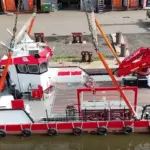
Turkish tug builders and tugowners Sanmar Denizcilik Makine ve Ticaret Ltd, of Istanbul, celebrated in fine style at the flag change ceremony for the first vessel of their new Sanmar Eskort 80 series.
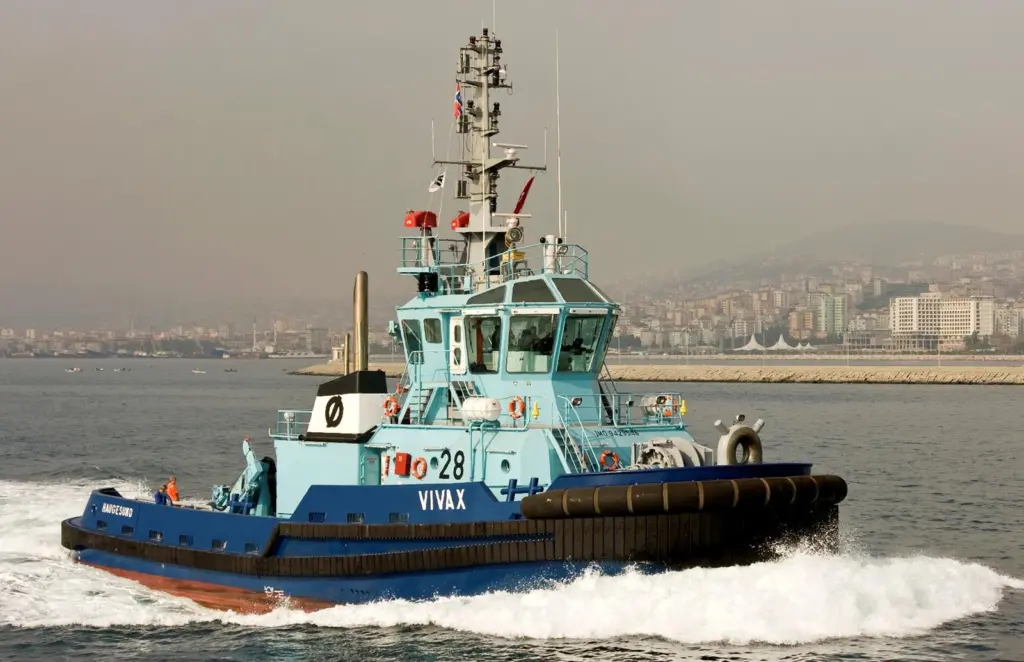
A sizable number of invited guests, including the friends, clients, the designer and owners, were all given the opportunity to see the new vessel for themselves and confirm that Sanmar has produced an excellent addition to their product range. The purpose of the ceremony was to formally change the name and flag of the impressive new tug from the temporary
Sanmar Eskort 80-1
under the Turkish flag to
Vivax
and the Norwegian registry of owner Ostensjo Rederi AS of Haugesund.
Vivax
was finally handed over a few days later and sailed from Turkey on its maiden voyage to Norway on 10 November. On arrival in Norway
Vivax
will be deployed at the Nyhamna gas processing terminal where it will be the principle tug, carrying out berthing and escort operations.
Sanmar now offers a range of six tug designs to the towage market worldwide, all emanating from the drawing board of the well known Canadian Naval Architect Robert Allan. The Istanbul based family firm has benefited from an association with Robert Allan and his company, Robert Allan Ltd of Vancouver, dating back to 1990 and was one of the first shipbuilders outside Canada to adopt his designs. During the early days of that association, Sanmar, as tugowners in their own right, were building tugs and other harbour craft for their own use. As the success of the first designs became known, the construction process continued with vessels being sold on, initially to local owners and then to a growing number of overseas clients. Now, at the end of 2008, Sanmar has an impressive record of 78 completions and a very healthy order book.
It was this close association between Robert Allan and Mr Ali Gurun, a family member and project director of Sanmar, that spawned the new Sanmar Eskort 80 design. An earlier design of the Sanmar Eskort known locally was based on the Robert Allan RAmpart 3200 design of azimuthing stern drive (ASD) tug now in service and in production in large numbers all round the world. Sanmar constructed their first Sanmar Eskort with a 70 ton bollard pull in 2004 and has since completed seven tugs of that type. During the production process the design was gradually refined and market research revealed the need for a more powerful version with a bollard pull of 80 tons capable of carrying out a full range of duties at oil and gas terminals.
Vixax was the first of ten vessels of the new design to be ordered. The tug is equipped for shiphandling, tanker escort, fire fighting, pollution control duties, coastal and short sea towage and anchor handling.
Ostenjo Rederi is a discerning tug owner with a reputation for high standards and attention to detail. It is therefore a considerable tribute to both the design and construction that this latest addition to their fleet is the ‘standard product’ with only minimal changes to the specification.
The tug is 32m in length, with a moulded breadth of 12m (a slight increase over the previous version) and depth of 5.36m. In keeping with most Sanmar tugs of this type, the vessel complies with the class requirements of ABS +A1 Towage Service, Escort Vessel; ABCU, FiFi1, Oil Recovery Class 1, Unrestricted Service.
The underwater configuration of the double chine hull is designed to afford a good flow of water to the propulsion units throughout the operational envelope and produces an excellent stern first performance. A long box keel and forward skeg enhances the vessel’s handling characteristics when operating in the indirect mode and increases the steering forces generated during escort operations. The hull has a semi-raised foredeck and a fendering configuration in the bow and forward quarters that has proved highly successful in ‘push-pull’ operations. The latter comprises a series of heavy rectangular moulded rubber sections, surmounted by a horizontal cylindrical moulding installed in the bow at bulwark level. Fendering around the sides and stern is also made up of rectangular moulded ‘keyhole’ sections, each held in place by a vertical steel pin.
A well designed after deck has an open stern with a 1m in diameter roller installed for anchor handling. The deck has a maximum load rating of 5 tons/m2 and is capable of transporting three standard 20 foot ISO containers. A good sized hold for towing gear and other equipment is located between the engine room and propulsion unit compartment. Dedicated internal tanks can accommodate 195 m3 of fuel, 38 m3 of fresh water, 18 m3 of foam compound and 126 m3 of recovered oil.
Vivax is powered by two Wartsila 8L26 main engines producing a total of 6,522 bhp (4,800 kW) at their maximum continuous rating of 1,000 rpm. The engines are cooled by means of Bloksma box coolers and the exhaust system silencers are equipped with spark arrestors. Power is transmitted to a pair of Rolls Royce US 255 fully azimuthing propulsion units incorporating four blade controllable pitch propellers of 2,800mm diameter. On trials the tug achieved a maximum bollard pull of over 80 tons towing ahead and a maximum free running speed of over 14 knots, with a similar performance going astern. Manoeuvrability, in what is already an inherently agile tug, is enhanced further with the addition of a 250 hp Mjosundet S-1150-250-V250 transverse bow thruster. In the indirect, escort mode of operation a maximum braking force of 101 tons and steering force of 79 tons have been predicted at 10 knots.
Electrical power onboard is supplied by two Lindenberg alternators powered by MAN D2866 LXE diesels and rated at 120 kVa. A smaller Stamford 40 kVa alternator driven by a Perkins 4GM engine supplied by Beta Marine is installed as a harbour set and for emergency use. The engine room is highly automated in order to comply with class rules for un-manned machinery spaces, with computerised monitoring and alarm panels in the wheelhouse, engineer’s cabins and mess room. Locating audible alarms and flashing beacons on deck, adjacent to the rear door alerts the crew to important machinery alarms.
Rolls-Royce Marine supplied the towing winches installed fore and aft. A single drum winch on the foredeck incorporates a windlass to handle the vessel’s own anchors. The single drum, configured for shiphandling and escort work, has a brake holding capacity of 200 tons and a line pull of 50 tons with dynamic self tensioning capability. The drum carries a 150m of high performance manmade fibre UHMWPE towline deployed through a ‘staple’ type fairlead with a stainless steel lining.
A twin drum winch is located aft for general towage duties and anchor handling. The drums each have a maximum brake holding load of 175 tons, a line pull of 40 tons at 12m/min or 8 tons at 64m/min. Both drums incorporate automatic spooling gear and can accommodate 950m of 52mm diameter steel wire rope. A double fairlead mounted aft of the winch drums is lined with stainless steel.
Other deck equipment includes a Karmoy tugger winch and one set of hydraulically operated Karmoy tow pins located forward of the stern roller. The work deck forward of the stern roller has a protective timber covering. A hydraulically operated Palfinger ‘knuckle boom’ deck crane with 65 t/m capacity and 10m outreach is mounted to starboard of the main winch.
Fire fighting equipment aboard Vivax meets the standards of FiFi1 and includes a self protection dousing system. A pair of remotely operated water/foam fire monitors of the short barrel type, from Norwegian FFS Fire Systems AS, are located on a platform above the wheelhouse roof. The system is supplied by two FFS pumps driven by the main engines via Kumera step up gearboxes.
Vixax is fitted out to a very high standard. Fully air conditioned accommodation includes two single cabins for the Captain and Chief Engineer, two double berth cabins, a day room, ship’s office, galley, laundry, washroom, sanitary spaces, a dry store, and a drying area for wet weather clothing. The accommodation is well lined with acoustic and thermal insulation where appropriate. An excellent wooden flooring imported from Norway for this vessel will now be standard in Sanmar tugs of this type. Heating is provided in the hold, engine room and propulsion unit compartment.
The well glazed wheelhouse gives the tug master excellent visibility and is accessible from within the accommodation or from the deck. A central control position has two longitudinal consoles, one either side of the Captain’s chair. Controls for the propulsion system, and winches fall easily to hand and the consoles also house the main machinery monitoring panels, navigational and communications equipment. Two radars are fitted, an autopilot, two GPS sets, a chart plotter, echo sounder, speed log, gyro and magnetic compasses, and an AIS transponder, most of which was supplied by Simrad. Communication equipment meets the requirements for European GMDSS Area 2 with radios by Sailor. A Mini-Com intercom and a self powered internal telephone system are fitted.
Among the other orders for the new Sanmar Eskort 80 is a single vessel for Norwegian operators Stadt Sjotransport AS and two tugs for Bugsier Reederei of Hamburg. Sanmar’s current building programme also has orders for six twin screw harbour tugs of the 25m Dogancay class, with 3,300bhp main engines and a further four vessels of 2,200bhp. Thirteen of the new and increasingly popular 24m Ulupinar class ASD tugs are also on order and six 28m Sanmar Terminal ASD vessels of 5,000bhp. All will be delivered between 2008 and 2011.