![MaritimeJournal[Seawork]](https://www.maritimejournal.com/wp-content/uploads/2026/09/MaritimeJournalSeawork.svg)


Major test of Channel rescue services
A major international exercise has been held to test the UK and French maritime rescue services plans to cope with a major maritime disaster in the Dover Strait. Manchex 2009 was the latest in the biennial series of exercises aimed at testing the coordination and response to such an event by various organisations both afloat and ashore and on both sides of the Channel.
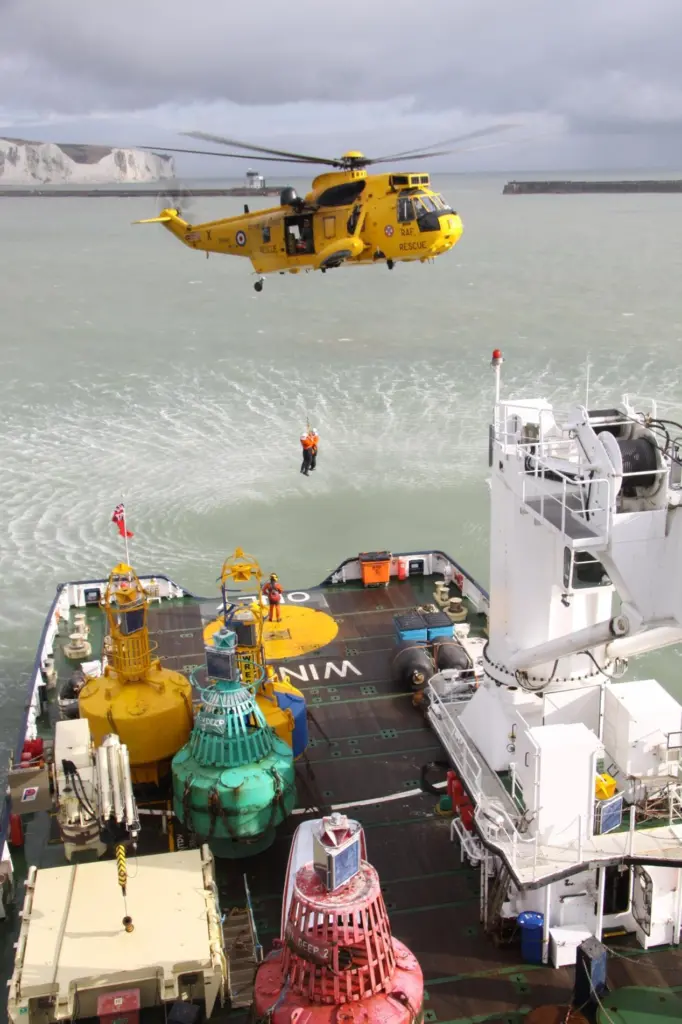
The scenario involved a simulated fire on a cross channel ferry with passengers injured and missing overboard. A number of separate strands were developed as the situation unfolded including search and rescue, fire-fighting, casualty evacuation, salvage and counter pollution response and shoreside casualty reception facilities. Courtesy of Trinity House, the multi-functional buoy tender
Galatea
played the part of the casualty vessel with coordination of the incident taking place at the Maritime and Coastguard Agency operations room at Dover Coastguard. Representatives from the French Coastguard were present both at Dover and on board the
Galatea
to observe the exercise.
The SAR element of the exercise involved a response from sea-borne assets including RNLI lifeboats from Ramsgate, Walmer and Dover and French lifeboats from Calais and Boulogne. Weighted dummies were put into the sea before the start of the exercise to add realism to the search planning and detection capabilities of the lifeboats. All these ‘casualties’ were subsequently located and recovered.
On board the Galatea, while the crew responded to the simulated fire using their own firefighting resources, the exercise plan followed the scenario that the fire could not be controlled by the crew alone and outside assistance had to be requested. Coastguards at Dover alerted the UK Maritime Incident Response Group (MIRG), comprising specially trained and equipped teams drawn from the shoreside civil fire and rescue services and the Kent Fire and Rescue MIRG team was brought in to assist. Two groups, each comprising six firefighters and their equipment, were transferred to the vessel from Kent International Airport at Manston by a Sea King helicopter from RAF Wattisham.
Coastguards at Dover also alerted their Counter Pollution and Response Branch at Southampton, which tasked the coastguard tug Anglian Monarch. Owned by UK based JP Knight and chartered to the MCA, this specially equipped vessel was soon alongside the Galatea, using its firefighting monitors to simulate boundary cooling on the vessel.
With the MIRG team now working alongside the Galatea’s own crew in combating the developing fire, the Dover RNLI lifeboat evacuated a number of injured casualties from the vessel and landed them at a reception facility set up by Dover Harbour Board at the cruise terminal in the Western Docks, where Kent County Council’s emergency planning team was on hand to deal with the influx of 125 survivors played out by volunteers from Coventry University and Thanet College. Involvement was not only centred on Dover however and various agencies throughout Kent and the Trinity House operations room at Harwich also took part.
The exercise plan assumed that the situation rapidly deteriorated and with the vessel now at real risk of sinking the master ordered a simulated full abandonment of the vessel including the evacuation of the fire team as well as the ship’s own crew, kitted out in their own lifejackets and immersion suits. The exercise ended with the Anglian Monarch making a simulated towing connection to the Galatea.
Andy Roberts, coastguard exercise director on board the Galatea said, ‘Today’s exercise was the largest to be held in the Dover Strait for two years and was months in the planning. Not only did we exercise various resources at sea, we also strongly tested the survival reception area at Dover Harbour, which dealt with 125 survivors from the incident, some requiring decontamination and others with various injuries. A meeting of all the partaking agencies will take place in due course where all the learning points will be discussed.’
By Peter Barker