

Deep Green flies kite for tidal energy
As political leaders gather in Copenhagen this week for COP 15 United Nations Climate Change, Saab spin-off Minesto has revealed another step towards tidal energy commercialisation by producing electricity with the Deep Green concept. Minesto is a Swedish and UK based company founded in 2007, with majority owners including the Saab Group, Midroc New Technology, Verdane Capital and Chalmers University of Technology.
COP 15 aims to reach consensus on a global climate agreement beyond the Kyoto Protocol running until 2012. In order to achieve a sustainable future and implement the transformation of energy systems, technologies advancing now are crucial.
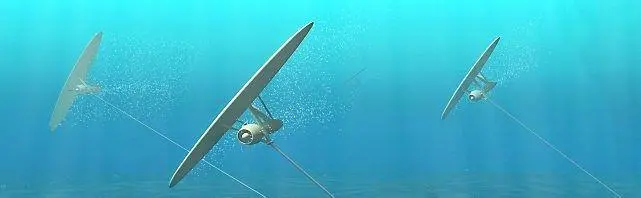
A video released by Minesto shows a demonstration power plant in generation mode. Predictable and carbon neutral electricity from tidal and ocean currents will be a keystone for the renewables mix in many countries in order to reach the 2020 target of 20% of energy from renewable sources.
The theoretical models, simulations and previous model tests have proven the power plant’s ability to utilize unexplored resources in the form of low velocity tidal currents. However the practical testing of actual electricity production pushes the boundaries of existing knowledge even further ahead.
Following the successful demonstration, development of the technology is continuing to the next stage, deployment of a prototype off the coast of Northern Ireland in 2011. The long term goal of contributing to the future energy system seems more likely than ever and expert assessments of the role that marine energy technology will play in the future verifies that Minesto is moving in the right direction.
A report commissioned by the British Wind Energy Association (The Benefits of Marine Technologies Within a Diversified Renewables Mix) stated that an approximate optimal mix between marine technologies and wind power in the future UK power system would gain from having a 40/60 ratio in order to reduce the cost of backup systems, reserve capacity, fuel cost and CO2 emissions and to avoid redundant investments in over capacity of renewables. The extent of cost reductions from optimal energy mixture totalled €1bn per year compared to the sole use of wind power, according to the report.
Tidal energy technologies possess the advantage of being able to deliver a predictable and continuous flow of electricity to the grid regardless of whether conditions are windy or sunny. Tidal energy will not cause unexpected and sudden variations which eventually wear out transmission devices and cables. This suggests that tidal technologies can complement wind, increasing the cost effectiveness of variable renewables and ultimately expanding the potential share for renewables in the overall generation mix. By combining different technologies the result is a more stable system with higher reliability and lower cost. Tidal energy is estimated to reach a 10 to15% contribution to the energy mix.
Deep Green technology can contribute significantly to this as it can use slow water currents in areas where no other technologies can operate cost efficiently. The Deep Green concept opens up entirely new areas for electricity production from the seas. In the UK, the estimated power from tides increases from around 22 TWh to 40 TWh annually which corresponds to 3.8m additional households.
Deep Green technology can be best explained as a two stage process. The first stage increases the relative flow speed entering a turbine. When the tide hits the wing it creates a lift force. Since the kite is secured to the ocean bed with a tether and is controlled by a rudder, the kite can be placed in the desired trajectory. This method brings about a tenfold increase in the flow velocity into the turbine compared to actual stream velocity. The second stage uses a generator to convert kinetic energy into electrical power.
The net result is increased power from a smaller package. The planned normal full size unit weighs only 7 tons excluding anchoring, which gives an energy payback time of 3 weeks, compared to 8 months for onshore wind power.
Related Articles
 MARINE CONSTRUCTION
 ENVIRONMENT
 ENVIRONMENT