![MaritimeJournal[Seawork]](https://www.maritimejournal.com/wp-content/uploads/2026/09/MaritimeJournalSeawork.svg)


Successful inland shipping trial on Ouse
Some 1,200 tons of Pulverised Fuel Ash (PFA) from Yorkshire’s Drax Power Station in the UK was carried for its entire journey by water freight late last month in a trial which is expected to set the stage for more shipments later this year.
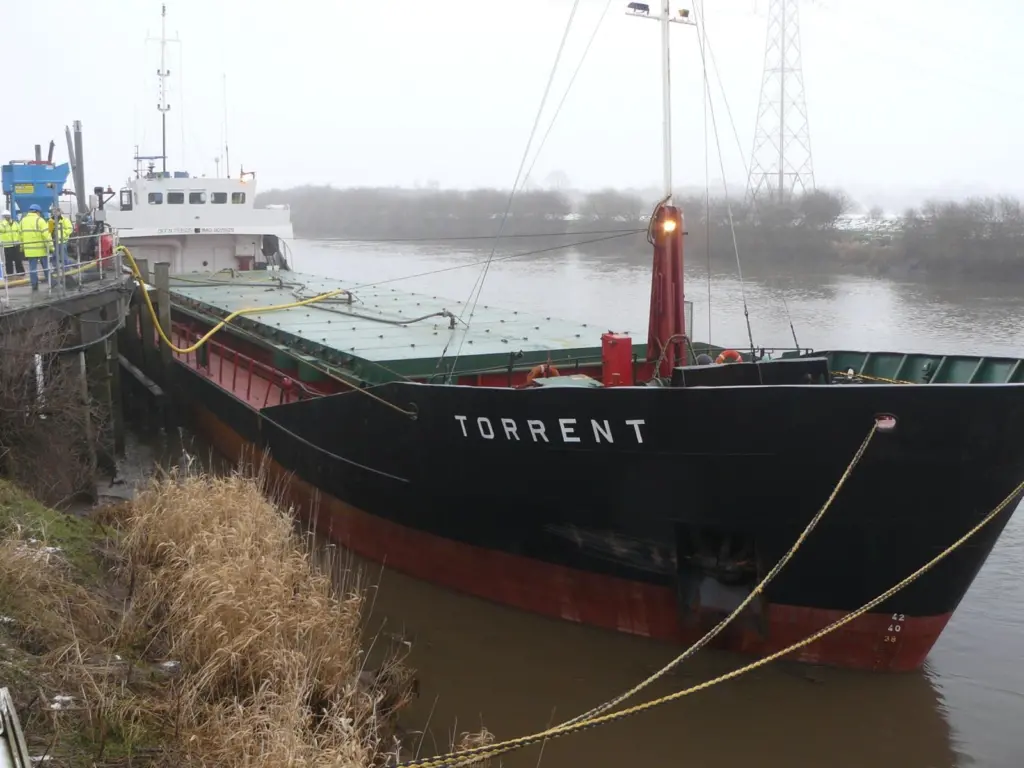
The cargo ship Torrent was loaded at Drax on the River Ouse, some 60 miles inland from the sea for delivery to Waterford. An alternative was to use 40 HGVs on the M62 across the Pennines to reach a western port before being loaded onto a ship for Ireland.
John Dodwell, chairman of the Commercial Boat Operator’s Association (CBOA) said, ‘With over 100 ports around the UK which can handle vessels like the Torrent, using ships from inland wharves provides additional scope for further shipments both from Drax and from other power stations in Yorkshire and the Trent Valley. They have a choice of as many as nine inland wharves and docks in the area at which ships can load PFA.
‘This is just what the Government wants. The use of water freight means less congestion and less carbon emissions. The waterways are underused transport arteries and there is considerable scope for more tonnages.’
Specialist bulk handling company T W Logistics Ltd worked in partnership with ash sales agent Hargreaves Coal Combustion Products Ltd to organise the water route.
PFA is a by-product from power stations. It can be used for a number of purposes including the manufacture of concrete and concrete products and building blocks, as well as for structural fill.
Transporting freight by water has the potential to cut fuel and labour costs, with just two men crewing one single 600 ton barge which is able to move the equivalent of twenty-four 25 tonne lorry loads.
Peter Emery, production director of Drax, commented, ‘Drax produces about 1.4m tons of PFA per year and has traditionally used road transport to take it away. Using the waterways to transport our PFA not only means that we utilise a lower carbon form of transport and reduce our movements by road.
‘But by reducing transportation costs we are able to look further afield and gain access to new markets. The more PFA we are able to sell the less goes to landfill, taking us closer towards our target of zero ash landfill.’
Stuart McKenzie, freight and harbour supervisor for British Waterways North East, which is the navigation authority for the River Ouse added, ‘We have been working closely with developers, freight operators and other partners to facilitate freight transport and explain the benefits of using the waterways for freight use. We see major opportunities to carry freight on our waterways and we will continue to be supportive of companies looking to explore these opportunities.’
The transfer of freight from road to water is encouraged by the Government’s grants schemes. Subject to certain criteria, companies can apply for grants for both operating and capital costs. They can be a key factor in the business decision to move freight by water and to provide waterside freight facilities. No grants were needed for the PFA traffic.