![MaritimeJournal[Seawork]](https://www.maritimejournal.com/wp-content/uploads/2026/09/MaritimeJournalSeawork.svg)





First of new series for heavy lift sector
The very first Beluga multipurpose project carrier of the latest generation proved its capabilities by transporting several large reactors during its recent maiden voyage.
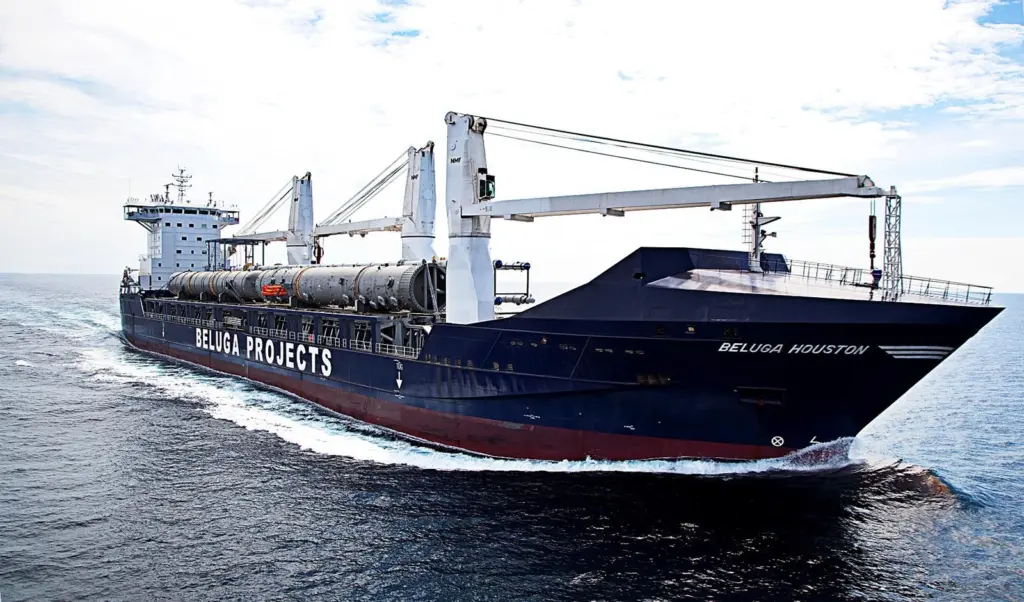
Shortly after delivery from the equipping shipyard in Shanghai, MV Beluga Houston headed for the port of Yokohama in Japan, where the specialised vessel loaded two reactors destined for Aratu in Brazil, each of them weighing 485 tons and measuring 21m in length. In the next port of loading, Pyeong Taek in South Korea, another three reactors measuring 70m in length and weighing 300 tons each were loaded. In the Chinese port of Mailiao a further two heavy lift modules completed the cargo, both weighing about 250 tons and measuring more than 40m long. The maiden voyage of MV Beluga Houston illustrates the sorts of transport projects which the P-type vessels will be capable of in the future.
MV Beluga Houston was delivered as first of 16 new ships for Beluga Shipping, with 800 to 1,400 tons crane capacities, a deadweight capacity of 20,000 tons and an ice classification of Finnish-Swedish 1 A (German E3), combined with a moderate fuel consumption. The cranes are not only quicker and stronger, they are also equipped with additional loading tackle for smaller cargoes.
This business sector involving heavy goods and project loadings with individual weights of between 500 and 1,400 tons, the so called super heavy lift segment, is stable and thus represents an expansion orientated, financially attractive sector. The worldwide demand for ships constructed for such shipping tasks is significant and it continues to grow. For these transport challenges, the industry is dependent on reliable logistics partners who are capable of providing the appropriate special ships. For this reason, naval architects, design engineers and shipbuilders have developed, together with the Fleet Management of Beluga, a freighter type which offers this very constituency of customers a package of all in one services.
The newly constructed vessels of the P-Class are also equipped for voyages through polar latitudes and can thus traverse the route of the Northeast Passage along the Siberian coast, which shortens the sea transit from Europe towards Asia by approximately one-third. As a result, not only daily expenses and fuel consumption costs are reduced, but an active contribution is made to improving environmental protection, given that the reduced usage of bunker causes the production of less climate damaging emissions.

Related Articles
 ACCESSORIES & EQUIPMENT
 OTHER NEWS
 ACCESSORIES & EQUIPMENT