![MaritimeJournal[Seawork]](https://www.maritimejournal.com/wp-content/uploads/2026/09/MaritimeJournalSeawork.svg)



New milestones reached in Maasvlakte project- by David Foxwell
Recent weeks have seen a number of important milestones in the Maasvlakte 2 project at the Port of Rotterdam. March saw construction start on the first deep-sea quay at the new facility, which is for the future Rotterdam World Gateway terminal, which will benefit from a water depth of 20m at the quay.
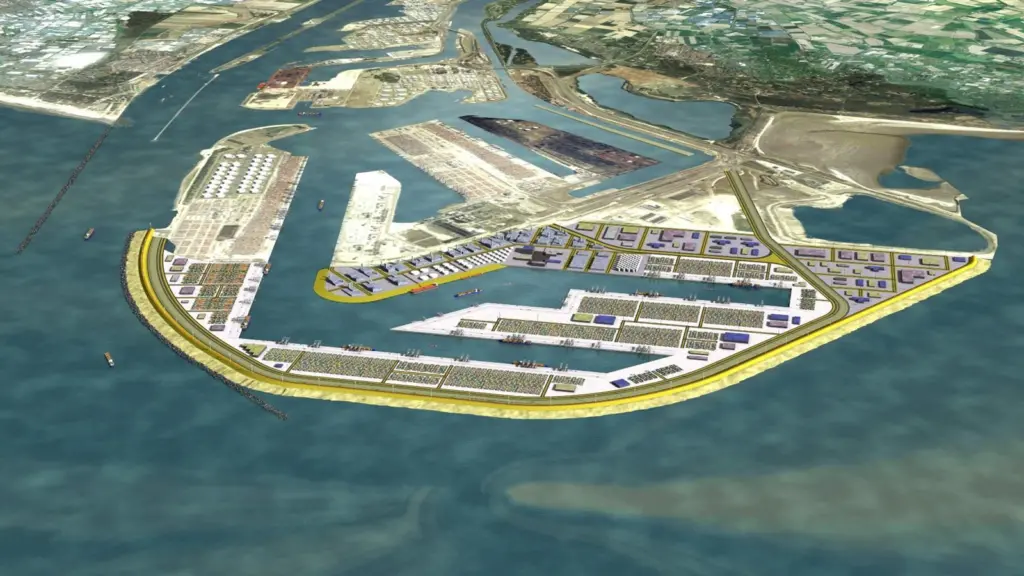
The quay itself will be 1,000m in length and will also be suitable also for use by inland vessels and feeders vessels. It will have its own rail terminal with a connection to the Betuwe Railway Line. The terminal, which is due to be operational in 2013, will have a capacity of about 4m TEU in the final phase. The quay walls for the deep-sea quays are made from 1.2m thick reinforced concrete poured to a depth of no less than 40m below the surface of the quay, a technique that was also used during the construction of the Euromax Terminal on the existing Maasvlakte facility.
Some 240 million cubic metres of sand is required for the construction of the first phase of Maasvlakte 2 and, as of the end of January 2010, 91.5 million cubic metres had been obtained. Of this sand, 86.5 million cubic metres was extracted from a borrow area in the North Sea, and 5 million cubic metres from the Yangtzehaven, the future entrance to Maasvlakte 2 which is currently being deepened and widened. At times, as many as 10 trailing suction hopper dredgers have been working on the site. An average of 2 to 3 million cubic metres of sand has been transferred every week since the project got underway.
Every two weeks, a Norwegian bulk carrier unloads 90,000 tonnes of rock for the Maasvlakte 2 project, which the contractor PUMA is using to build the new seawall. Approximately 5m tons of quarry stone will eventually end up in this seawall, as well as 2m tons of stone from the existing seawall, which will be recycled.
Related Articles
 OTHER NEWS
 OTHER NEWS
 FEATURES & VIDEOS