![MaritimeJournal[Seawork]](https://www.maritimejournal.com/wp-content/uploads/2026/09/MaritimeJournalSeawork.svg)






‘Bute’ ferry benefits from long shaft solution
Over the last 10 years, power transmissions specialists Centa Transmissions has been a leading innovator in the development of lightweight composite driveshafts.
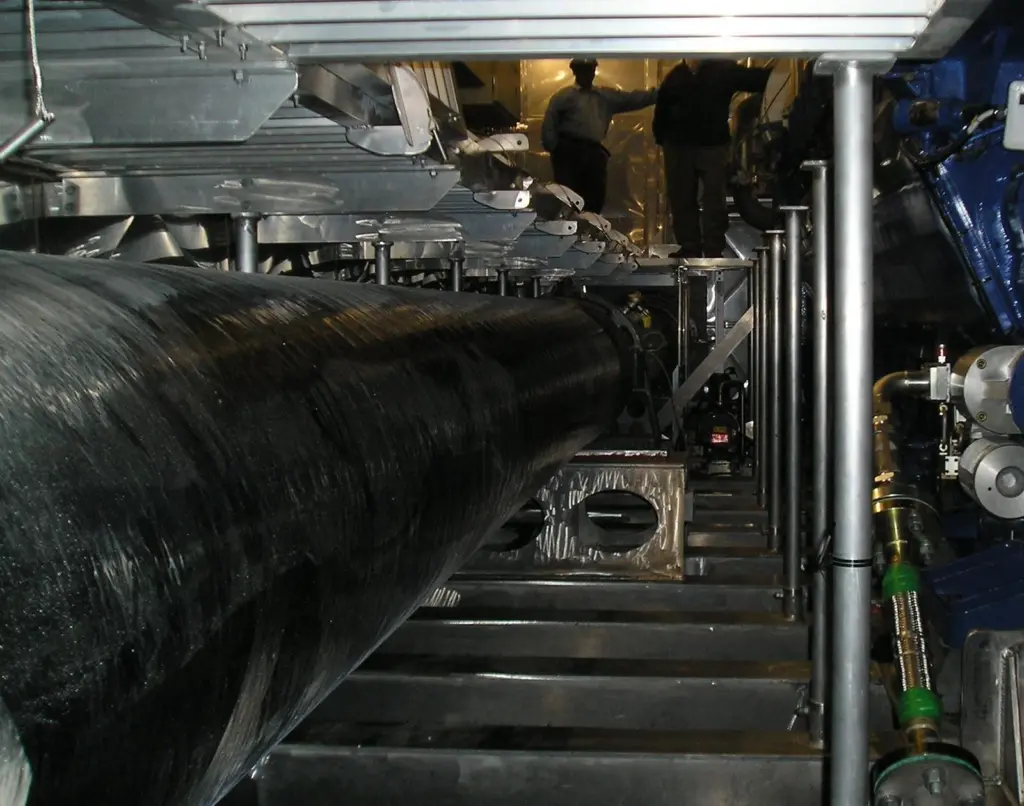
This has resulted in the creation of their versatile Centadisc-C coupling and composite/carbon fibre shaft that spans distances of 10m and more without the need for intermediate bearing support.
Very often, it is drive misalignment, coupled with non-aligned support bearings, which results in noise and excessive wear on the bearings. The solution created for Caledonian MacBrayne on their ferry Bute is a classic employment of Centa’s long shaft technology.
On Bute, where the single span of over 5m between bulkheads cannot be achieved with steel shafting, Centa used a carbon fibre shaft to extend from one bulkhead to the other. This meant there was no need for any pedestal bearings and the result is a lower cost, higher quality solution that eliminates a great deal of supporting steelwork.
Compatible with drives of all sizes, the benefits of carbon fibre shafts are high strength, the ability to span long distances without intermediate support and their light weight.
The Bute solution features the carbon fibre shaft coupled with Centa’s versatile Centalink couplings. This proven combination provides huge strength across the span and complete flexibility through the couplings situated at both ends of the shaft. The resulting flexibility facilitated by the couplings also overcomes large degrees of misalignment. A Centa spokesperson said, ‘The biggest problem in any shaftline are the pedestal bearings as they require a lot of maintenance, are expensive and time consuming to replace. It is therefore easier and far more cost efficient to eliminate them completely by specifying a very strong, high performance carbon fibre shaft like ours.’
Further benefits of carbon fibre are that shafts can run at higher speeds, are very low in weight, require minimal maintenance and provide a robust, torsionally stiff, corrosion resistant and sound absorbing answer to transmission vibration and noise. They can also bridge ever longer spans without the need for support along the length and are designed to compensate for axial, radial and angular misalignment.
Weight saving has been the foremost reason that short versions of the composite shaft are now in service in numerous civil and military RIBs, where lower weight means higher speed and where minimal maintenance and high reliability are mandatory.