![MaritimeJournal[Seawork]](https://www.maritimejournal.com/wp-content/uploads/2026/09/MaritimeJournalSeawork.svg)




Self propelled trencher for offshore wind farms
As the number of offshore wind turbines increases, so too does the need for cost effective and efficient installation solutions.
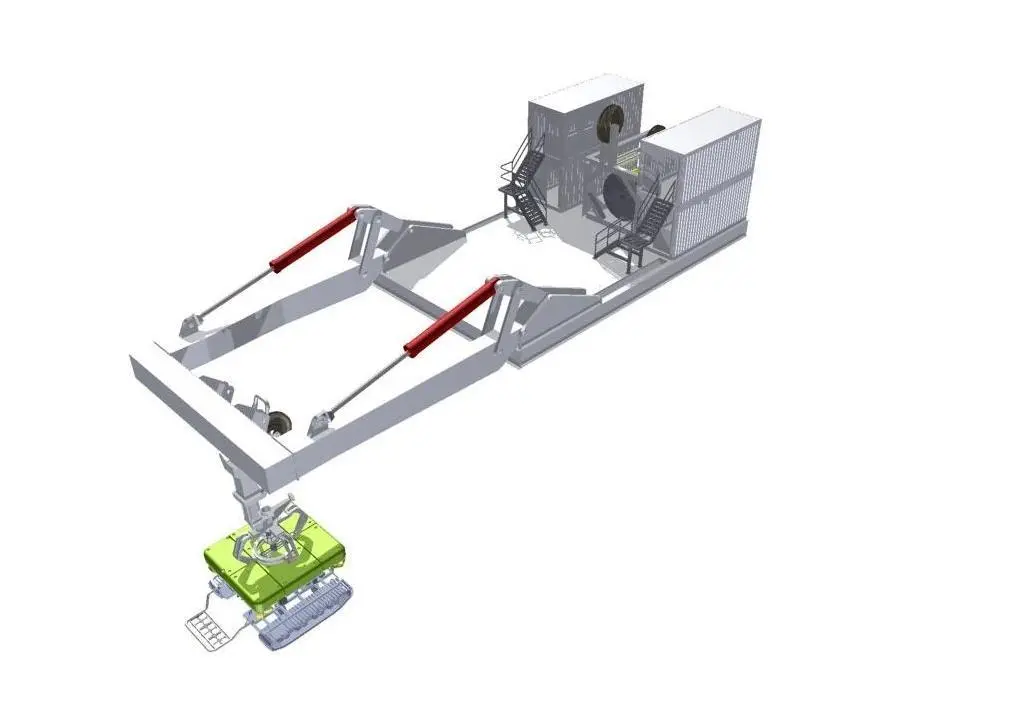
IHC Engineering Business (IHC EB), part of the IHC Merwede group, has developed a self-propelled trenching solution for the inter-array power cables used to connect turbines on offshore wind farms.
The spread has been designed specifically for this work and to maximise functional operability, speed of trenching and ease of mobilisation. For the first time IHC EB is intending making the trenching spread available for rental as well as for purchase.
Trenchers have very definite appeal to developers who would rather see them used than ploughs for inter-array work close to the turbines. As they are self propelled, there is no necessity for the cable lay vessel to come too close to the turbines.
‘The ITAT uses trenching and jetting techniques, for which we have partnered with Pharos Offshore Group Ltd on this development, said Robbie Blakeman, special projects manager at IHC EB. ‘The ITAT–HG, for use in harder soils than the ITAT, is based on our successful i-Trencher design, in effect a mini i-Trencher. We are therefore working with known technology to ensure a cost effective and efficient solution to a major challenge. Both the ITAT and ITAT-HG can be launched and recovered by means of a common launch and recovery system (EM-LARS), making mobilisation simpler and quicker, while also reducing the overall cost.’
The ITAT has been designed for a single lift mobilisation of the A-frame, winch and all necessary control and monitoring systems, on a common structural grillage. This grillage also serves to distribute loads into the vessel deck, removing the requirement for dedicated under-deck reinforcement.
The ITAT is seen as the ‘tool of choice’ due to the predominantly sandy soil conditions evident in the majority of wind farm sites. However, when survey data highlights the presence of harder clays or gravels which are not readily jettable, the ITAT-HG can be quickly deployed to mechanically trench the problem section. Through the use of a common umbilical and subsea pod with quick release mounts and a single control system, the two machines can be rapidly interchanged, launched and recovered, giving flexibility when working offshore where the reality may not be as predicted by survey data.
‘We will be manufacturing and supplying the ITAT as a fully integrated unit, continued Robbie Blakeman. ‘Both vehicles have a number of features built into them to reflect a dedicated use in inter-array work, such as low profile buoyancy for reduced susceptibility to cross currents and large tracks for operation in very soft soils. The ITAT and ITAT-HG have a common control and power system which ensures that deck space and costs can be kept at a minimum.’
Related Articles
 OFFSHORE RENEWABLES
 OFFSHORE RENEWABLES
 ENVIRONMENT