![MaritimeJournal[Seawork]](https://www.maritimejournal.com/wp-content/uploads/2026/09/MaritimeJournalSeawork.svg)



Likely LAD makes safe as vessel lists
Swedish maritime safety company CM Hammar has developed new technology whereby liferafts and EPIRBs can be released and float freely when a ship or vessel is listing.
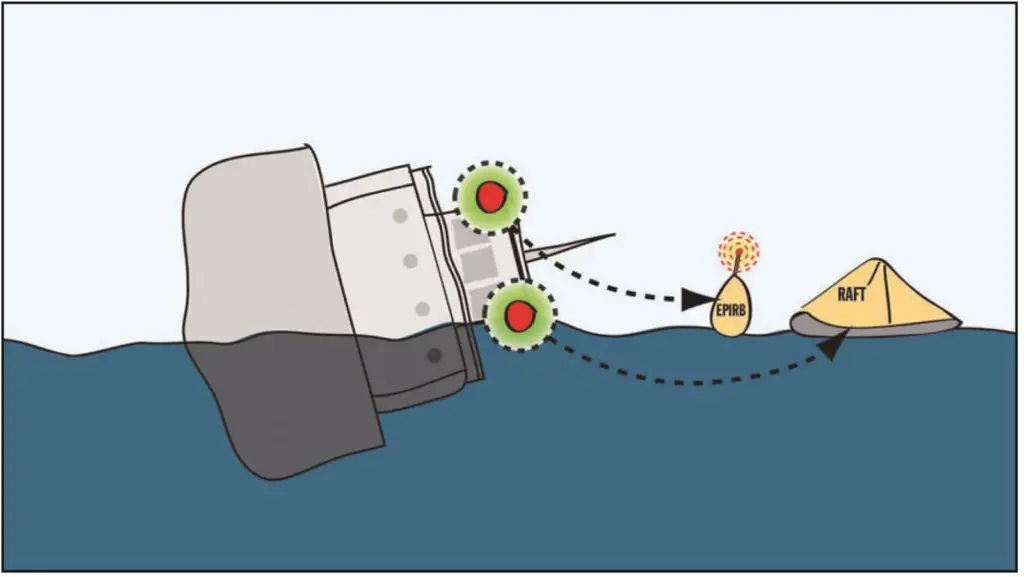
With current release systems on the market, safety equipment is released first when it reaches a depth of 1.5m to 4m. When a ship or a vessel capsizes without sinking, there is therefore a major risk that liferafts and EPIRBs are trapped under the craft, or never released at all.
With List Angle Detection (LAD), the new technology introduced by CM Hammar, liferafts and EPIRBs can be automatically released at a specified degree of list when a vessel capsizes. The released safety units reach the surface before the ship flips around, significantly reducing the risk of them being trapped or entangled in obstructions on deck.
The problem with safety equipment not being released or getting trapped under the vessel has a long history. It was most recently put under the spotlight after the tragic capsize of the anchor handling Norwegian ship Bourbon Dolphin in 2007, when eight people lost their lives. IMO Norway proposes amendments to the current resolutions, and demands ‘a release mechanism that operates immediately when the satellite EPIRB reaches the surface, instead of before reaching a depth of 4m in any orientation.’
‘We are excited about this new technology and how it can contribute to saving lives of seamen in distress all over the world. Norway requests a solution in the future, but as we see it the future is already here, said Henrik Pålsson, managing director at CM Hammar.
The LAD consists of a control box with two activating outputs for Hammar H20 ERUs. The control box has an integrated inclination sensor designed to release the ERUs automatically in case the vessel capsizes. The preset activation angle can be adjusted to suit different ships and vessels. There is also a pushbutton used for controlled manual activation. Output number two is activated automatically two seconds after output number one has been activated. The system has an integrated battery back-up and is built for the tough marine environment.
Related Articles
 ACCESSORIES & EQUIPMENT
 OTHER NEWS
 ACCESSORIES & EQUIPMENT