![MaritimeJournal[Seawork]](https://www.maritimejournal.com/wp-content/uploads/2026/09/MaritimeJournalSeawork.svg)






Bow conversions save money for HADAG
Hamburg ferry and excursion fleet operator HADAG is claiming fuel consumption savings of up to 9% as well as environmental benefits from fitting bulbous bows to some of the small ships in its fleet.
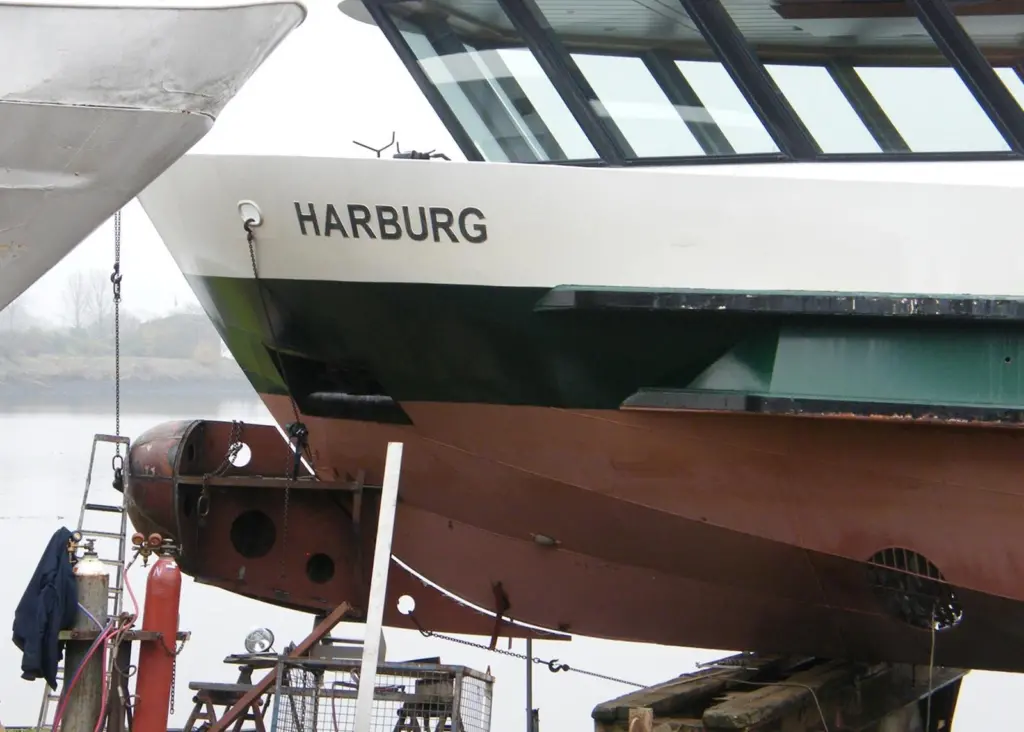
The owner has just fitted one Type 2000 ferry, the 29.8m long MS Harburg, with the new bow and said eleven other ships of the type will get the same treatment over about the next two years. The next ship to be converted will be the MS Wilhelmsburg.
The conversions follow extensive testing at the Schiffbauversuchsanstalt ship research centre (HSVA) in Hamburg, during which the new bow ‘exceeded even company and expert expectations’, according to Hadag.
Acting as a wave-breaker, the bow enables Harburg speeds of 11.4 knots to be maintained but at significantly reduced revolutions from its Volvo-Penta diesels, thus cutting fuel consumption, HADAG chairwoman Gabriele Müller-Remer told MJ. The decision to fit bulbous bows was also a long-term contribution to climate and resources protection and would reduce CO2 emissions by 100 tons per ship per year, she said.
The bulbous bow on Harburg consists of 51 individual parts and was assembled and mounted at Hadag’s ‘house’ shipyard SSB Spezialschiffbau in Oortkaten on the Elbe near Hamburg, where the Type 2000 ferries were built. The bow is made of 15mm steel, which is nearly twice as thick as normal hull plating and weighs about 1.7 tons.
Hadag said the first bow and installation cost about €18,000, which indicated an overall investment for the twelve ships of some €216,000. Hadag technical director Manfred Tiews was quoted as saying the cost of testing at the HSVA would have cost around €10,000 alone, had there not been a Type 2000 test model available at the centre.
Once all twelve ships have been converted, Hadag reportedly reckons with diesel fuel savings of €10,000 per ship per year, which would mean that the investment can be recouped in about two years.
By Tom Todd