![MaritimeJournal[Seawork]](https://www.maritimejournal.com/wp-content/uploads/2026/09/MaritimeJournalSeawork.svg)




Tandem lift twirls marine construction barge
In a remarkable tandem lift operation carried out by its onboard cranes, the MV Beluga Stavanger loaded a huge barge in Germany destined for a port construction project in Odessa.
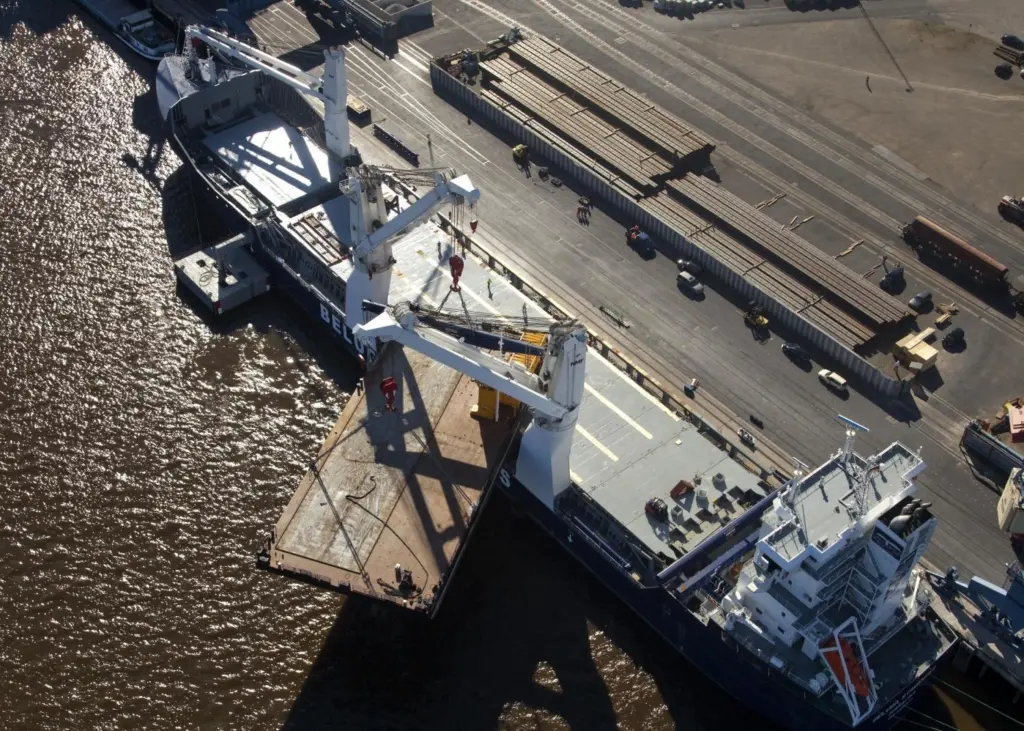
This construction barge, Kurt, is able to dig, pile, vibrate and swim but loading it onto the Beluga Stavanger meant it also had to learn how to fly. Unfortunately, with its 50m length, 22m beam and weighing in at almost 1,000 tons, the marine construction unit is anything but a lightweight.
The crew of the multipurpose heavy lift carrier, one of the new P-class ships from Beluga Shipping, was aware from the start that the operation was going to be one of the most interesting capability tests to date for its loading gear.
Although the pair of onboard cranes, each designed with 700 tons of capacity, could lift 1,400 tons in tandem, this particular operation meant the cranes were working almost to their full outreach, creating huge leverage.
Experts mingled with interested onlookers on the waterfront to watch the remarkable procedure in the German Port of Brake.
Preparatory work including the fitting of specially designed attachments which had to take place prior to the operation as the vessel was not designed for loading. Before lifting the bulky platform on board, some of Kurt´s superstructure had to be removed. Then, in tandem, both cranes slowly lifted the bulky freight centimetre by centimetre out of the river Weser. As the cranes took the weight, the Beluga Stavanger only heeled slightly. The pumps of its very powerful ballast water system secured the stability of the 20,000 dwt vessel.
Kurt was now hanging on the cranes, with a heavy duty (1 ton) traverse keeping the steel ropes apart and stopping them squeezing the cab of the platform. The shackles used on the vessel were also heavy duty, some having a weight of 600kg. The extra equipment together weighed some 30 tons.
However, the biggest issue surrounding this lift was not Kurt´s weight, it was the barge’s enormous dimensions. Having got the construction unit airborne, the real challenge of the operation had begun. The load now had to be turned in a wide arc across to the two crane-frames. During this entire time the beam of one crane had to be extended to some 26m while still continuing to hold half of the entire weight of the platform.
The shipping company´s own engineering experts had made meticulous calculations on the movements and forces taking place during the operation but now theory had to be converted into practice.
Slowly and precisely the operators passed Kurt like a gigantic flying tray through the space between their crane frames. Four hours after takeoff, Kurt was finally standing on board Beluga Stavanger.
Since Kurt was contracted to enlarge a quay wall in the Ukraine, several thousand tons of steel was also travelling in the hold of the Beluga Stavanger, stowed prior to the loading of the construction platform.
Eleven days later the vessel punctually berthed in Odessa. After the trip of 4,000 sea miles the onboard cranes of the heavy-lift freighter set the platform down. Utilising the ship’s cranes for support, Kurt´s superstructure was remounted.

Related Articles
 ACCESSORIES & EQUIPMENT
 OTHER NEWS
 ACCESSORIES & EQUIPMENT