![MaritimeJournal[Seawork]](https://www.maritimejournal.com/wp-content/uploads/2026/09/MaritimeJournalSeawork.svg)


Rotterdam prepares for LNG imports
Work is nearing completion on the Netherlands first LNG import terminal at Rotterdam in a project involving previously reclaimed land being given back to the sea.
Once commissioned the €800m Gate LNG terminal (Gas Access to Europe) will have a potential annual throughput of 16bn cu/m of LNG, equivalent to the natural gas requirements of all 7m homes in the Netherlands.
Gate Terminal BV was formed in 2005 by NV Nederlandse Gasunie and Koninklijke Vopak NV to establish an LNG import terminal at Maasvlakte in Rotterdam. The construction contract was awarded to a consortium from across Europe comprising the Italian Techint Group, Spanish company Sener Ingenieŕia y Sistemas SA, and the two French companies ENTREPOSE Contracting and Vinci Construction.
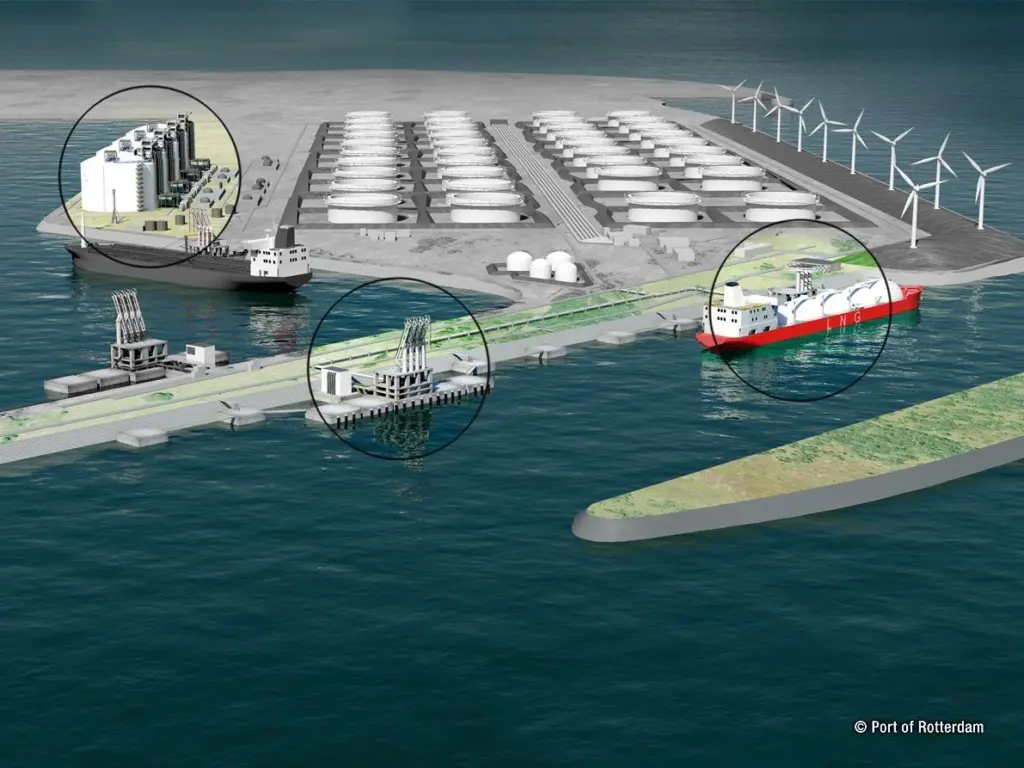
The terminal comprises two main elements; the gas storage and processing area built on an 800m by 270m area of reclaimed land south of the Maasvlakte Olie Terminal and the access channel and two loading jetties, which involved the transformation of the topography of an area of reclaimed land at the north eastern extremity of Maasvlakte.
Due consideration was given to navigation and berthing at this busy area of the port of Rotterdam, set to become even busier with the Maasvlakte 2 development. Requirements included locating the terminal away from residential areas and close to the sea for ease of access at a sufficiently sheltered location, taking existing shipping movements into consideration.
Two berths were specified, capable of handling current and future generation LNG carriers to Qatar Max size up to 350m length and 12.5m draught. These were to be located at Papegaaiebek, an area of land around 1km long and half a kilometre wide bordering the Beerkanaal access channel to the Maasvlakte harbour complex.
The plan involved removing part of the peninsular, returning the area to the sea. A small ‘offshore’ island has been retained, providing protection to what will become a channel with the berths on the newly formed eastern extremity of the mainland. LNG carriers will consequently enter without passing existing harbours and involve relatively simple berthing manoeuvres, thereafter sheltered from other shipping activity.
Papendrecht based Royal Boskalis Westminster BV was contracted by Rotterdam Port Authority for phase one of the dredging work, with a combination of Boskalis and Rotterdam based Van Oord Dredging and Marine Contractors responsible for phase two. Initially diggers formed a basin by excavating sand which was removed by inland barges. Soil protection work to the bank of the newly formed mainland comprised filter cloth with rock protection. Sand was retained where the jetties were to be located, allowing for construction on a solid platform later to be removed. Each jetty comprises a 36m by 26m platform for the loading arms supported by 45 piles driven 35m into the ground. Access bridges are supported by 12 angled piles.
The basin was then flooded to sea level, allowing the removal of land connecting the south end of the mainland with what was to become the south end of the island, allowing a cutter suction dredger to remove the deeper salt layers to the required depth. Between 6 and 7m cu/m of material were removed in the sand removal and dredging operation. Finally, the northernmost connection between the island and the mainland will be removed.
Jetty equipment includes loading arms from Germany’s SVT GmbH, 20 Viking Hook stations and sensors from Aarhus based MARIMATECH AS, gangway equipment from Aalsmeer based Verhoef Gangways, and fendering from Spanish company Prosertek.
Two 36” diameter pipelines will transfer LNG to the terminal using the ship’s own cargo pumps. During discharge, LNG gathers heat generating boil off gas which has to be recovered rather than released to atmosphere and following compression and conversion back to liquid, pumps return the gas to the ship via a third smaller pipeline. This also avoids a vacuum being created in the ship’s cargo tanks during discharge.
At the heart of the terminal area are the three storage tanks. With a diameter of 86m and a height of 55m, each tank has a usable capacity of 180,000 cu/m of LNG stored while still in liquid form. Designed to meet high safety standards, the tanks comprise a steel inner and concrete outer tank. The outer tank was constructed first followed by the roof then the inner, liquid gas containment tank, comprising 210 steel plates (for each tank) transferred to the interior through an opening in the outer concrete wall. Three layers of insulation are included in the base, comprising a light but strong foam glass material and an electric heating system to prevent the base freezing.
The integrity of each tank was confirmed through weld testing and by pumping in water to test the foundations. The density of water is twice that of LNG so it was only necessary to fill each tank to a depth of 20m, equal to 125% of the final loading when in service.
The dome shaped roofs comprise a steel plate on framework structure and, once installed, additional layers of reinforced concrete and environmental protection were added to the exterior to a thickness of between 500mm at the centre of the dome and 1m at the edge.
An interesting technique was employed to install the tank roofs. The basic structure was constructed within the perimeter of the outer tank wall. Seven powerful booster pumps then required just three to four hours to air-lift the 650 ton structure to the top of the tank where it was secured to the concrete wall.
The remainder of the terminal process area includes the regasification plant to convert the gas from its -161°C liquid form to the 0°C gaseous state before entering the transmission pipeline network via the gas analysis and metering area. The regasification plant contains 12 open rack vaporisers imported from Japan. LNG from the storage tanks passes through a network of thin pipes over which warm water is cascaded to gradually heat the liquid within. This process also expands the gas to 600 times its volume in the liquid form.
The warm water is sourced from the nearby E.ON Maasvlakte power station. At 7°C this water is slightly warmer than that available within the port and sufficient for the regasification process. It is transferred to the terminal via two 3.5km long, 1.8m diameter GRP pipelines imported from Italy in 12m sections.
Open tunnelling, use of a boring machine and directional drilling were employed to install the pipelines along with plastic conduit pipes and electrical cables following a route which including running beneath the Yangtzehaven. The pipelines were buried at various depths taking into consideration services routed to existing occupants in the area and including an allowance for any future dredging within the port. Eight electrically driven centrifugal pumps capable of delivering 60,000 cu/m of warm water per hour to the terminal were installed at the water basin at the E.ON site, with just three months required by the boring machine to complete the link.
Provision of towage services will be the responsibility of the terminal’s customers and are yet to be decided, with commercial cargo operations due to commence in September 2011.
DONG Energy (co-owner of the terminal) has 3bn cu/m of the annual capacity of the terminal at its disposal and early in 2010 announced a ten year commercial agreement whereby the Spanish energy company IBERDROLA will supply 1bn cu/m of natural gas a year to DONG Energy commencing in 2011.
Late in 2010 Rotterdam based energy company Eneco announced the signing of a multi-year agreement with Gate terminal for the throughput of a further 1bn cu/m of LNG, also commencing in September 2011. The LNG will be imported by Eneco and then onto their own end users, customers and power stations.
By Peter Barker