![MaritimeJournal[Seawork]](https://www.maritimejournal.com/wp-content/uploads/2026/09/MaritimeJournalSeawork.svg)


The human touch for maritime simulators
Kongsberg Maritimes simulation division and Norway’s Vestfold University College have signed a framework agreement to further explore projects of joint interest for research and development of maritime simulators.
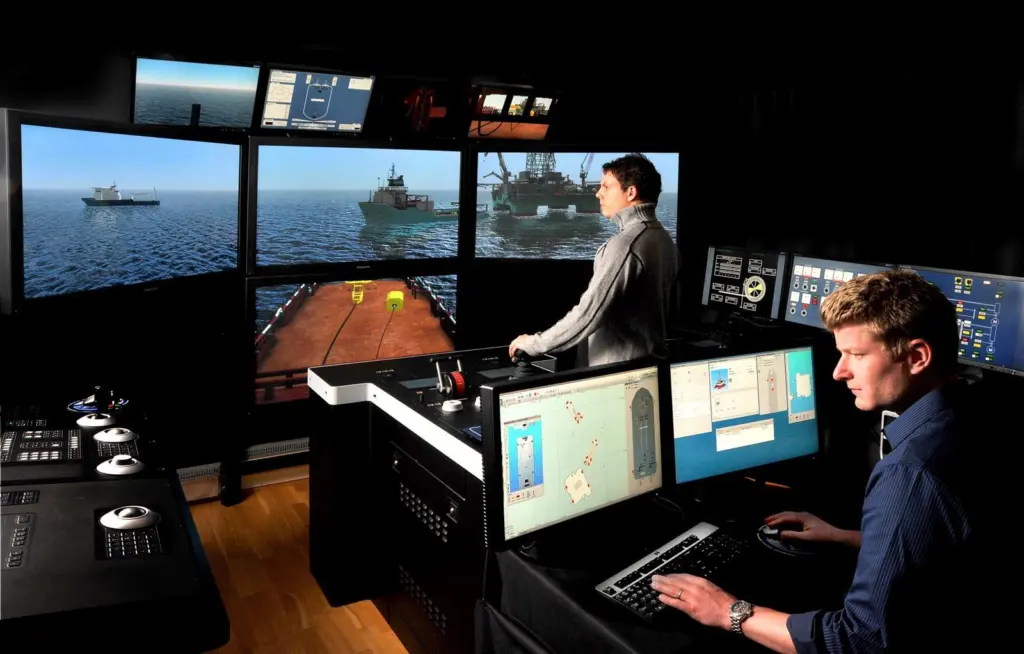
The agreement comprises extensive R&D project plans and the use of an Interactive Simulator Laboratory (SIMSAM lab) at Vestfold University College, which will serve as an R&D facility.
The agreement will include several R&D projects involving maritime simulators in different aspects. The ongoing project, called Simulation of Demanding Maritime Operations (SIMAR), with the aim of improving simulation training by enhancing the focus on human factors, is the first project to be established.
Both Kongsberg Maritime and Vestfold University College are major players in the SIMARproject, in addition to the University in Oslo and Chalmers University of Technology in Sweden. Other R&D projects under consideration are communication and team training for best practice in maritime simulation and environmental/fuel efficient surveys for Green Ship training.
Kongsberg Maritime will deliver an Offshore Vessel Simulator configured as a navigation bridge, which will be used as a test facility for the R&D projects at Vestfold University College. This simulator will be one of the major components in the planned SIMSAM laboratory, which will also be equipped with additional functions to facilitate various interaction scenarios to stimulate innovation. The SIMSAM lab will be a part of the University’s new Oslofjord Research and Innovation Park and a focus area for the entire maritime cluster in the Oslofjord area south of Norway.
The new University Park will also be equipped with a Seismic Vessel Simulator, which will be developed and delivered by Kongsberg Maritime. Norway based company Petroleum Geo-Services (PGS) will be the exclusive owner of this module, which will serve as a training facility for the company, while the University will host it and contribute pedagogical services.
‘Kongsberg Maritime see many interesting areas where the need for research is evident and where focused R&D at the University could become fields of shared interest. Examples are interactive innovation process, Man-Machine Interface (MMI), Human Factors, user interface design, information ergonomics/graphics and new communication technology. The cooperation between the University, PGS and us is considered as a win-win situation for all’, said Terje Heierstad, product and technology manager at Kongsberg Maritime, Simulation & Training.
There will also be an opportunity to connect the different simulators at the University’s Research, Innovation and Industry Center, for team training and extended R&D projects.
Related Articles
 ACCESSORIES & EQUIPMENT
 OTHER NEWS
 ACCESSORIES & EQUIPMENT