

Intelligent USVs could cut loose from signals
A research project aiming at the eventual installation of intelligent navigation in remotely controlled craft has begun.
Academics are now looking for a new form of navigation system that will enable unmanned waterborne vehicles to operate in areas without satellite coverage.
This ability to allow military and civilian craft, commonly known as Unmanned Surface Vehicles (USVs), to ‘think for themselves’ will allow them to manoeuvre even when the radio signals are being blocked. This blocking can happen either simply because the surrounding terrain gets in the way or, more sinisterly, because the signal is being deliberately interrupted by jamming equipment.
The three and a half year project, funded by a £350,000 grant from the Engineering and Physical Science Council, is being led by the University of Plymouth in conjunction with Atlantic Inertial Systems Ltd, which is part of the Goodrich Corporation.
Professor Bob Sutton, of the School of Marine Science and Engineering, along with Dr Sanjay Sharma, will be working on the design of an intelligent adaptive autopilot system. He said, ‘This is a very exciting project as the developed techniques will allow USVs to operate in truly autonomous modes in unstructured environments and, hence, further enhance their operational capabilities. This is also a good example of how universities and businesses can combine their resources to create solutions to real world problems.’
Remote controlled USVs are commonly used by the military in danger zones or on surveillance missions. They also play a key role in hydrographic survey work, especially in conditions where it would be dangerous for people to operate. But in confined areas, such as in mountainous regions, or close to canyons, the GPS technology can break down, as satellite signals suffer interference.
Professor Sutton’s colleague Dr Culverhouse, of the School of Computing and Mathematics, will be responsible for the design of a navigation subsystem based on visual simultaneous localisation and mapping techniques.
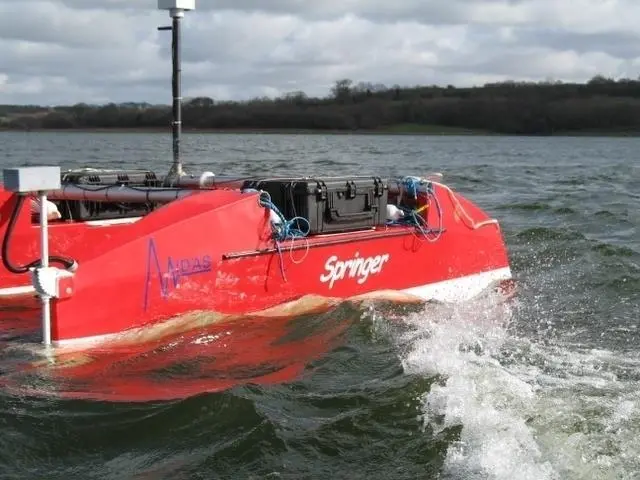
The combined approach will result in a new advanced intelligent system which will be tested and trialled in the University’s Springer USV vehicle at Roadford Reservoir in the Tamar Valley, and in the Plymouth Sound.
‘The need for complete autonomous capability is becoming more necessary, particularly when undertaking covert missions in littoral waters or restricted waterways’, concluded Professor Sutton.