


Scot MSPs oppose coastguard plans
Liberal Democrat Northern Isles MSPs, Tavish Scott and Liam McArthur, have jointly responded to the UK Government’s consultation on the future of the Coastguard service.
In it they set out the case for the retention of three full time coastguard stations in Scotland, in Lerwick, Stornoway and Aberdeen.
Noting that Scotland has over half of the UK’s coastline they argue that ‘Local knowledge of this long and complex coastline is of vital importance if the coastguards are to be able to respond quickly when an emergency arises. It is not just the knowledge of the geography of the area that is vital, the coastguards also need to understand local pronunciations, be knowledgeable of the marine operations in their area and be familiar with the tides and sea states in different weather conditions.’
They challenge the MSA proposal that the local knowledge can be provided by the network of local volunteer coastguards and the search and rescue bodies. The written submission states, ‘An officer taking a message from a mariner in distress cannot ask him to wait until they have located a local volunteer to seek his advice, or have contacted the local lifeboat crew.’
Arguing that the previous closure of the Coastguard stations in Kirkwall and Oban left officers in Lerwick and Stornoway already covering a larger area than is ideal, they wrote, ‘Officers in a single Scottish full time station, backed up during the day time by one other station, could not possibly have anything like the degree of local knowledge of Scotland’s coastline and waters which they need to be able to deal quickly and effectively with an emergency incident.’
Tavish Scott and Liam McArthur then argued that growth in the offshore oil industry in the North Atlantic and the development of the marine renewable energy industry, the movement of the aquaculture industry into deeper more exposed water, and the growth of leisure shipping all combined to add to the coastguard’s workload.
They also warned against depending on good communication links to allow all of Scotland’s seas to be monitored from Aberdeen, referring to the many times in 2009 and 2010 when the communication connections between the Lerwick station and the Scottish mainland failed. They wrote, ‘The links tend to fail during periods of poor weather, when transport and other logistical problems can delay their repair. But it is precisely during such periods when the coastguard’s service is of greatest importance.’
Tavish Scott and Liam McArthur then stressed the vital importance of the clean environment of the Northern and Western Isles to their economies, writing, ‘The islands are placed on busy shipping lanes used by very large vessels carrying hazardous and potentially environmentally destructive cargoes.’
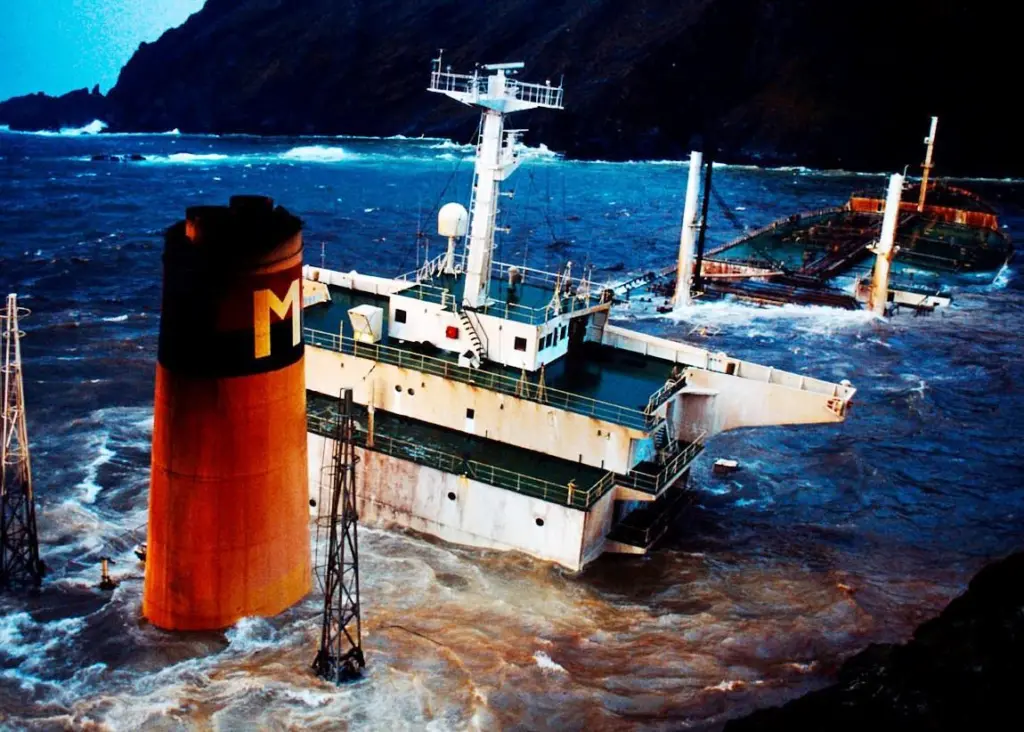
Arguing that, the wrecking of the Braer hit Shetland’s seafood and tourist industries hard, despite the unusually prolonged period of storm force winds which dispersed the light crude oil spilled, they wrote that the incident demonstrated the vulnerability of the islands’ coastlines to accidents involving hazardous cargoes and the need for speedy and effective responses to threats.
‘That is why it is vital that the emergency tugs are maintained in the Northern and Western Isles, as recommended in the Donaldson Report, and why locally based coastguards must remain in place with the local knowledge and ability to react quickly to an emergency.’
Summarising their case, Tavish Scott and Liam McArthur wrote, ‘We totally reject the irresponsible proposal to leave Scotland with only two coastguard stations during the day, and only one during the night, when the challenges they could face can be greater than such a reduced service could safely cover. We believe that if an acceptable and safe service is to be provided it needs, as a minimum, the retention of full time stations in Lerwick, Stornoway and Aberdeen.’
Related Articles
 MARINE CONSTRUCTION
 POWER & PROPULSION
 ENVIRONMENT