![MaritimeJournal[Seawork]](https://www.maritimejournal.com/wp-content/uploads/2026/09/MaritimeJournalSeawork.svg)


Hybrid electric research ship conversion
BMT Fleet Technology, of Ottawa, Ontario is collaborating with the University of Victoria to design and deliver North America’s first ever hybrid electric research ship.
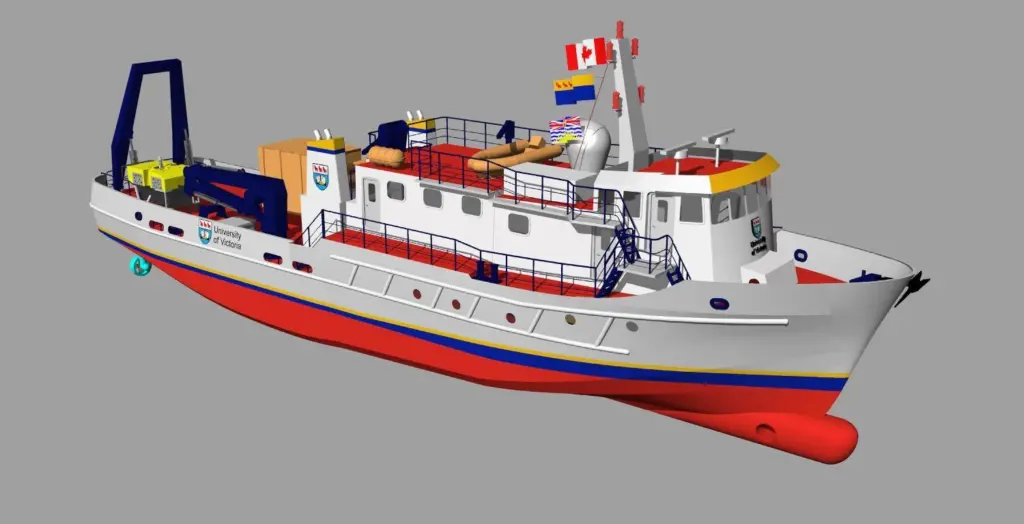
The vessel, formerly known as CCG Tsekoa II, will be used by the University as a research facility off the British Columbia (BC) coast to investigate changing coastal ecosystems, marine resources and continental shelf and slope dynamics.
Funding in excess of $10m has been provided by the Canada Foundation for Innovation, the BC Knowledge Development Fund and other partners, including industry.
Kim Juniper, lead scientist on the project said, ‘As a national and international leader in the study of the oceans we are always looking to enhance our research capabilities. With the help of BMT Fleet Technology and its marine engineering expertise, this ship will enable us to perform acoustically sensitive studies in the ocean and on marine mammals, without the thundering noise of diesel engines.’
The vessel, which is currently 26.7m long and 7.25m wide will be cut in half and a new section will be inserted at mid-ship in order to bring the total length to 33m. The new section will include a science lab and additional berths to accommodate 15 crew and scientists.
David Stocks, vice president Pacific Region for BMT Fleet Technology said, ‘We are very proud to be working alongside the University helping to deliver a ship which is not only fit for purpose, but also environmentally friendly. Through the application of green technology a reduction in carbon emissions will be achieved, as well as an enhancement in the ship’s fuel efficiency.’
BMT Fleet Technology will align the new ship design with the University’s requirements, equipping the vessel with a hybrid-electric propulsion system powered by batteries, fuel cells and low emission diesel generators.
This project aligns with the pioneering work being undertaken by BMT Group Ltd, investigating nuclear propulsion and the commercial maritime applications for small modular reactors. This research is being carried out through a newly formed consortium which also includes Lloyd’s Register, Enterprises Shipping and Trading and Hyperion Power Generation.