


Floating boxport plan for Scapa Flow
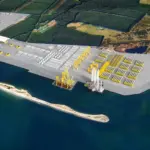
An innovative plan for a floating container port that could be located at Scapa Flow in the Orkney Islands could bring enormous benefits to Scotland’s economy.
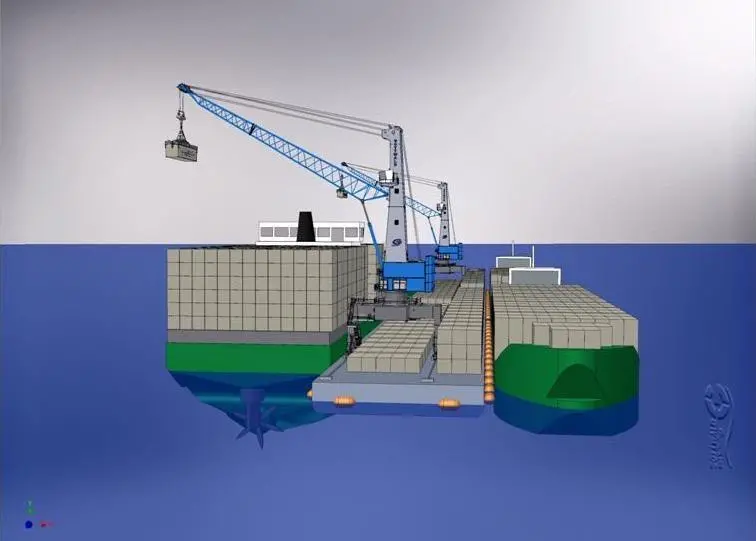
Project leader, Professor Alf Baird of Edinburgh Napier University’s Transport Research Institute, told Maritime Journal, ‘We have estimated a single 4,000 to 4,500 teu vessel with four slewing cranes would give the equivalent of about 700,000 teu per annum capacity maximum, and would easily be able to handle around half a million teu.’
One of the benefits of using a Floating Container Storage & Transhipment Terminal (FCSTT) is that it could rehabilitate an existing containership, which could take place without massive costs or vast amounts of steelwork. One approach would be to get rid of the hatches, which would no longer be needed, then raise the cell guides where the containers are slotted in.
The university’s involvement in the EU funded StratMoS project took place in collaboration with German crane manufacturer, Gottwald Port Technology, which has already developed ‘floating cranes’ for use in Indonesia and on the Mississippi River, where barge mounted cranes are used to give a port or terminal more operational flexibility.
The FCSTT’s projected cranes would be similar to the Gottwald GHPK8200B model, which would allow 50 tons of lift at a 43m outreach. Although fixed pedestal cranes could be fitted, Prof Baird explained that they have a limitation in that the reach tends to be restricted when the crane is at an angle. However, fitting rail mounted cranes overcomes the limitation.
The design would be approved for working in 2m to 2.5m significant wave height, which means that it is suited for places where there are stable waters such as the Scapa Flow, which has around 50 square miles of deep water anchorage.
However, the design has applications worldwide as it avoids the issues of shallow draft found close to shore that hinders the development of many Asian ports. Prof Baird explained, ‘We have done an analysis with two cranes, which though giving a more limited capacity of around 350,000 teu, would still be useful as smaller regional terminals.’
FCSTT facilities would also be able to move around, and may well prove useful in emergency situations where port infrastructure has been badly damaged but there is enormous pressure to get aid into the region.
The FCSTT could also become the ‘ultimate green port’ due in part to its proximity to Orkney’s burgeoning marine renewable energy sector, said Prof Baird.
Its green credential may well be a selling point. ‘It would have virtually zero impact on the landside, lead to major reductions in deep-sea and feeder ship CO2 emissions due to the shorter vessel sailing distances, and make use of renewable energy to power the container cranes.’
A working FCSTT may already be on the horizon, as Prof Baird says there are a few parties that are presently ‘in negotiations’ for a demonstration platform, which could perhaps be part EU and Scottish government funded.
Related Articles
 MARINE CONSTRUCTION
 POWER & PROPULSION
 ENVIRONMENT