![MaritimeJournal[Seawork]](https://www.maritimejournal.com/wp-content/uploads/2026/09/MaritimeJournalSeawork.svg)



Spanish equipment for Taiwan research vessel
Spanish companies Ibercisa, working together with Industrias FERRI, are supplying deck equipment and oceanographic winches for a new Taiwanese research vessel.
The Taiwan Ocean Research Institute’s (TORI) new 2,700 ton multi-purpose Oceanographic Research Vessel (ORV) will be called Research V. It is being constructed by the Jong Shyn Shipbuilding Group in Kaohsiung and will be delivered next year.
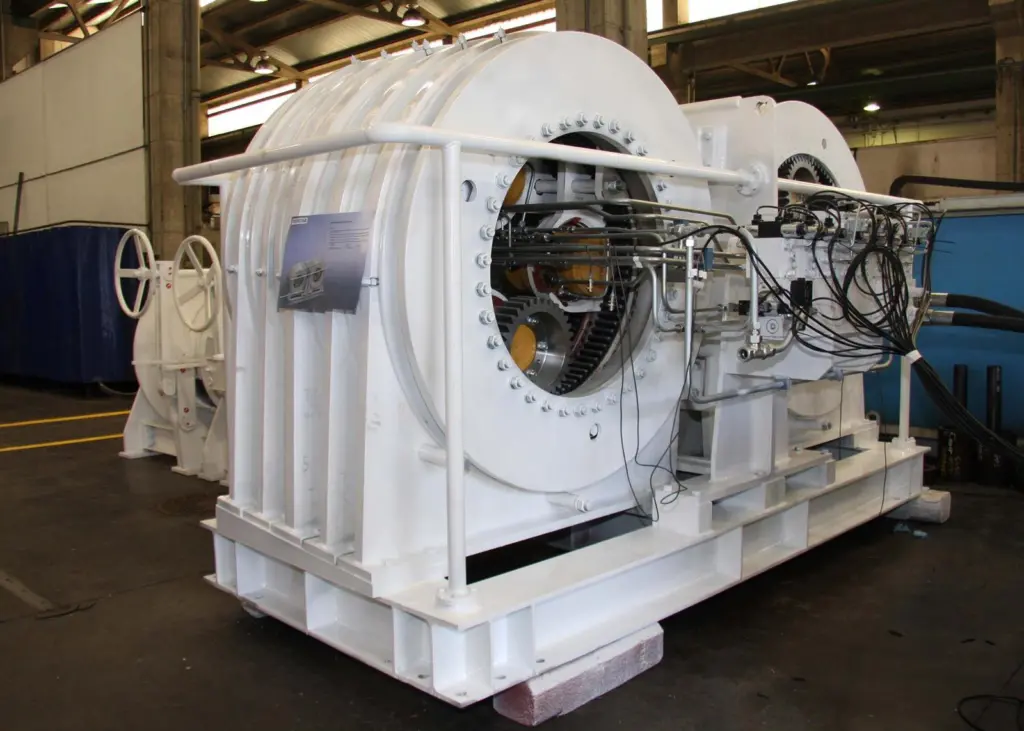
The vessel’s oceanographic winches, designed and manufactured by Ibercisa, include one deep sea winch which will accommodate 8,500m of fiber Technora cable that works in constant tension with a traction unit. The traction unit was designed to work with individual driven sheaves that are controlled by eight motors. They are controlled automatically, changing the sheaves’ speed according to the enlargement produced during the cable loading.
This fiber cable will work with the aft A-frame supplied by FERRI. The Arm Telescopic Frame from FERRI, with 15 ton working capacity and 6.5m displacement, will work with the CTD winch, with a capacity for 8,000m of Ø17mm electromechanical cable from Rochester. It has a maximum speed of 100 m/min and 16 tons pull.
The oceanographic winches were supplied from the Ibercisa factory with the cables already spooled with tension, in order to avoid any damage and for an easy vessel installation. The total package includes windlasses, capstans, fairlead and the supply of the power packs to drive the cranes and the winches.
The Spanish companies were selected above others due to their experience on other oceanographic vessels such as Sarmiento de Gamboa and Miguel Oliver.
The new ORV will contribute to Taiwan’s ocean exploration and research capabilities. New owner TORI focuses on sustainable ocean science and technology development. The operation of the new research vessel will substantially raise marine research and exploration capability and also cultivate talented marine researchers, aiming to set a new standard for ocean science in the Pacific region.
Related Articles
 ACCESSORIES & EQUIPMENT
 OTHER NEWS
 ACCESSORIES & EQUIPMENT