

Fast boats picking up good vibrations
The work of STResearch (STR) has been influential in the development of recent major projects by the US Coast Guard and Customs & Border Protection.
The UK specialist in the incorporation of human factors and ergonomics in the design and operation of high speed craft was founded four years ago by Dr Trevor Dobbins. It helps clients to develop and assess craft, looking at factors including ergonomics, fatigue and shock mitigation during high speed operations. Clients include the UK Ministry of Defence (MoD), the Maritime & Coastguard Agency, the US Navy’s Naval Surface Warfare Centre and Office of Naval Research, the Royal National Lifeboat Institution, the Maritime Accident Investigation Branch, and QinetiQ.
The US Coast Guard, currently procuring its Over the Horizon cutter, and the US Customs & Border Protection, which is buying its Coastal Interceptor Vessel, both used an internationally recognised design guide principally authored by STR. These craft will be used in harsh sea conditions for patrol, special operations, port security support and to pursue suspect vessels.
Dr Dobbins is the main author of the ‘High Speed Craft Human Factors Engineering Design Guide’, which assists in the design of high speed craft, particularly in relation to the shock and vibration that crew and passengers are exposed to. This has been instrumental in helping organisations with their boat design requirements and review procedures, especially in light of the 2006 EU legislation reducing the levels of vibration that employees can be exposed to.
“Over the years, there has been an increasing demand for marine craft to operate at faster speeds, said Dr Dobbins. “When operating high speed craft in poor sea conditions, there is an increase in the shock and vibration for crew, passengers and the craft, too. For passengers, this can result in an uncomfortable voyage, reduced physical, cognitive and psychomotor performance, and the risk of acute and chronic musculoskeletal injuries. There is also a risk of damage to the boat and its equipment.”
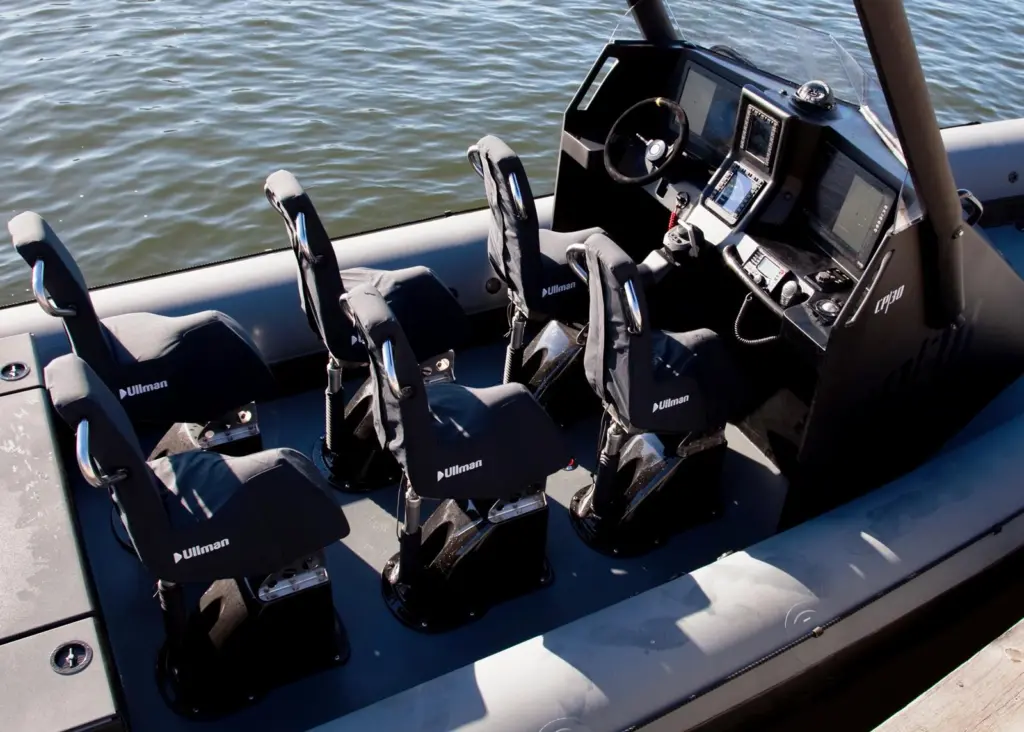
STR recently completed a design support project of boats built by Dutch company Extreme RIBs, a joint venture between Marström Composites and TornadoSport. The hull of their eXtreme RIB is made from 4mm solid carbon fibre, the equivalent of 6mm of steel in strength, but a fraction of the weight. Its construction gives it the best weight to strength ratio, resulting in a lightweight boat with exceptional fuel economy and payload capability.
In May, Dr Dobbins, working with FRC International, supported a series of workshops at the RNLI Lifeboat College in Poole UK, focusing on imparting knowledge and an understanding of compliance with the European vibration legislation for high speed craft operations. Follow-on work will include rolling this support out to mainland Europe.