![MaritimeJournal[Seawork]](https://www.maritimejournal.com/wp-content/uploads/2026/09/MaritimeJournalSeawork.svg)


Close call on mega-dredger’s first job
DEME’s brand new mega dredger Congo River was named at Zeebrugge on July 8 by the Belgian tennis champion Justine Henin and was working on its first job only six days later when it pulled up a 2,000 pound WWII mine.
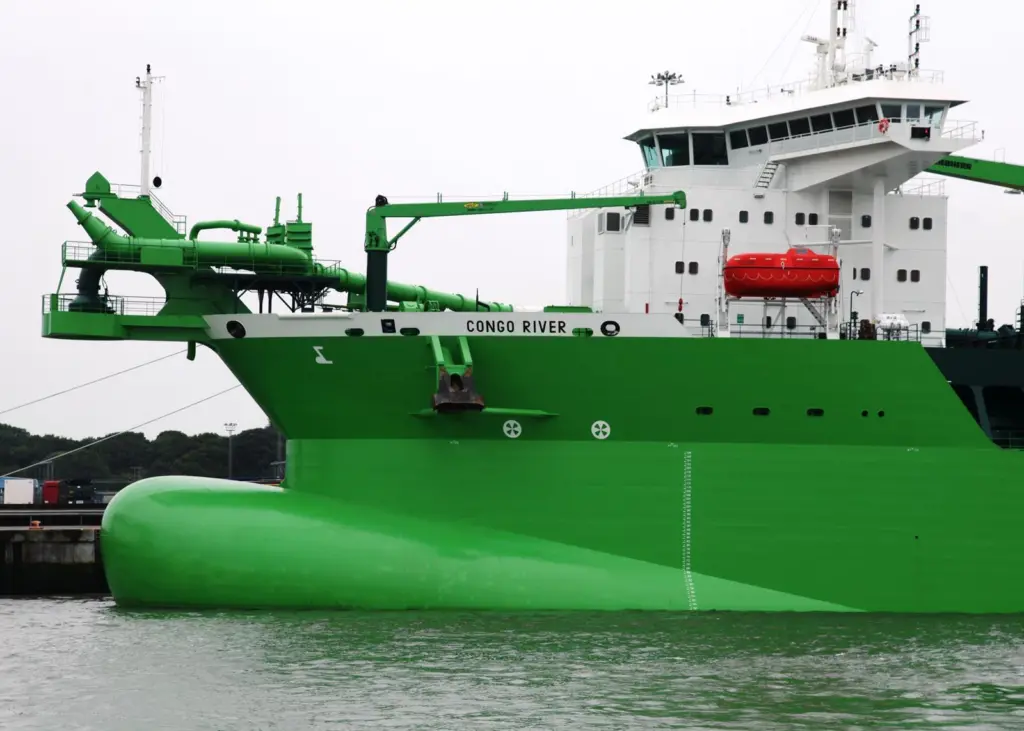
Dredging in an area south of the Sunk pilot station some eight miles off the Essex UK coast, the 30,000 cu/m capacity trailing suction hopper dredger caught the ordnance in its drag head. It was dredging a new deep water shipping channel to the north of the Thames Estuary approaches which will provide access for deep draught vessels calling at the new Thames Gateway terminal at Shell Haven on the River Thames, which is due to open in 2013.
While it is not uncommon for dredgers working off the UK’s east coast to encounter ordinance, the on board bomb disposal officer reportedly identified the 2m long object as a live German parachute mine. As he was not familiar with the device, he called in a Royal Navy team from Portsmouth to disarm it. After securing the mine, it was decided to evacuate 27 crew members, who were taken off the vessel by the Walton-on-the-Naze lifeboat and the Svitzer Victory tug, based at Sheerness. A one mile exclusion zone was set up around the vessel by the UK’s Maritime and Coastguard Agency (MCA).
On following days the tugs Svitzer Victory and Svitzer Mallaig went alongside the vessel with additional equipment and personnel. There are conflicting accounts of what happened next, with early reports stating that the mine was dropped or slipped from its harness. The Navy, however, said the cylindrical object had been removed from the ship onto a RIB, was deliberately lowered to the sea bed and was being tracked by GPS. A 60m line with a marker buoy apparently broke away and bad weather then prevented divers from recovering the mine, which was still on the sea bed several days later. It was finally exploded in the afternoon of Tuesday July 19.
The Congo River was launched in January 2011. It was built for, and is operated by, the Belgian consortium DEME, which includes Dredging International.
The 168m long vessel has a beam of 38m and comparatively shallow draught of 13.3m, making it especially manoeuvrable. The suction pipe is 1,300mm in diameter and the vessel can dredge to depths of 100m. Congo River was built by dredger specialists IHC Dredgers BV at Kapelle aan den Ijssel in the Netherlands. It is packed with hi-tech equipment and features one man operation. Two massive BARKE flap-type rudders, each weighing 75 tons, are fully enclosed for working in shallow water. Driven by two propellers, the vessel can reach a maximum speed of 16.6 knots. It is claimed to be one of the most efficient and economical dredgers operating today.
By Graeme Ewens