![MaritimeJournal[Seawork]](https://www.maritimejournal.com/wp-content/uploads/2026/09/MaritimeJournalSeawork.svg)



New wave device creates ‘lift’
Tests are taking place at Texas A&M University on a wave power prototype which takes advantage of blades that, like modern aircraft or wind turbines, create lift rather than drag.
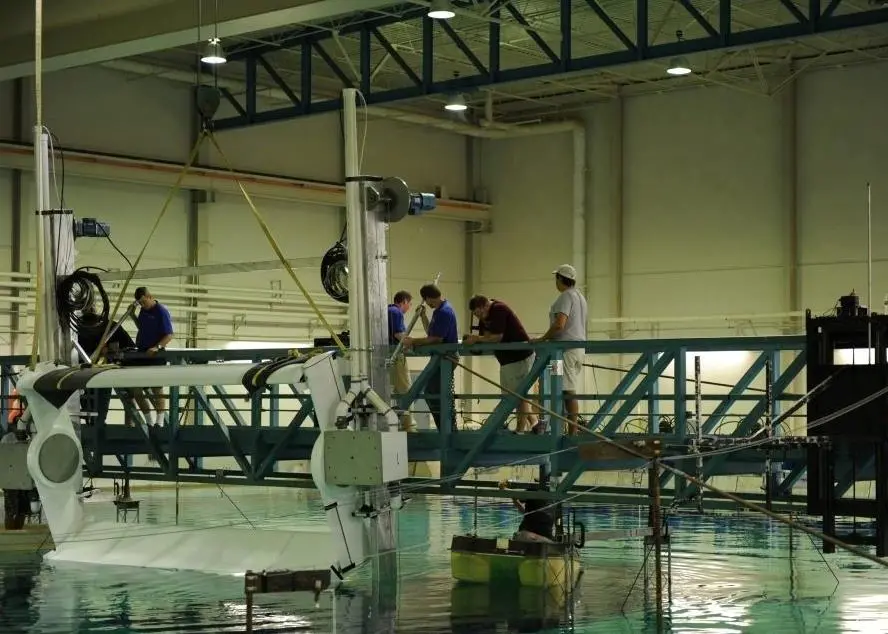
Atargis Energy Corp, founded by former US Air Force Academy scientist Dr Stefan Siegel, took over the university’s wave tank to test out the Cycloidal Wave Energy Converter (CycWEC) in a large offshore wave basin facility.
Dr Siegal explained that certain issues have held back efficient wave power development: “Devices that can survive deep sea storms have often paid for this by much greater construction costs and are often heavier, which then impacts on efficiency.” He added, “There are wave devices that have been developed further, but most are way too expensive in terms of the electricity you get out.”
So, the new design takes advantage of the kind of blade such as you find in a modern wind turbine or aircraft. “Instead of creating drag or buoyancy, it creates lift through its hydrofoil design,” said Dr Siegal.
Further, the device will be normally operating around 20m below the surface, but it can adjust its height on the monopole and retract further underneath to avoid the storms.
Similar in construction to the Voith Schneider propellers common in tug boats and ferries, the rotating blades can capture about 95% of a wave’s energy, and although not all of this available due to the constraints of energy conversion, the rotational movement links more directly to a shaft than an oscillating movement.
However, in order to be useful as a wave energy converter, a CycWEC rotor is synchronised to the phase of the incoming wave, achieved by an array of surface elevation sensors.
Algorithms to estimate the direction as well as the phase and amplitude of the incoming wave are used to control both the main shaft power take off as well as the pitch of the wave energy converter blades.
“Ocean wave energy is decades behind wind. But with all the resource in the ocean, it’s much more attractive,” said chief technology officer Dr Siegel. He added: “The wind doesn’t always blow. The sun doesn’t always shine. But ocean waves, they are always there.”
The one-tenth scale prototype yielded 370W, but it’s calculated that with design improvements, a full-scale version will churn out 5MW in the ocean, enough to power 3,000 to 4,000 homes.