
Safehaven Wildcat 53
Safehaven Marine, constructor of specialised workboats, has launched a 16 metre hydrographic research and survey vessel for clients in Kuwait.
Safehaven Marine, the County Cork, Ireland-based constructor of specialised workboats, have launched the latest in their series of 16 metre Wildcat 53 catamarans. This vessel is a hydrographic research and survey boat ordered by, and delivered on time to, the Kuwait Institute of Scientific Research (KISR).This is the fifth example of the highly successful Wildcat 53 range, designed and built by Safehaven at their Youghall facility.
Contracts for the build were signed in December 2013, work commenced in May 2014 and she was launched in early February 2015. The build period was nine months.
AL Boom in Kuwait are the agents through whom Safehaven Marine are working and, together with KISR’s technical team, the design and outfitting of Safehaven’s Wildcat 53 was refined and finalised to ensure the client received a vessel suited to their exact operational requirements. KISR personnel visited the builder just once and, being very happy with the vessel’s design and progress saw no need to visit further until she was launched and ready for commissioning trials.
KISR was established in 1967 by the Arabian Oil Company to carry out applied research in petroleum, arid-zone agriculture and marine biology. It is now an independent public institution whose main research programmes include Environmental Management; Aquaculture, Fisheries, and Marine Environment; Biotechnology; Petroleum Production and Refining; Petrochemical Processes; Hydrology; Water Management; Desalination and Wastewater. It is also involved in Kuwait’s efforts to preserve and protect sea turtles from extinction, which have been followed with interest by international scientific organisations and institutions concerned with marine biological diversity. The vessel will generally be operated by a crew of four on a 12 hour-shift basis, but it has room to carry 12 persons and has the facilities to remain at sea for up to four days.
The basic hull design features high buoyancy bows and a high bridge deck, providing excellent seakeeping and rough weather capabilities as well as operational economy and load carrying capabilities with a 33,000kg fully loaded displacement. The Wildcat 53 is available with two configurations of wheelhouse, one is a conventional single level design, while the KISR vessel has a raised bridge deck, separating crew from passengers and providing a higher vantage point for navigation without being too high and introducing excessive motions for the crew.
Construction is GRP composite with typical bottom laminates of 5,700gm2 with closely spaced transverse framing at 500mm centres providing a very strong and durable structure. The hull, deck and superstructure have plan approval from Lloyds for service area / passenger vessel, and built under Lloyds survey for her hull. Classification was through the MCA and the vessel is certified class 2, 60nm offshore. Fendering is heavy duty 150x100mm ‘D’ section rubber all around her deck edge to protect the hull when alongside.
Powered by a pair of Caterpillar C18 engines rated at 873hp and driving through Twin Disc 5145SC gearboxes supplied by Finning Ireland, the vessel has achieved 28 knots on sea trials.
The decision to use conventional sterngear with 30″ diameter 4-blade propellers and 62mm Duplex F51 S steel shafts, was made because of its dependability and low maintenance as well as economy at medium speeds, and was supplied by Clements Engineering in the UK.
The vessel has been specifically designed and outfitted for hydrographic research and survey roles in the maritime waters off the coast of Kuwait and the Gulf. For ease and efficiency of operation both internally and externally, the vessel features an ‘Island’ wheelhouse configuration. The raised helm /navigation position is fitted with a full array of Raymarine navigation equipment grouped around multiple C127 colour displays for radar, plotter and sounders, all supplied by SMG UK. It is fitted with a Comer class B AIS transceiver.
Hydraulic power steering supplied by Hypro Marine provides light, fast and responsive steering and is augmented by a Simrad autopilot system. Close quarters manoeuvring is assisted by CCTV cameras fitted on the mast. CAB 500 series suspension seats provide crew comfort. The vessel features LED lighting throughout for low power consumption and durability. These include all interior and hold lights as well as forward and aft deck spot lighting.
Externally the superstructure design allows for a high degree of crew safety with safe secure bulwarks all round the deck area. There is a large forward working area and a spacious aft deck which features a wide transom gate fitted with an hydraulic tilting ‘A’ frame, allowing sonar and research equipment to be deployed safely off the transom and easily recovered. Twin dive platforms have been fitted to each side providing waterline access.
In addition, the vessel is fitted with a moon pool positioned in the aft deck, and it is provided with Safehaven’s own proven design of multi-beam sonar transducer deployment system, which allows transducers to be quickly interchanged and lowered hydraulically to below keel line. This means the valuable transducers can be raised up to above deck during transits and when not in use.
The design of this system is the result of several years of in-service development over multiple vessels fitted with the system, during which continuous refinements have produced a reliable and durable system allowing the valuable multi beam transducers to be easily interchanged and angled. The transducer is lowered through the moon pool in the weather deck to below keel level, on a 150mm tube guided on nylon rollers and powered hydraulically from a long stroke hydraulic cylinder where it locates on specially machined tapered locating pins just above the static waterline and 2m above the deck, allowing total accuracy and repeatability of the positioning of the transducer, essential for highly accurate data acquisition.
The working area aft contains twin 1,000kg slip ring hydraulic winches. These allow the deployment of various towed transducers and magnetometers to be towed behind the vessel. The slip ring winches allow for data cable conections between the equipment and survey station. All of these were supplied by Spencer Carter in the UK, along with a 1-ton capstan. A Palfinger PC2700 hydraulic slewing crane has been supplied by Outreach to facilitate working on deck and cargo transfer. A 40kg Bruce anchor is stowed on the foredeck and raised via a 2000w electric Lofrans windlass.
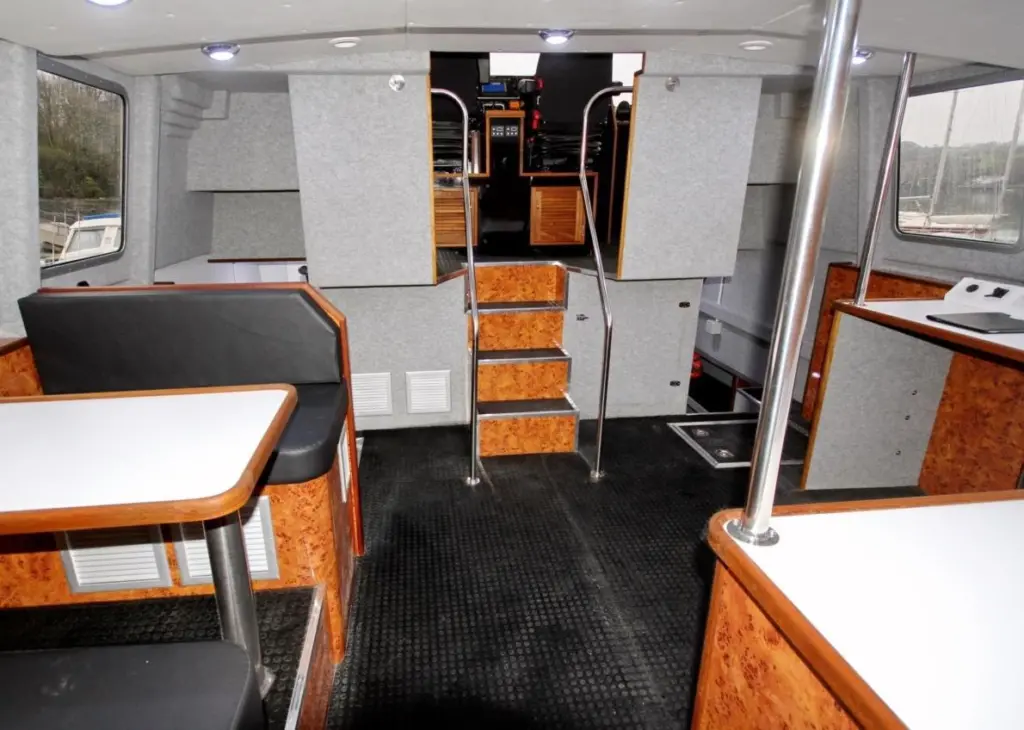
The vessel’s accommodation features a fully equipped galley in the port hull, with cooker, fridge, microwave and sink and four sleeping berths in the starboard hull. A separate toilet and shower compartment is provided in the main cabin with access close from the aft deck. The main cabin comprises a dinette living and mess area and large hydrographic work benches, incorporating computer racking underneath, with a McMurdo weather station and computer screens.
Another useful feature, specified by the client, is the incorporation of a wet room for water sampling that houses sinks and work benches, and is to be fitted with a Ferry Box mini. The Ferry Box is fitted with multiple sensors to allow the quality and purity of seawater to be analysed and monitored. The water is pumped from a subsurface inlet into the measuring circuit of multiple sensors. A ‘debubbling’ unit removes air bubbles, which might enter the system during heavy seas. At the same time coarse sand particles, which may be introduced in shallow harbours and which settle and tend to block the tubes, are removed as well. Coupled to the debubbler there is an internal water loop in which the seawater is circulated with a constant velocity of about 1 m/s. This already decreases the tendency for building bacterial slimes on sensors and tube surfaces. A small part of the water is filtered by a hollow-fibre cross-flow filter module for automatic nutrient analysis. For a reliable unattended operation the system is supervised by a computer which can shut-off the system in case of sever errors and operates automatic cleaning cycles, for example, when in harbour.
The bilge system is centred around twin bilge distribution manifolds, one in each hull, distributing bilge suctions to the eight watertight compartments, which provide a high degree of survivability. A cross connection allows switching between the hulls, and the system can select between manual pumps and an engine driven pump.
The vessel has been designed for very hot climates with temperatures that can measure up to 50 degrees C in the summer months and is therefore fitted with light coloured external surfaces to reflect heat, The cabin roof was insulated with 50mm thick pvc insulation to prevent excessive heat transmission, and the cabin is fitted with 4x 27,000 btu air-conditioning units supplied by Dometic UK. With more than 100,000btu of air-conditioning this may appear to be over-spec’ed but it should easily provide efficient cooling, and a comfortable living area for her crew of four in the often extreme temperatures encountered in this region. A 23kw Westerbeeke AC generator supplied by Advance Yacht systems UK, provides power to the air con units as well as delivering AC power throughout the vessel’s accommodation and working areas.
In March, the vessel will be sailed under its own steam from Cork to Antwerp for onward transhipment as deck cargo to Kuwait. The delivery of the KISR vessel follows on from a contract for similar hydrographic survey vessels just completed for the Polish Navy, whereby four of Safehaven’s Wildcat 40 cameramans were delivered. Meanwhile, another larger Wildcat 60 oceanographic research vessel is also under construction for MS Tech in Germany, underlining Safehaven’ s proven levels of expertise in this specialised field.
With another contract just signed with Luanda for the supply of one of Safehaven’s renowned Interceptor 48 pilot vessels to Angola, Safehaven have a very healthy order book for the future.
Visitors to Mercator Media’s Seawork International in June can find Safehaven Marine on stand A307.
By Graeme Ewens
Principal Dimensions
Length moulded (GRP hull only)- 16m
L.O.A. (Length overall)- 17m
L.W.L. (Length along waterline)- 14.2m
Beam Moulded (GRP only ex fender)- 6.2m
Beam overall (Including fenders)- 6.4m
Depth (Highest point of deck at bow to lowest
point of hull, ex keel)-
3.33
Draft (Depth of hull below waterline)- 1.4m
Displacement Lightship- 28,795kg
Fully loaded- 33,000kg
Fuel capacity- 3,000 litres
Water capacity 200 litres
Crew capacity- 12 persons
Subdivision- 8 x separate watertight
compartments
Maximum speed- 28kts
Range- 300nm
Classification- MCA Cat II Workboat
Design standards- Lloyds SSC rules area G3
Machinery
Main engines- 2x Caterpillar C18 (‘D’ Rating)
Maximum power- output 873hp
Gearbox- Twin disc 5145 SC
Generator- Westerbeeke 23kw
Crane- Palfinger PC2700
Deck winches- 2x 1 ton hydraulic Spencer Carter slip ring winches
‘A’ Frame- Hydraulic ‘tilting’ 500kg SWL
Capstan- Lofrans 2000w
Air-Conditioning- 4x Dometic 2,700btu