![MaritimeJournal[Seawork]](https://www.maritimejournal.com/wp-content/uploads/2026/09/MaritimeJournalSeawork.svg)



Barge collapse still all too common
More and more project cargo is going by barge, pushed by Europe’s concern with pollution and its congested roads. But dramatic barge failures “are still a regular occurrence” says Carlos Maenhout of BMT Surveys.
“There’s a growing tendency to use inland barges for everything, including transporting components like transformers or other heavy cargo,” Mr Maenhout told MJ, adding that if a barge breaks up, there’s not just the price of the barge and the salvage operation, there’s also damage to some potentially very expensive cargo.
“Since there are a lot of old barges still in use on the waterways and its not unusual to find working vessels of 30 or 40 years old, given a failure, the first question that’s asked is, ‘was this barge corroded and really too old for the job?’ While it’s true that sometimes issues have been caused by degraded sections in the barge’s construction, after making ultrasonic measurements we generally find the steel to be within acceptable limits.”
So the BMT Surveys team has found it’s often needed to look further, recreating the moments before the barge failed.
What came to light were issues in the way barges were being loaded. Firstly, Mr Maenhout explained that there seems to be an occasional lack of judgement the difference between an inland navigation barge and a seagoing vessel, as one is only designed for sheltered waters while the other has to deal with far rougher conditions. Further, “the depth of the hold of a seagoing vessel tends to be higher to create more freeboard… which also gives more resistance against bending”.
Secondly, inland barges are traditionally designed to carry cargo in bulk or in bags which are spread evenly within the holds or over the entire tank top, and while there are some newer vessels entering the market that may be more robust, the greater proportion of waterway barges are still of traditional construction.
Given this, Mr Maenhout explained that if the weight is concentrated in the centre on one of these barges, it will tend to ‘sag’, generating very high compression stresses in the hatch coaming – a particularly vulnerable point – which then buckles inward. At the same time, equally disastrous tensile stresses are being created on the underside of the hull, leading to the bottom plates giving way under the strain. Further, he said, cargo needs proper athwartships distribution, otherwise the hull tends to try to bend in a transverse direction, the effect being heightened by the hydrostatic pressure of the surrounding water which helps push the barge’s sides inward.
In fact Mr Maenhout added the results of all this can be dramatic: “On one occasion a 280 tonne transformer was just lowered straight onto a barge amidships, as it came down, the barge just folded up underneath…”
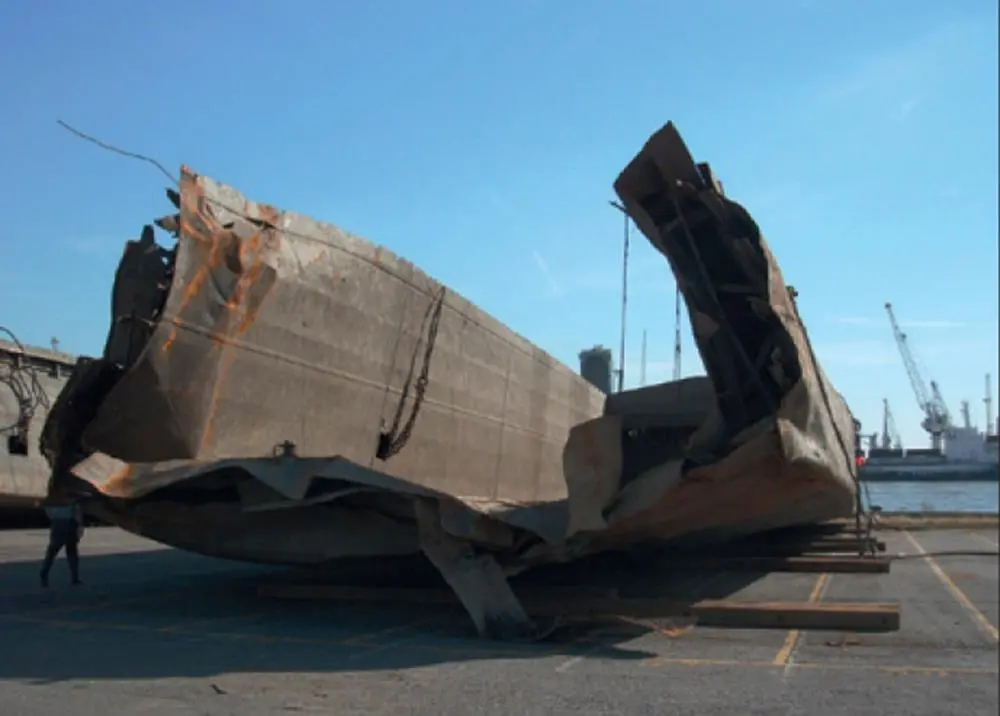
But other types of cargo cause problems if its placing isn’t thought through: one example which graphically illustrates the point is the story of push barge, Thor (pictured) that didn’t have its load of heavy steel plate stacks covering the length of the cargo hold; more, the weight was concentrated near the barge’s centre line rather than being spread sideways.
Dramatically, just ten minutes after leaving its berth, Thor suddenly collapsed and sank. Mr Maenhout explained that the typical failure mechanism could be clearly seen from the salvaged wreck: the barge’s bottom was bent downward in a transverse direction, its sides were pushed in and its hatch coaming was heavily buckled.
However the solution is simple according to Mr Maenhout: if you can’t spread the load around the entire surface, do the calculations and put the right amount of compensation ballast both at the ends and on each of the sides of the vessel to prevent it deforming and collapsing.
It could stop a perfectly viable barge looking like a piece of origami, and costly kit ending up in the water.
By Stevie Knight
Related Articles
 OTHER NEWS
 ACCESSORIES & EQUIPMENT
 ACCESSORIES & EQUIPMENT